

length of a lens pair with individual focal lengths f 1 and f 2 separated by distance d is
given by:
1
f
à ¼
1
f 1
þ
1
f 2
À
d
f 1 f 2
ð2:8Þ
If we arrange a pair of quadrupoles with opposite magnetic fields, so that in both
vertical and horizontal planes f 1 ¼ Àf 2 ¼ f, then the first two terms in the above
equation will cancel, and the total focal length will be fà ¼ f
2 /d. In practice, the above
result is only good in the thin lens approximation, and since quadrupole magnets are
not really “thin,” the horizontal and vertical focal lengths will be different. This is
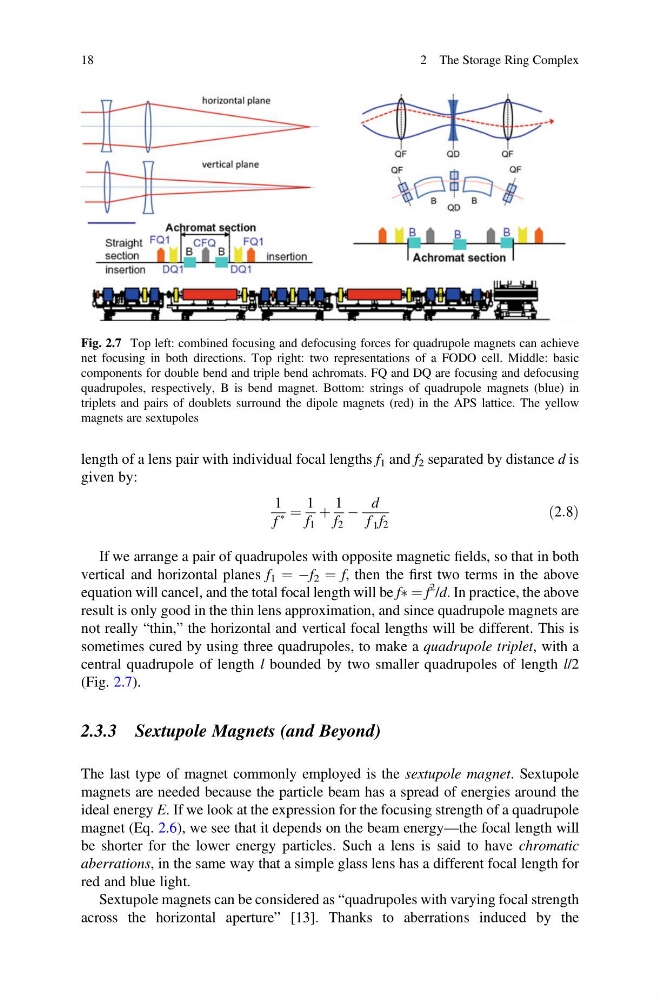
sometimes cured by using three quadrupoles, to make a quadrupole triplet, with a
central quadrupole of length l bounded by two smaller quadrupoles of length l/2
(Fig. 2.7).
2.3.3 Sextupole Magnets (and Beyond)
The last type of magnet commonly employed is the sextupole magnet. Sextupole
magnets are needed because the particle beam has a spread of energies around the
ideal energy E. If we look at the expression for the focusing strength of a quadrupole
magnet (Eq. 2.6), we see that it depends on the beam energy—the focal length will
be shorter for the lower energy particles. Such a lens is said to have chromatic
aberrations, in the same way that a simple glass lens has a different focal length for
red and blue light.
Sextupole magnets can be considered as “quadrupoles with varying focal strength
across the horizontal aperture” [13]. Thanks to aberrations induced by the
Fig. 2.7 Top left: combined focusing and defocusing forces for quadrupole magnets can achieve
net focusing in both directions. Top right: two representations of a FODO cell. Middle: basic
components for double bend and triple bend achromats. FQ and DQ are focusing and defocusing
quadrupoles, respectively, B is bend magnet. Bottom: strings of quadrupole magnets (blue) in
triplets and pairs of doublets surround the dipole magnets (red) in the APS lattice. The yellow
magnets are sextupoles
18
2 The Storage Ring Complex
given by:
1
f
à ¼
1
f 1
þ
1
f 2
À
d
f 1 f 2
ð2:8Þ
If we arrange a pair of quadrupoles with opposite magnetic fields, so that in both
vertical and horizontal planes f 1 ¼ Àf 2 ¼ f, then the first two terms in the above
equation will cancel, and the total focal length will be fà ¼ f
2 /d. In practice, the above
result is only good in the thin lens approximation, and since quadrupole magnets are
not really “thin,” the horizontal and vertical focal lengths will be different. This is
sometimes cured by using three quadrupoles, to make a quadrupole triplet, with a
central quadrupole of length l bounded by two smaller quadrupoles of length l/2
(Fig. 2.7).
2.3.3 Sextupole Magnets (and Beyond)
The last type of magnet commonly employed is the sextupole magnet. Sextupole
magnets are needed because the particle beam has a spread of energies around the
ideal energy E. If we look at the expression for the focusing strength of a quadrupole
magnet (Eq. 2.6), we see that it depends on the beam energy—the focal length will
be shorter for the lower energy particles. Such a lens is said to have chromatic
aberrations, in the same way that a simple glass lens has a different focal length for
red and blue light.
Sextupole magnets can be considered as “quadrupoles with varying focal strength
across the horizontal aperture” [13]. Thanks to aberrations induced by the
Fig. 2.7 Top left: combined focusing and defocusing forces for quadrupole magnets can achieve
net focusing in both directions. Top right: two representations of a FODO cell. Middle: basic
components for double bend and triple bend achromats. FQ and DQ are focusing and defocusing
quadrupoles, respectively, B is bend magnet. Bottom: strings of quadrupole magnets (blue) in
triplets and pairs of doublets surround the dipole magnets (red) in the APS lattice. The yellow
magnets are sextupoles
18
2 The Storage Ring Complex