

Consider a typical storage ring operating mode, the APS running with 24 bunches
with a 33 ps bunch length and a separation of 153 ns between bunches. Assuming a
flat distribution within the bunch, we see the duty cycle is approximately 33 ps out of
153 ns or ~2 Â 10
À4 . Thus, the peak brightness that occurs when the bunch is
actually illuminating the beamline is higher than the average brightness by almost
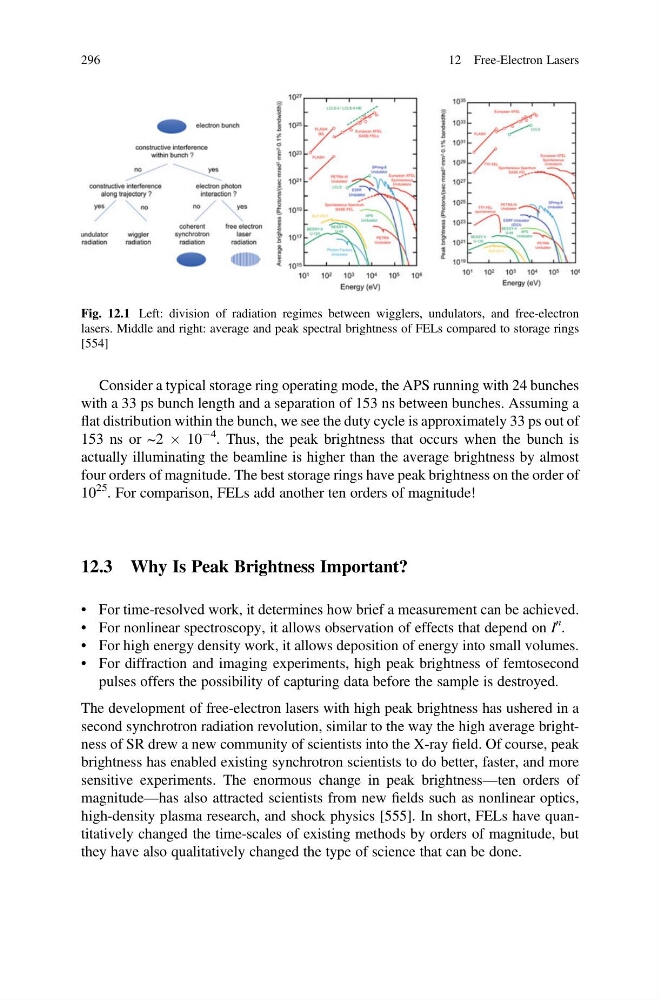
four orders of magnitude. The best storage rings have peak brightness on the order of
10
25 . For comparison, FELs add another ten orders of magnitude!
12.3 Why Is Peak Brightness Important?
• For time-resolved work, it determines how brief a measurement can be achieved.
• For nonlinear spectroscopy, it allows observation of effects that depend on I
n .
• For high energy density work, it allows deposition of energy into small volumes.
• For diffraction and imaging experiments, high peak brightness of femtosecond
pulses offers the possibility of capturing data before the sample is destroyed.
The development of free-electron lasers with high peak brightness has ushered in a
second synchrotron radiation revolution, similar to the way the high average brightness of SR drew a new community of scientists into the X-ray field. Of course, peak
brightness has enabled existing synchrotron scientists to do better, faster, and more
sensitive experiments. The enormous change in peak brightness—ten orders of
magnitude—has also attracted scientists from new fields such as nonlinear optics,
high-density plasma research, and shock physics [555]. In short, FELs have quantitatively changed the time-scales of existing methods by orders of magnitude, but
they have also qualitatively changed the type of science that can be done.
Fig. 12.1 Left: division of radiation regimes between wigglers, undulators, and free-electron
lasers. Middle and right: average and peak spectral brightness of FELs compared to storage rings
[554]
296
12 Free-Electron Lasers
with a 33 ps bunch length and a separation of 153 ns between bunches. Assuming a
flat distribution within the bunch, we see the duty cycle is approximately 33 ps out of
153 ns or ~2 Â 10
À4 . Thus, the peak brightness that occurs when the bunch is
actually illuminating the beamline is higher than the average brightness by almost
four orders of magnitude. The best storage rings have peak brightness on the order of
10
25 . For comparison, FELs add another ten orders of magnitude!
12.3 Why Is Peak Brightness Important?
• For time-resolved work, it determines how brief a measurement can be achieved.
• For nonlinear spectroscopy, it allows observation of effects that depend on I
n .
• For high energy density work, it allows deposition of energy into small volumes.
• For diffraction and imaging experiments, high peak brightness of femtosecond
pulses offers the possibility of capturing data before the sample is destroyed.
The development of free-electron lasers with high peak brightness has ushered in a
second synchrotron radiation revolution, similar to the way the high average brightness of SR drew a new community of scientists into the X-ray field. Of course, peak
brightness has enabled existing synchrotron scientists to do better, faster, and more
sensitive experiments. The enormous change in peak brightness—ten orders of
magnitude—has also attracted scientists from new fields such as nonlinear optics,
high-density plasma research, and shock physics [555]. In short, FELs have quantitatively changed the time-scales of existing methods by orders of magnitude, but
they have also qualitatively changed the type of science that can be done.
Fig. 12.1 Left: division of radiation regimes between wigglers, undulators, and free-electron
lasers. Middle and right: average and peak spectral brightness of FELs compared to storage rings
[554]
296
12 Free-Electron Lasers