

W 1 ¼
Z
ES E
ð ÞdE ¼ E R
ð10:19Þ
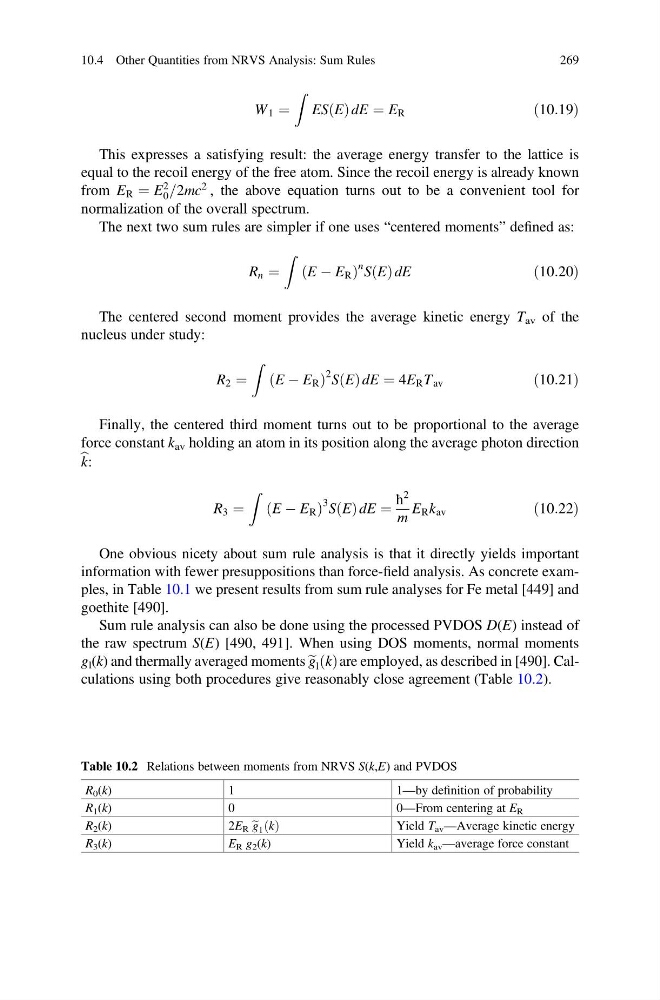
This expresses a satisfying result: the average energy transfer to the lattice is
equal to the recoil energy of the free atom. Since the recoil energy is already known
from E R ¼ E
2
0 =2mc
2 , the above equation turns out to be a convenient tool for
normalization of the overall spectrum.
The next two sum rules are simpler if one uses “centered moments” defined as:
R n ¼
Z
E À E R
ð
Þ
n S E
ð ÞdE
ð10:20Þ
The centered second moment provides the average kinetic energy T av of the
nucleus under study:
R 2 ¼
Z
E À E R
ð
Þ
2 S E
ð ÞdE ¼ 4E R T av
ð10:21Þ
Finally, the centered third moment turns out to be proportional to the average
force constant k av holding an atom in its position along the average photon direction
b k:
R 3 ¼
Z
E À E R
ð
Þ
3 S E
ð ÞdE ¼
ħ
2
m
E R k av
ð10:22Þ
One obvious nicety about sum rule analysis is that it directly yields important
information with fewer presuppositions than force-field analysis. As concrete examples, in Table 10.1 we present results from sum rule analyses for Fe metal [449] and
goethite [490].
Sum rule analysis can also be done using the processed PVDOS D(E) instead of
the raw spectrum S(E) [490, 491]. When using DOS moments, normal moments
g l (k) and thermally averaged moments e g l k
ð Þare employed, as described in [490]. Calculations using both procedures give reasonably close agreement (Table 10.2).
Table 10.2 Relations between moments from NRVS S(k,E) and PVDOS
R 0 (k)
1
1 —by definition of probability
R 1 (k)
0
0 —From centering at E R
R 2 (k)
2 E R e g 1 k
ð Þ
Yield T av —Average kinetic energy
R 3 (k)
E R g 2 (k)
Yield k av —average force constant
10.4 Other Quantities from NRVS Analysis: Sum Rules
269
Z
ES E
ð ÞdE ¼ E R
ð10:19Þ
This expresses a satisfying result: the average energy transfer to the lattice is
equal to the recoil energy of the free atom. Since the recoil energy is already known
from E R ¼ E
2
0 =2mc
2 , the above equation turns out to be a convenient tool for
normalization of the overall spectrum.
The next two sum rules are simpler if one uses “centered moments” defined as:
R n ¼
Z
E À E R
ð
Þ
n S E
ð ÞdE
ð10:20Þ
The centered second moment provides the average kinetic energy T av of the
nucleus under study:
R 2 ¼
Z
E À E R
ð
Þ
2 S E
ð ÞdE ¼ 4E R T av
ð10:21Þ
Finally, the centered third moment turns out to be proportional to the average
force constant k av holding an atom in its position along the average photon direction
b k:
R 3 ¼
Z
E À E R
ð
Þ
3 S E
ð ÞdE ¼
ħ
2
m
E R k av
ð10:22Þ
One obvious nicety about sum rule analysis is that it directly yields important
information with fewer presuppositions than force-field analysis. As concrete examples, in Table 10.1 we present results from sum rule analyses for Fe metal [449] and
goethite [490].
Sum rule analysis can also be done using the processed PVDOS D(E) instead of
the raw spectrum S(E) [490, 491]. When using DOS moments, normal moments
g l (k) and thermally averaged moments e g l k
ð Þare employed, as described in [490]. Calculations using both procedures give reasonably close agreement (Table 10.2).
Table 10.2 Relations between moments from NRVS S(k,E) and PVDOS
R 0 (k)
1
1 —by definition of probability
R 1 (k)
0
0 —From centering at E R
R 2 (k)
2 E R e g 1 k
ð Þ
Yield T av —Average kinetic energy
R 3 (k)
E R g 2 (k)
Yield k av —average force constant
10.4 Other Quantities from NRVS Analysis: Sum Rules
269