

to repeat and expand on this discovery. With the discovery of a strong
Mössbauer effect in
57 Fe [466–467], the field took off.
Perturbed Angular Correlation. The history of perturbed angular correlation
[453] goes back to 1940, when Hamilton published the theory of directional
correlation between successive γ-ray emissions in a radiative cascade
[468]. Experimental confirmation came after the war, when Brady and
Deutsch reported a pronounced anisotropy in the successive gamma-ray
emission from both
60 Co and
46 Sc [469]. In 1946, Goertzel analyzed the
effect of extranuclear fields on the nuclear emissions, thus the “perturbed
angular correlation.” The time dependence of the perturbed angular correlation (TDPAC) was first observed in 1955 [470].
Synchrotron Nuclear Experiments. In 1974, Stan Ruby at SSRL made the
rather outrageous suggestion that synchrotron radiation could be used for a
resonant excitation of nuclei [471,472]. Although a number of attempts
were made at SSRL and elsewhere to observe the predicted effects, as
described in Gerdau’s historical overview, these initial attempts were
“doomed to failure” [473]. Improvements in source brightness, monochromator resolution, detector speed, and samples were needed. A decade later,
Gerdau and coworkers accomplished the first successful nuclear Bragg
scattering (NBS) experiments with synchrotron radiation, using an isotopically enriched
57 Fe single crystal and the DORIS storage ring source at
HASYLAB [474]. The first nuclear forward scattering (NFS) measurements were reported in 1991 by Hastings and coworkers [475], followed
rapidly by Seto’s nuclear inelastic scattering measurements [476] and the
first synchrotron radiation perturbed angular correlation experiments by
Baron and coworkers [477]. By now, nuclear experiments with synchrotron
radiation are routinely done at many facilities around the world.
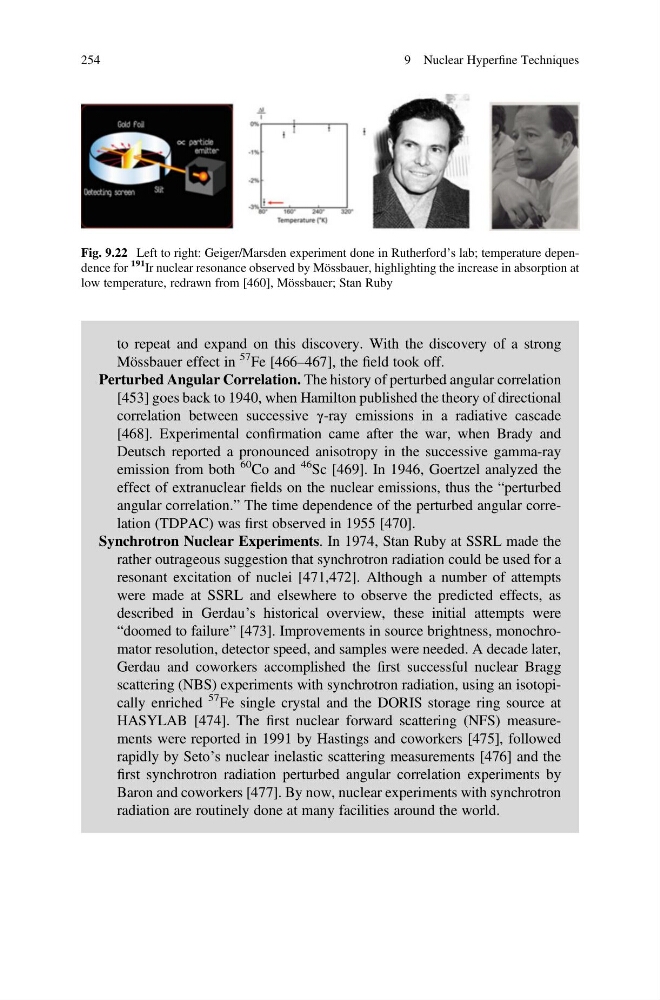
Fig. 9.22 Left to right: Geiger/Marsden experiment done in Rutherford’s lab; temperature dependence for
191
Ir nuclear resonance observed by Mössbauer, highlighting the increase in absorption at
low temperature, redrawn from [460], Mössbauer; Stan Ruby
254
9 Nuclear Hyperfine Techniques
Mössbauer effect in
57 Fe [466–467], the field took off.
Perturbed Angular Correlation. The history of perturbed angular correlation
[453] goes back to 1940, when Hamilton published the theory of directional
correlation between successive γ-ray emissions in a radiative cascade
[468]. Experimental confirmation came after the war, when Brady and
Deutsch reported a pronounced anisotropy in the successive gamma-ray
emission from both
60 Co and
46 Sc [469]. In 1946, Goertzel analyzed the
effect of extranuclear fields on the nuclear emissions, thus the “perturbed
angular correlation.” The time dependence of the perturbed angular correlation (TDPAC) was first observed in 1955 [470].
Synchrotron Nuclear Experiments. In 1974, Stan Ruby at SSRL made the
rather outrageous suggestion that synchrotron radiation could be used for a
resonant excitation of nuclei [471,472]. Although a number of attempts
were made at SSRL and elsewhere to observe the predicted effects, as
described in Gerdau’s historical overview, these initial attempts were
“doomed to failure” [473]. Improvements in source brightness, monochromator resolution, detector speed, and samples were needed. A decade later,
Gerdau and coworkers accomplished the first successful nuclear Bragg
scattering (NBS) experiments with synchrotron radiation, using an isotopically enriched
57 Fe single crystal and the DORIS storage ring source at
HASYLAB [474]. The first nuclear forward scattering (NFS) measurements were reported in 1991 by Hastings and coworkers [475], followed
rapidly by Seto’s nuclear inelastic scattering measurements [476] and the
first synchrotron radiation perturbed angular correlation experiments by
Baron and coworkers [477]. By now, nuclear experiments with synchrotron
radiation are routinely done at many facilities around the world.
Fig. 9.22 Left to right: Geiger/Marsden experiment done in Rutherford’s lab; temperature dependence for
191
Ir nuclear resonance observed by Mössbauer, highlighting the increase in absorption at
low temperature, redrawn from [460], Mössbauer; Stan Ruby
254
9 Nuclear Hyperfine Techniques