

8.2 High-Energy Resolution X-ray Fluorescence
(HERXRF)
X-ray fluorescence is the electromagnetic radiation (photons) emitted following
creation of an inner-shell vacancy (core hole) in an atom. In some cases, the core
hole can be created by electron impact (in an electron microscope), by a proton beam
(in a PIXE measurement), or even by radioactive decay (in a K-capture experiment).
At a synchrotron, this is a photon-in photon-out process, in which the incoming
photon has an energy considerably higher than the absorption edge. As we saw with
EXAFS, changing the incoming photon energy will change the outgoing photoelectron energy, but the atom with the core vacancy is the same for different excitation
energies. This allows the use of relatively broadband X-ray excitation to increase the
flux on sample and the resulting fluorescence intensity.
The relative intensities of different fluorescence lines vary by orders of magnitude, primarily because of the wide variation in overlap integrals between the core
vacancy and other orbitals. When comparing the fluorescence intensities between
different elements, another important factor is the overall fluorescence yield. This is
because the X-ray emission process competes with Auger emission as a means for
relaxing the core-hole vacancy (Fig. 8.2):
I f / ϕ i r
j jϕ f
2
ð8:1Þ
The general nomenclature, introduced by Siegbahn [331], for the strongest
fluorescence lines is summarized in Figs. 8.2 and 8.3. Fluorescence corresponding
to 2p ! 1s transitions is called Kα, while transitions that fill a 1s vacancy from 3p or
higher levels are grouped as Kβ. The labeling is rather archaic and the earliest
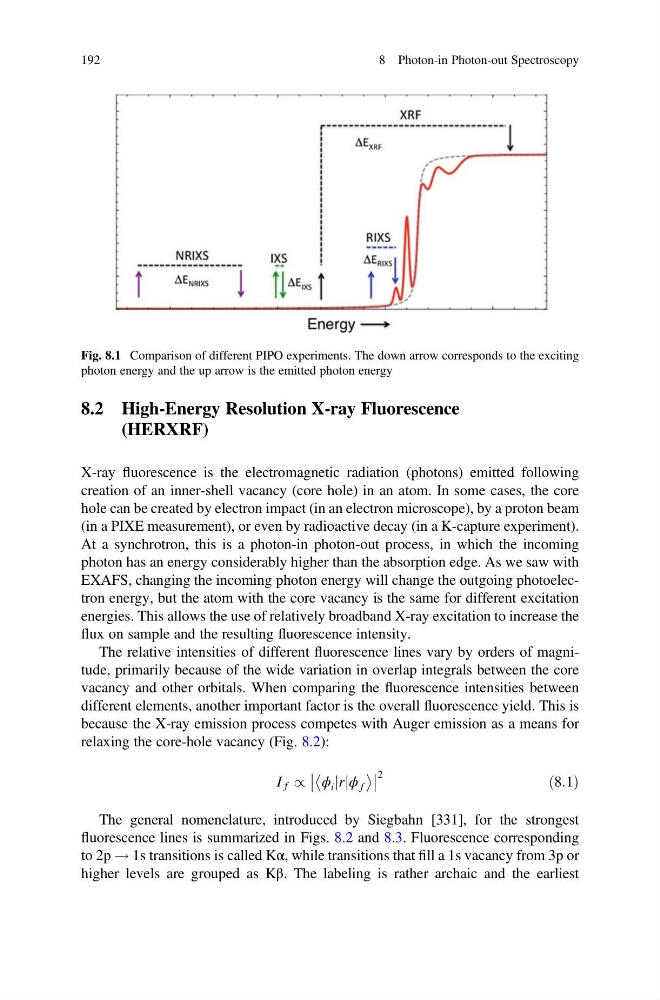
Fig. 8.1 Comparison of different PIPO experiments. The down arrow corresponds to the exciting
photon energy and the up arrow is the emitted photon energy
192
8 Photon-in Photon-out Spectroscopy
(HERXRF)
X-ray fluorescence is the electromagnetic radiation (photons) emitted following
creation of an inner-shell vacancy (core hole) in an atom. In some cases, the core
hole can be created by electron impact (in an electron microscope), by a proton beam
(in a PIXE measurement), or even by radioactive decay (in a K-capture experiment).
At a synchrotron, this is a photon-in photon-out process, in which the incoming
photon has an energy considerably higher than the absorption edge. As we saw with
EXAFS, changing the incoming photon energy will change the outgoing photoelectron energy, but the atom with the core vacancy is the same for different excitation
energies. This allows the use of relatively broadband X-ray excitation to increase the
flux on sample and the resulting fluorescence intensity.
The relative intensities of different fluorescence lines vary by orders of magnitude, primarily because of the wide variation in overlap integrals between the core
vacancy and other orbitals. When comparing the fluorescence intensities between
different elements, another important factor is the overall fluorescence yield. This is
because the X-ray emission process competes with Auger emission as a means for
relaxing the core-hole vacancy (Fig. 8.2):
I f / ϕ i r
j jϕ f
2
ð8:1Þ
The general nomenclature, introduced by Siegbahn [331], for the strongest
fluorescence lines is summarized in Figs. 8.2 and 8.3. Fluorescence corresponding
to 2p ! 1s transitions is called Kα, while transitions that fill a 1s vacancy from 3p or
higher levels are grouped as Kβ. The labeling is rather archaic and the earliest
Fig. 8.1 Comparison of different PIPO experiments. The down arrow corresponds to the exciting
photon energy and the up arrow is the emitted photon energy
192
8 Photon-in Photon-out Spectroscopy