

We will also need the photoelectron wave number: k ¼ 2π/λ, which is in practical
units:
k Å
À1
h
i
¼
2π
λ Å
 à ¼ 2π
ffiffiffiffiffiffiffiffiffiffiffiffiffiffiffiffiffiffiffiffiffiffiffiffiffiffi ffi
2m e E À E 0
ð
Þ
h
2
r
¼
ffiffiffiffiffiffiffiffiffiffiffiffiffiffiffiffiffiffiffiffiffiffiffiffiffiffiffiffiffiffiffiffiffiffiffiffiffiffiffi
0:2625 E À E 0
ð
ÞeV ½
p
ð6:14Þ
Thus, when taking a spectrum, as the X-ray energy is increased, the photoelectron
wavelength decreases (Fig. 6.7). A key point is that the strength of absorption, given
by the absorption coefficient μ(E), is proportional to the overlap between the initial
wave function, a core orbital localized near the nucleus, and the final diffuse
outgoing wave function. In the absence of neighboring atoms, the overlap between
the initial core electron wave function and the outgoing photoelectron wave function
monotonically decreases, and the absorption falls off as the smooth, μ 0 (E) function
illustrated for Kr in Fig. 6.6.
When neighboring atoms are present, the outgoing wave from the absorber is
scattered in all directions by these neighbors. Back at the absorber, the scattered
wave oscillates between adding in phase, for constructive interference, or out of
phase, for destructive interference. The larger the distance between absorber and
scatterer, the higher the frequency the oscillations. In general, the larger the number
N or size Z of neighboring atoms, the larger the amplitude of the oscillations. Thus,
EXAFS contains information that can be used to deduce local structure.
6.4 Single Scattering EXAFS Equation
From the qualitative treatment above, we see that the frequency of the EXAFS
depends first and foremost on the distance between the absorbing atom a and the
backscattering atom b, while the amplitude will depend on the number and type of
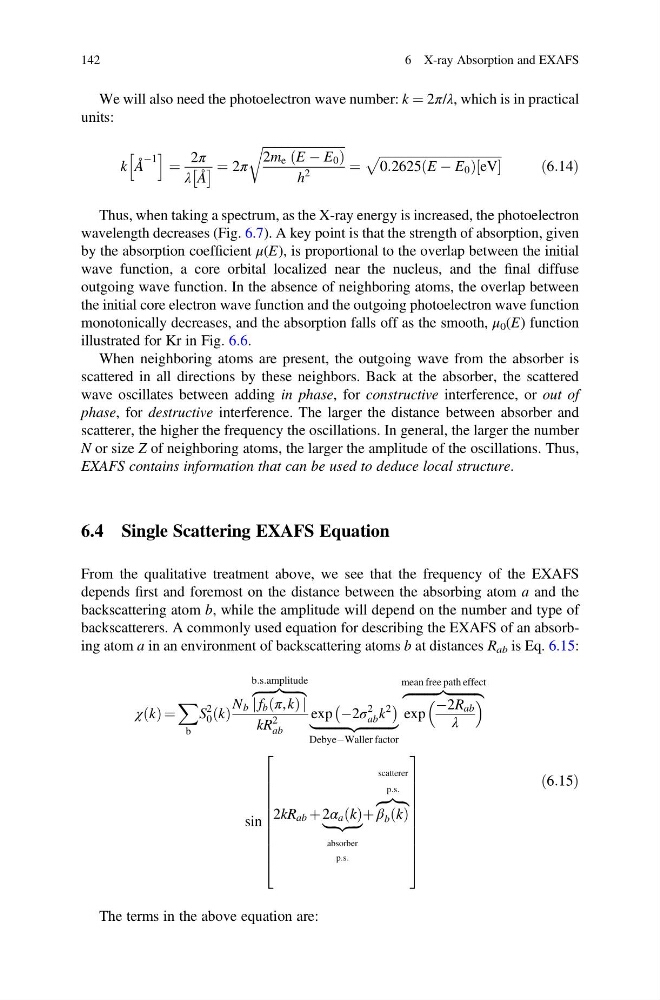
backscatterers. A commonly used equation for describing the EXAFS of an absorbing atom a in an environment of backscattering atoms b at distances R ab is Eq. 6.15:
χ k
ð Þ¼
X
b
S
2
0 k
ð Þ
N b j f b π,k
ð Þj
zfflfflfflffl ffl}|fflfflfflffl ffl{
b:s:amplitude
kR
2
ab
exp À2σ
2
ab k
2
À
Á
|fflfflfflfflfflfflfflfflfflffl{zfflfflfflfflfflfflfflfflfflffl}
DebyeÀWaller factor
exp
À2R ab
λ
zfflfflfflfflfflfflfflfflffl}|fflfflfflfflfflfflfflfflffl{
mean free path effect
sin 2kR ab þ 2α a k
ð Þ
|fflffl ffl{zfflffl ffl}
absorber
p:s:
þ β b k
ð Þ
zffl}|ffl{
scatterer
p:s:
2
6
6
6
6
6
6
6
6
6
4
3
7
7
7
7
7
7
7
7
7
5
ð6:15Þ
The terms in the above equation are:
142
6 X-ray Absorption and EXAFS
units:
k Å
À1
h
i
¼
2π
λ Å
 à ¼ 2π
ffiffiffiffiffiffiffiffiffiffiffiffiffiffiffiffiffiffiffiffiffiffiffiffiffiffi ffi
2m e E À E 0
ð
Þ
h
2
r
¼
ffiffiffiffiffiffiffiffiffiffiffiffiffiffiffiffiffiffiffiffiffiffiffiffiffiffiffiffiffiffiffiffiffiffiffiffiffiffiffi
0:2625 E À E 0
ð
ÞeV ½
p
ð6:14Þ
Thus, when taking a spectrum, as the X-ray energy is increased, the photoelectron
wavelength decreases (Fig. 6.7). A key point is that the strength of absorption, given
by the absorption coefficient μ(E), is proportional to the overlap between the initial
wave function, a core orbital localized near the nucleus, and the final diffuse
outgoing wave function. In the absence of neighboring atoms, the overlap between
the initial core electron wave function and the outgoing photoelectron wave function
monotonically decreases, and the absorption falls off as the smooth, μ 0 (E) function
illustrated for Kr in Fig. 6.6.
When neighboring atoms are present, the outgoing wave from the absorber is
scattered in all directions by these neighbors. Back at the absorber, the scattered
wave oscillates between adding in phase, for constructive interference, or out of
phase, for destructive interference. The larger the distance between absorber and
scatterer, the higher the frequency the oscillations. In general, the larger the number
N or size Z of neighboring atoms, the larger the amplitude of the oscillations. Thus,
EXAFS contains information that can be used to deduce local structure.
6.4 Single Scattering EXAFS Equation
From the qualitative treatment above, we see that the frequency of the EXAFS
depends first and foremost on the distance between the absorbing atom a and the
backscattering atom b, while the amplitude will depend on the number and type of
backscatterers. A commonly used equation for describing the EXAFS of an absorbing atom a in an environment of backscattering atoms b at distances R ab is Eq. 6.15:
χ k
ð Þ¼
X
b
S
2
0 k
ð Þ
N b j f b π,k
ð Þj
zfflfflfflffl ffl}|fflfflfflffl ffl{
b:s:amplitude
kR
2
ab
exp À2σ
2
ab k
2
À
Á
|fflfflfflfflfflfflfflfflfflffl{zfflfflfflfflfflfflfflfflfflffl}
DebyeÀWaller factor
exp
À2R ab
λ
zfflfflfflfflfflfflfflfflffl}|fflfflfflfflfflfflfflfflffl{
mean free path effect
sin 2kR ab þ 2α a k
ð Þ
|fflffl ffl{zfflffl ffl}
absorber
p:s:
þ β b k
ð Þ
zffl}|ffl{
scatterer
p:s:
2
6
6
6
6
6
6
6
6
6
4
3
7
7
7
7
7
7
7
7
7
5
ð6:15Þ
The terms in the above equation are:
142
6 X-ray Absorption and EXAFS