

5.15.7 Gates
As the name implies, gates are electronic devices used to pass or reject signals,
which can be in analogue or digital form. Generally there are two inputs, a logic
pulse that determines whether the gate should be open or closed for an adjustable
duration and the signal itself which is either passed or rejected.
5.15.8 Analogue-to-Digital Converters
An “analogue-to-digital converter” or “ADC” is used to convert analogue signals
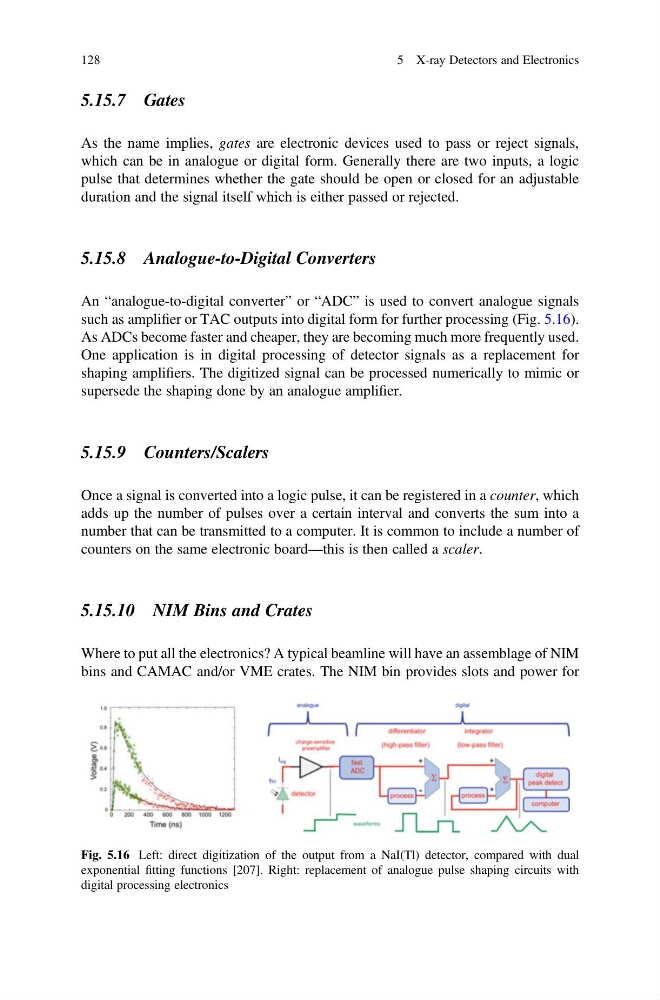
such as amplifier or TAC outputs into digital form for further processing (Fig. 5.16).
As ADCs become faster and cheaper, they are becoming much more frequently used.
One application is in digital processing of detector signals as a replacement for
shaping amplifiers. The digitized signal can be processed numerically to mimic or
supersede the shaping done by an analogue amplifier.
5.15.9 Counters/Scalers
Once a signal is converted into a logic pulse, it can be registered in a counter, which
adds up the number of pulses over a certain interval and converts the sum into a
number that can be transmitted to a computer. It is common to include a number of
counters on the same electronic board—this is then called a scaler.
5.15.10 NIM Bins and Crates
Where to put all the electronics? A typical beamline will have an assemblage of NIM
bins and CAMAC and/or VME crates. The NIM bin provides slots and power for
Fig. 5.16 Left: direct digitization of the output from a NaI(Tl) detector, compared with dual
exponential fitting functions [207]. Right: replacement of analogue pulse shaping circuits with
digital processing electronics
128
5 X-ray Detectors and Electronics
As the name implies, gates are electronic devices used to pass or reject signals,
which can be in analogue or digital form. Generally there are two inputs, a logic
pulse that determines whether the gate should be open or closed for an adjustable
duration and the signal itself which is either passed or rejected.
5.15.8 Analogue-to-Digital Converters
An “analogue-to-digital converter” or “ADC” is used to convert analogue signals
such as amplifier or TAC outputs into digital form for further processing (Fig. 5.16).
As ADCs become faster and cheaper, they are becoming much more frequently used.
One application is in digital processing of detector signals as a replacement for
shaping amplifiers. The digitized signal can be processed numerically to mimic or
supersede the shaping done by an analogue amplifier.
5.15.9 Counters/Scalers
Once a signal is converted into a logic pulse, it can be registered in a counter, which
adds up the number of pulses over a certain interval and converts the sum into a
number that can be transmitted to a computer. It is common to include a number of
counters on the same electronic board—this is then called a scaler.
5.15.10 NIM Bins and Crates
Where to put all the electronics? A typical beamline will have an assemblage of NIM
bins and CAMAC and/or VME crates. The NIM bin provides slots and power for
Fig. 5.16 Left: direct digitization of the output from a NaI(Tl) detector, compared with dual
exponential fitting functions [207]. Right: replacement of analogue pulse shaping circuits with
digital processing electronics
128
5 X-ray Detectors and Electronics