

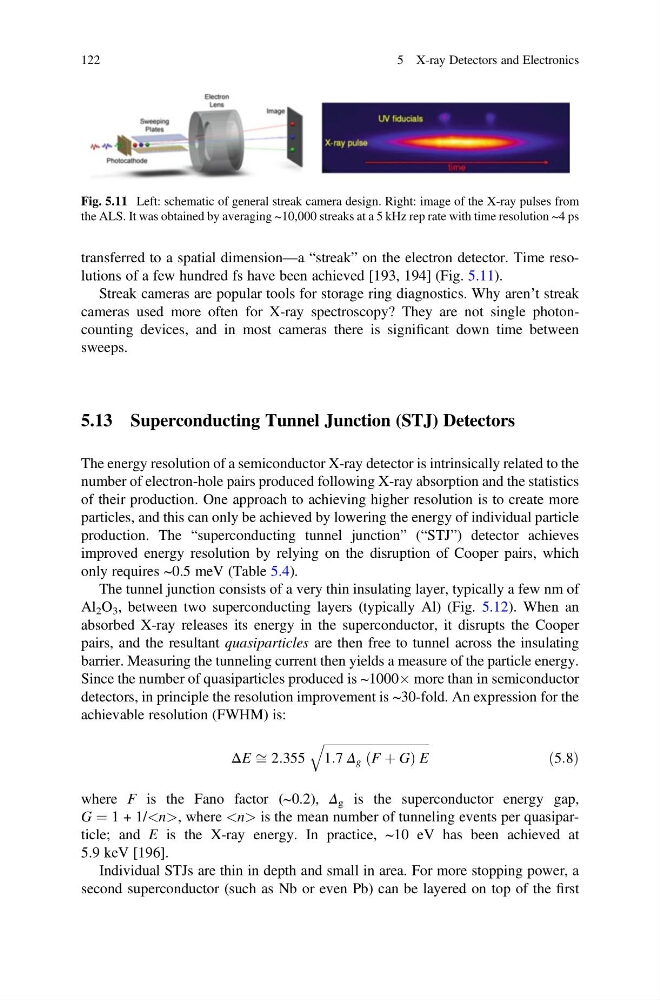
transferred to a spatial dimension—a “streak” on the electron detector. Time resolutions of a few hundred fs have been achieved [193, 194] (Fig. 5.11).
Streak cameras are popular tools for storage ring diagnostics. Why aren’t streak
cameras used more often for X-ray spectroscopy? They are not single photoncounting devices, and in most cameras there is significant down time between
sweeps.
5.13 Superconducting Tunnel Junction (STJ) Detectors
The energy resolution of a semiconductor X-ray detector is intrinsically related to the
number of electron-hole pairs produced following X-ray absorption and the statistics
of their production. One approach to achieving higher resolution is to create more
particles, and this can only be achieved by lowering the energy of individual particle
production. The “superconducting tunnel junction” (“STJ”) detector achieves
improved energy resolution by relying on the disruption of Cooper pairs, which
only requires ~0.5 meV (Table 5.4).
The tunnel junction consists of a very thin insulating layer, typically a few nm of
Al 2 O 3 , between two superconducting layers (typically Al) (Fig. 5.12). When an
absorbed X-ray releases its energy in the superconductor, it disrupts the Cooper
pairs, and the resultant quasiparticles are then free to tunnel across the insulating
barrier. Measuring the tunneling current then yields a measure of the particle energy.
Since the number of quasiparticles produced is ~1000Â more than in semiconductor
detectors, in principle the resolution improvement is ~30-fold. An expression for the
achievable resolution (FWHM) is:
ΔE ffi 2:355
ffiffiffiffiffiffiffiffiffiffiffiffiffiffiffiffiffiffiffiffiffiffiffiffiffiffiffiffiffiffiffiffiffiffi
1:7 Δ g F þ G
ð
ÞE
q
ð5:8Þ
where F is the Fano factor (~0.2), Δ g is the superconductor energy gap,
G ¼ 1 + 1/, where is the mean number of tunneling events per quasiparticle; and E is the X-ray energy. In practice, ~10 eV has been achieved at
5.9 keV [196].
Individual STJs are thin in depth and small in area. For more stopping power, a
second superconductor (such as Nb or even Pb) can be layered on top of the first
Fig. 5.11 Left: schematic of general streak camera design. Right: image of the X-ray pulses from
the ALS. It was obtained by averaging ~10,000 streaks at a 5 kHz rep rate with time resolution ~4 ps
122
5 X-ray Detectors and Electronics
Streak cameras are popular tools for storage ring diagnostics. Why aren’t streak
cameras used more often for X-ray spectroscopy? They are not single photoncounting devices, and in most cameras there is significant down time between
sweeps.
5.13 Superconducting Tunnel Junction (STJ) Detectors
The energy resolution of a semiconductor X-ray detector is intrinsically related to the
number of electron-hole pairs produced following X-ray absorption and the statistics
of their production. One approach to achieving higher resolution is to create more
particles, and this can only be achieved by lowering the energy of individual particle
production. The “superconducting tunnel junction” (“STJ”) detector achieves
improved energy resolution by relying on the disruption of Cooper pairs, which
only requires ~0.5 meV (Table 5.4).
The tunnel junction consists of a very thin insulating layer, typically a few nm of
Al 2 O 3 , between two superconducting layers (typically Al) (Fig. 5.12). When an
absorbed X-ray releases its energy in the superconductor, it disrupts the Cooper
pairs, and the resultant quasiparticles are then free to tunnel across the insulating
barrier. Measuring the tunneling current then yields a measure of the particle energy.
Since the number of quasiparticles produced is ~1000Â more than in semiconductor
detectors, in principle the resolution improvement is ~30-fold. An expression for the
achievable resolution (FWHM) is:
ΔE ffi 2:355
ffiffiffiffiffiffiffiffiffiffiffiffiffiffiffiffiffiffiffiffiffiffiffiffiffiffiffiffiffiffiffiffiffiffi
1:7 Δ g F þ G
ð
ÞE
q
ð5:8Þ
where F is the Fano factor (~0.2), Δ g is the superconductor energy gap,
G ¼ 1 + 1/
5.9 keV [196].
Individual STJs are thin in depth and small in area. For more stopping power, a
second superconductor (such as Nb or even Pb) can be layered on top of the first
Fig. 5.11 Left: schematic of general streak camera design. Right: image of the X-ray pulses from
the ALS. It was obtained by averaging ~10,000 streaks at a 5 kHz rep rate with time resolution ~4 ps
122
5 X-ray Detectors and Electronics