

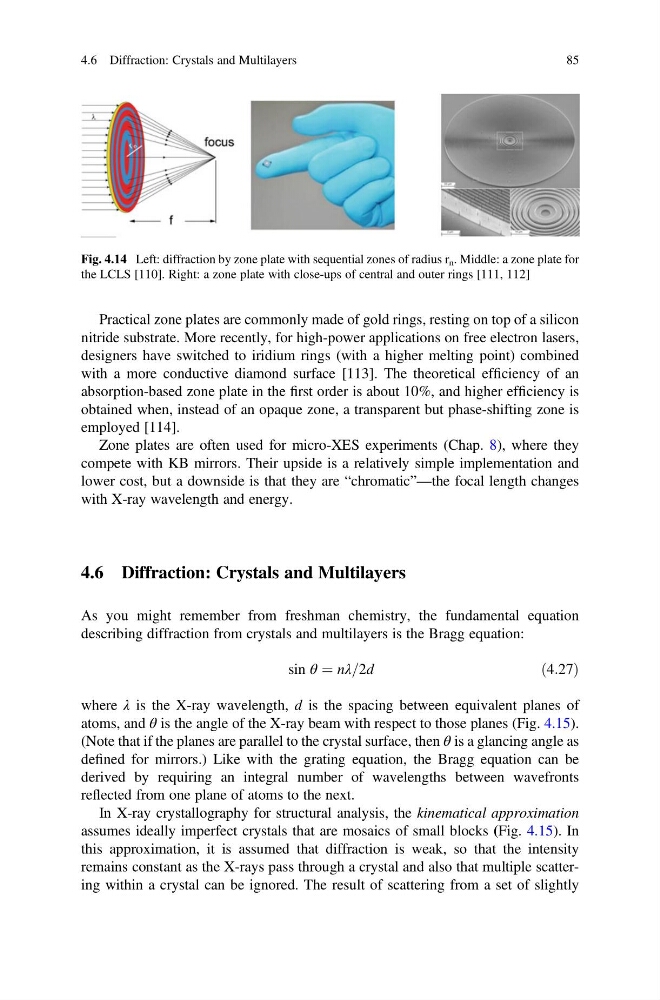
Practical zone plates are commonly made of gold rings, resting on top of a silicon
nitride substrate. More recently, for high-power applications on free electron lasers,
designers have switched to iridium rings (with a higher melting point) combined
with a more conductive diamond surface [113]. The theoretical efficiency of an
absorption-based zone plate in the first order is about 10%, and higher efficiency is
obtained when, instead of an opaque zone, a transparent but phase-shifting zone is
employed [114].
Zone plates are often used for micro-XES experiments (Chap. 8), where they
compete with KB mirrors. Their upside is a relatively simple implementation and
lower cost, but a downside is that they are “chromatic”—the focal length changes
with X-ray wavelength and energy.
4.6 Diffraction: Crystals and Multilayers
As you might remember from freshman chemistry, the fundamental equation
describing diffraction from crystals and multilayers is the Bragg equation:
sin θ ¼ nλ=2d
ð4:27Þ
where λ is the X-ray wavelength, d is the spacing between equivalent planes of
atoms, and θ is the angle of the X-ray beam with respect to those planes (Fig. 4.15).
(Note that if the planes are parallel to the crystal surface, then θ is a glancing angle as
defined for mirrors.) Like with the grating equation, the Bragg equation can be
derived by requiring an integral number of wavelengths between wavefronts
reflected from one plane of atoms to the next.
In X-ray crystallography for structural analysis, the kinematical approximation
assumes ideally imperfect crystals that are mosaics of small blocks (Fig. 4.15). In
this approximation, it is assumed that diffraction is weak, so that the intensity
remains constant as the X-rays pass through a crystal and also that multiple scattering within a crystal can be ignored. The result of scattering from a set of slightly
Fig. 4.14 Left: diffraction by zone plate with sequential zones of radius r n . Middle: a zone plate for
the LCLS [110]. Right: a zone plate with close-ups of central and outer rings [111, 112]
4.6 Diffraction: Crystals and Multilayers
85
nitride substrate. More recently, for high-power applications on free electron lasers,
designers have switched to iridium rings (with a higher melting point) combined
with a more conductive diamond surface [113]. The theoretical efficiency of an
absorption-based zone plate in the first order is about 10%, and higher efficiency is
obtained when, instead of an opaque zone, a transparent but phase-shifting zone is
employed [114].
Zone plates are often used for micro-XES experiments (Chap. 8), where they
compete with KB mirrors. Their upside is a relatively simple implementation and
lower cost, but a downside is that they are “chromatic”—the focal length changes
with X-ray wavelength and energy.
4.6 Diffraction: Crystals and Multilayers
As you might remember from freshman chemistry, the fundamental equation
describing diffraction from crystals and multilayers is the Bragg equation:
sin θ ¼ nλ=2d
ð4:27Þ
where λ is the X-ray wavelength, d is the spacing between equivalent planes of
atoms, and θ is the angle of the X-ray beam with respect to those planes (Fig. 4.15).
(Note that if the planes are parallel to the crystal surface, then θ is a glancing angle as
defined for mirrors.) Like with the grating equation, the Bragg equation can be
derived by requiring an integral number of wavelengths between wavefronts
reflected from one plane of atoms to the next.
In X-ray crystallography for structural analysis, the kinematical approximation
assumes ideally imperfect crystals that are mosaics of small blocks (Fig. 4.15). In
this approximation, it is assumed that diffraction is weak, so that the intensity
remains constant as the X-rays pass through a crystal and also that multiple scattering within a crystal can be ignored. The result of scattering from a set of slightly
Fig. 4.14 Left: diffraction by zone plate with sequential zones of radius r n . Middle: a zone plate for
the LCLS [110]. Right: a zone plate with close-ups of central and outer rings [111, 112]
4.6 Diffraction: Crystals and Multilayers
85