

efficiency for a given order when the direction of the diffracted beam is the same as
that for specular reflection from the land—the blaze condition. However, at the
glancing angles required for X-ray reflectivity, one land shadows the next so that
only a fraction of each land is illuminated. The effect of this shadowing is that the
fraction f of each land that is illuminated is given by (where θ 1 is the angle of
incidence on the land):
f ¼ 1 À
tan θ b
tan θ 1
ð4:25Þ
The blaze angle should be as small as possible in order to illuminate as much land
as possible.
In a third approach, a laminar or lamellar or phase grating, the lands and grooves
both contribute to the diffracted intensity. By appropriate choice of groove depth
h and incidence angle, contributions from lands and grooves will interfere destructively, thus eliminating the wasteful zeroth-order radiation. The maximum efficiencies in a given order are in principle four times greater than the corresponding
amplitude grating. However, just as with blazed gratings, at glancing incidence
shadowing is significant. For laminar gratings, illumination of a groove is shadowed
by the preceding land, and the radiation from the groove is shadowed by the
subsequent land.
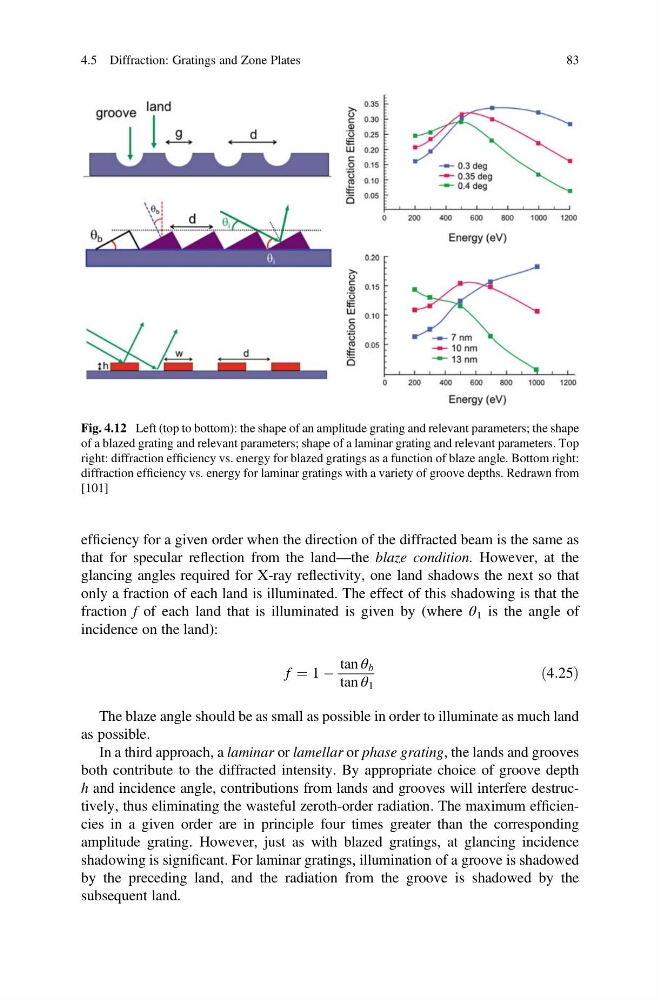
Fig. 4.12 Left (top to bottom): the shape of an amplitude grating and relevant parameters; the shape
of a blazed grating and relevant parameters; shape of a laminar grating and relevant parameters. Top
right: diffraction efficiency vs. energy for blazed gratings as a function of blaze angle. Bottom right:
diffraction efficiency vs. energy for laminar gratings with a variety of groove depths. Redrawn from
[101]
4.5 Diffraction: Gratings and Zone Plates
83
that for specular reflection from the land—the blaze condition. However, at the
glancing angles required for X-ray reflectivity, one land shadows the next so that
only a fraction of each land is illuminated. The effect of this shadowing is that the
fraction f of each land that is illuminated is given by (where θ 1 is the angle of
incidence on the land):
f ¼ 1 À
tan θ b
tan θ 1
ð4:25Þ
The blaze angle should be as small as possible in order to illuminate as much land
as possible.
In a third approach, a laminar or lamellar or phase grating, the lands and grooves
both contribute to the diffracted intensity. By appropriate choice of groove depth
h and incidence angle, contributions from lands and grooves will interfere destructively, thus eliminating the wasteful zeroth-order radiation. The maximum efficiencies in a given order are in principle four times greater than the corresponding
amplitude grating. However, just as with blazed gratings, at glancing incidence
shadowing is significant. For laminar gratings, illumination of a groove is shadowed
by the preceding land, and the radiation from the groove is shadowed by the
subsequent land.
Fig. 4.12 Left (top to bottom): the shape of an amplitude grating and relevant parameters; the shape
of a blazed grating and relevant parameters; shape of a laminar grating and relevant parameters. Top
right: diffraction efficiency vs. energy for blazed gratings as a function of blaze angle. Bottom right:
diffraction efficiency vs. energy for laminar gratings with a variety of groove depths. Redrawn from
[101]
4.5 Diffraction: Gratings and Zone Plates
83