

90
6
Cysteine loop pentameric ligand-gated ion channels are apparently also involved in
the rapid onset of the symptoms of alcohol ingestion. Ethanol interacts weakly with waterfilled cavities in GABA 2A , glycine, NAchR and 5HT 3 receptors and stabilizes certain conformations, leading to alterations in neuronal neurotransmission. This was demonstrated
in structural studies. In mouse models, especially GABA A and GlyRs have been indicated
in changes in behaviour after alcohol ingestion. Moreover, polymorphisms in genes
encoding these receptors are believed to count for the development of alcohol dependence
(Trudell et al. 2014).
6.5 Glutamate Receptors: Ibotenic Acid, Kainate and Ketamine
Takashi Hayashi injected glutamate into the grey matter of the brain of dogs and
induced epileptic seizures (Takashi Hayashi 1954). This was the basis for the glutamate
model of epilepsy; it was thought that epilepsy arises when quantities of glutamate
surpass a critical level. Later it was established that glutamate-related amino acids
worked excitatory on neurons, and pharmacological studies of N-methyl-D-aspartate
(NMDA), α-amino-3-hydroxy-5-methyl-4-isoxazolepropionic acid (AMPA) and the
natural compound kainate binding to these receptors led to a distinction of ionotropic
glutamate receptors into NMDA, AMPA and kainate receptors. Glutamate overload
Excitatory
collateral
Inhibitory interneuron
Renshaw cell
α-motor neuron
Acetylcholine
Glycin
Strychnine, tetanus toxin, tutin
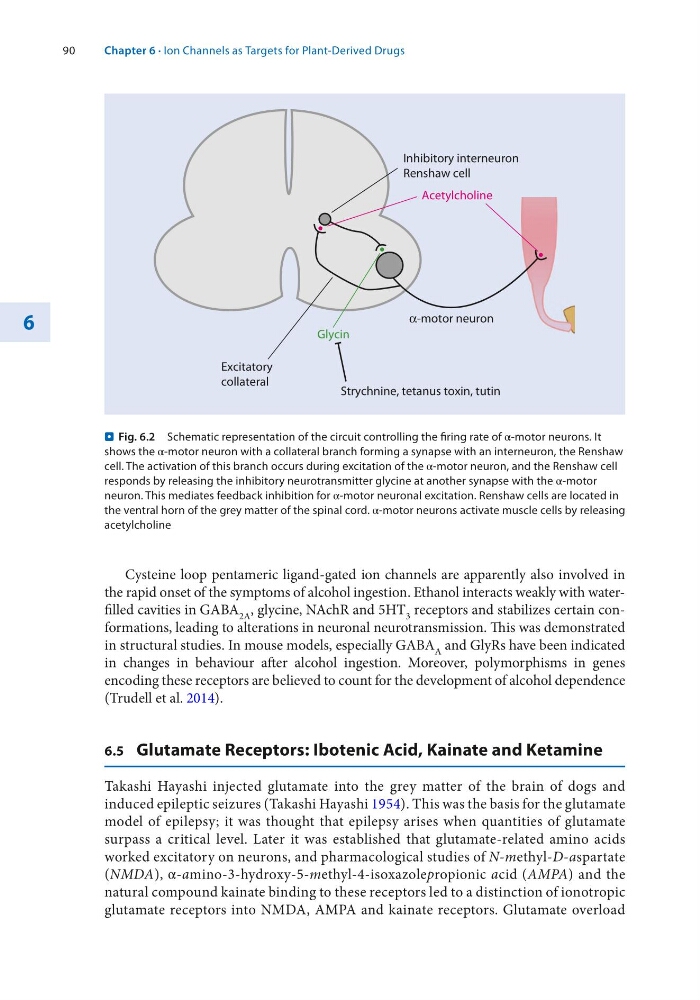
. Fig. 6.2 Schematic representation of the circuit controlling the firing rate of α-motor neurons. It
shows the α-motor neuron with a collateral branch forming a synapse with an interneuron, the Renshaw
cell. The activation of this branch occurs during excitation of the α-motor neuron, and the Renshaw cell
responds by releasing the inhibitory neurotransmitter glycine at another synapse with the α-motor
neuron. This mediates feedback inhibition for α-motor neuronal excitation. Renshaw cells are located in
the ventral horn of the grey matter of the spinal cord. α-motor neurons activate muscle cells by releasing
acetylcholine
Chapter 6 · Ion Channels as Targets for Plant-Derived Drugs
6
Cysteine loop pentameric ligand-gated ion channels are apparently also involved in
the rapid onset of the symptoms of alcohol ingestion. Ethanol interacts weakly with waterfilled cavities in GABA 2A , glycine, NAchR and 5HT 3 receptors and stabilizes certain conformations, leading to alterations in neuronal neurotransmission. This was demonstrated
in structural studies. In mouse models, especially GABA A and GlyRs have been indicated
in changes in behaviour after alcohol ingestion. Moreover, polymorphisms in genes
encoding these receptors are believed to count for the development of alcohol dependence
(Trudell et al. 2014).
6.5 Glutamate Receptors: Ibotenic Acid, Kainate and Ketamine
Takashi Hayashi injected glutamate into the grey matter of the brain of dogs and
induced epileptic seizures (Takashi Hayashi 1954). This was the basis for the glutamate
model of epilepsy; it was thought that epilepsy arises when quantities of glutamate
surpass a critical level. Later it was established that glutamate-related amino acids
worked excitatory on neurons, and pharmacological studies of N-methyl-D-aspartate
(NMDA), α-amino-3-hydroxy-5-methyl-4-isoxazolepropionic acid (AMPA) and the
natural compound kainate binding to these receptors led to a distinction of ionotropic
glutamate receptors into NMDA, AMPA and kainate receptors. Glutamate overload
Excitatory
collateral
Inhibitory interneuron
Renshaw cell
α-motor neuron
Acetylcholine
Glycin
Strychnine, tetanus toxin, tutin
. Fig. 6.2 Schematic representation of the circuit controlling the firing rate of α-motor neurons. It
shows the α-motor neuron with a collateral branch forming a synapse with an interneuron, the Renshaw
cell. The activation of this branch occurs during excitation of the α-motor neuron, and the Renshaw cell
responds by releasing the inhibitory neurotransmitter glycine at another synapse with the α-motor
neuron. This mediates feedback inhibition for α-motor neuronal excitation. Renshaw cells are located in
the ventral horn of the grey matter of the spinal cord. α-motor neurons activate muscle cells by releasing
acetylcholine
Chapter 6 · Ion Channels as Targets for Plant-Derived Drugs