

86
6
The NAchR has a molecular mass of 290 kDa. It consists of five subunits arranged
around a central pore. Each subunit has four transmembrane domains. By variable combinations of these five subunits, a wide range of different channels is produced. In the
muscle type, the embryonic form is composed of two α1-, one β1-, one γ- and one
δ-subunit ((α1)2(β1)1(γ)1(δ)1). Adult forms, on the other hand, are composed of two α1-,
one β1-, one δ- and one ε-subunit ((α1)2(β1)1(δ)1(ε)1). Some neuronal subtypes are
(α4)3(β2)2, (α4)2(β2)3 and (α7)5.
Acetylcholine is the ligand for NAchRs. It gates the flow of positive ions into the muscle cell and induces membrane depolarization. NAchRs play an important role in mediating activation-contraction coupling at the neuromuscular junction. When two
acetylcholine molecules bind to the extracellular domain of the receptor, within a few μs’
the channel opens and strong Na + influx results in an inwards net flow of positive charge.
This changes the resting membrane potential of the muscle cell from −85 mV to −60 mV
and provides the first step in the cascade of events inducing muscle contraction (see . Fig.
4.4). The gating mechanism involves twisting of the second helices of the membrane spanning domains of the five subunits lining the channel. The selectivity pore in this cation
a
4
2
1
3
3
1
2
4
N
N
C
C
S
S
S
S
4
2
3
1
4
2
3
1
1
2
4
3
1
2
3
4
1
2
3
4
Pore
90°
b
c
Pore
pore
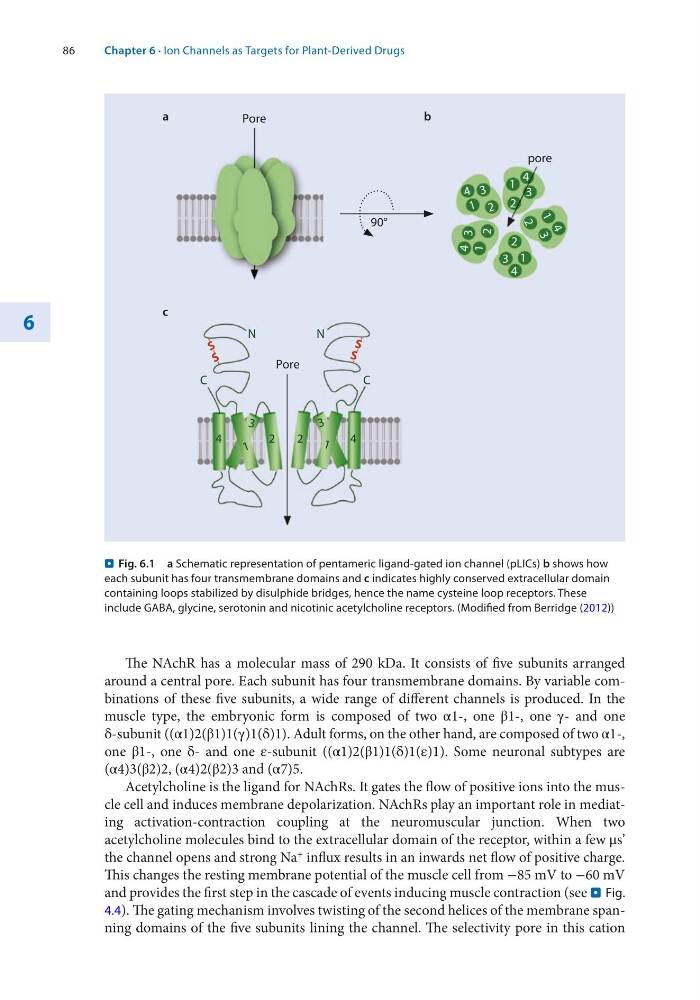
. Fig. 6.1 a Schematic representation of pentameric ligand-gated ion channel (pLICs) b shows how
each subunit has four transmembrane domains and c indicates highly conserved extracellular domain
containing loops stabilized by disulphide bridges, hence the name cysteine loop receptors. These
include GABA, glycine, serotonin and nicotinic acetylcholine receptors. (Modified from Berridge (2012))
Chapter 6 · Ion Channels as Targets for Plant-Derived Drugs
6
The NAchR has a molecular mass of 290 kDa. It consists of five subunits arranged
around a central pore. Each subunit has four transmembrane domains. By variable combinations of these five subunits, a wide range of different channels is produced. In the
muscle type, the embryonic form is composed of two α1-, one β1-, one γ- and one
δ-subunit ((α1)2(β1)1(γ)1(δ)1). Adult forms, on the other hand, are composed of two α1-,
one β1-, one δ- and one ε-subunit ((α1)2(β1)1(δ)1(ε)1). Some neuronal subtypes are
(α4)3(β2)2, (α4)2(β2)3 and (α7)5.
Acetylcholine is the ligand for NAchRs. It gates the flow of positive ions into the muscle cell and induces membrane depolarization. NAchRs play an important role in mediating activation-contraction coupling at the neuromuscular junction. When two
acetylcholine molecules bind to the extracellular domain of the receptor, within a few μs’
the channel opens and strong Na + influx results in an inwards net flow of positive charge.
This changes the resting membrane potential of the muscle cell from −85 mV to −60 mV
and provides the first step in the cascade of events inducing muscle contraction (see . Fig.
4.4). The gating mechanism involves twisting of the second helices of the membrane spanning domains of the five subunits lining the channel. The selectivity pore in this cation
a
4
2
1
3
3
1
2
4
N
N
C
C
S
S
S
S
4
2
3
1
4
2
3
1
1
2
4
3
1
2
3
4
1
2
3
4
Pore
90°
b
c
Pore
pore
. Fig. 6.1 a Schematic representation of pentameric ligand-gated ion channel (pLICs) b shows how
each subunit has four transmembrane domains and c indicates highly conserved extracellular domain
containing loops stabilized by disulphide bridges, hence the name cysteine loop receptors. These
include GABA, glycine, serotonin and nicotinic acetylcholine receptors. (Modified from Berridge (2012))
Chapter 6 · Ion Channels as Targets for Plant-Derived Drugs