

79
5
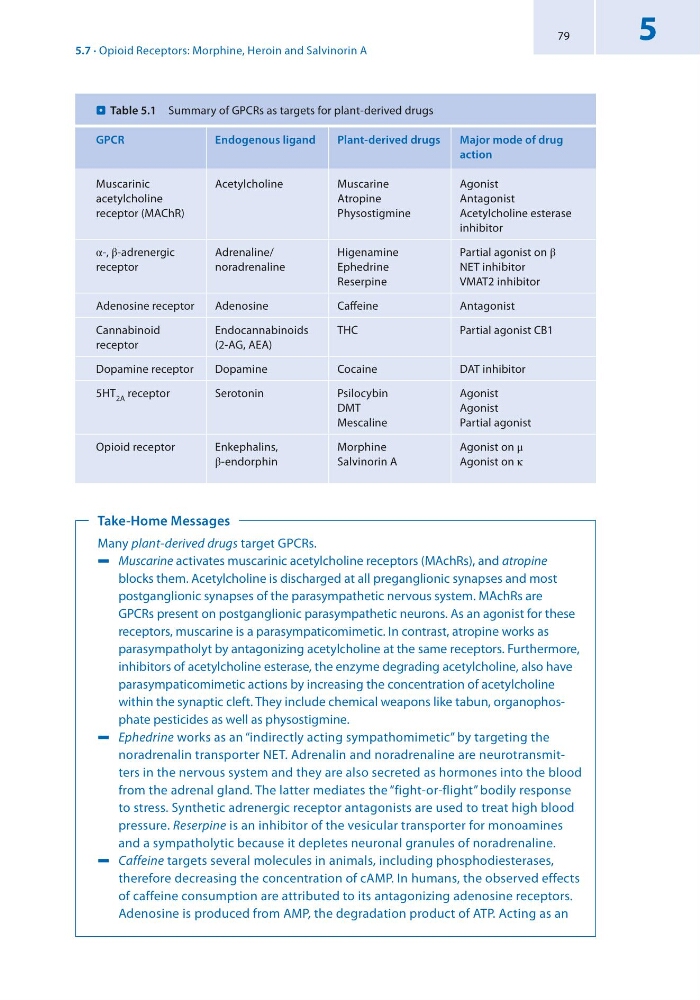
. Table 5.1 Summary of GPCRs as targets for plant-derived drugs
GPCR
Endogenous ligand
Plant-derived drugs
Major mode of drug
action
Muscarinic
acetylcholine
receptor (MAChR)
Acetylcholine
Muscarine
Atropine
Physostigmine
Agonist
Antagonist
Acetylcholine esterase
inhibitor
α-, β-adrenergic
receptor
Adrenaline/
noradrenaline
Higenamine
Ephedrine
Reserpine
Partial agonist on β
NET inhibitor
VMAT2 inhibitor
Adenosine receptor
Adenosine
Caffeine
Antagonist
Cannabinoid
receptor
Endocannabinoids
(2-AG, AEA)
THC
Partial agonist CB1
Dopamine receptor
Dopamine
Cocaine
DAT inhibitor
5HT 2A receptor
Serotonin
Psilocybin
DMT
Mescaline
Agonist
Agonist
Partial agonist
Opioid receptor
Enkephalins,
β-endorphin
Morphine
Salvinorin A
Agonist on μ
Agonist on κ
Take-Home Messages
Many plant-derived drugs target GPCRs.
5 Muscarine activates muscarinic acetylcholine receptors (MAchRs), and atropine
blocks them. Acetylcholine is discharged at all preganglionic synapses and most
postganglionic synapses of the parasympathetic nervous system. MAchRs are
GPCRs present on postganglionic parasympathetic neurons. As an agonist for these
receptors, muscarine is a parasympaticomimetic. In contrast, atropine works as
parasympatholyt by antagonizing acetylcholine at the same receptors. Furthermore,
inhibitors of acetylcholine esterase, the enzyme degrading acetylcholine, also have
parasympaticomimetic actions by increasing the concentration of acetylcholine
within the synaptic cleft. They include chemical weapons like tabun, organophosphate pesticides as well as physostigmine.
5 Ephedrine works as an “indirectly acting sympathomimetic” by targeting the
noradrenalin transporter NET. Adrenalin and noradrenaline are neurotransmitters in the nervous system and they are also secreted as hormones into the blood
from the adrenal gland. The latter mediates the “fight-or-flight” bodily response
to stress. Synthetic adrenergic receptor antagonists are used to treat high blood
pressure. Reserpine is an inhibitor of the vesicular transporter for monoamines
and a sympatholytic because it depletes neuronal granules of noradrenaline.
5 Caffeine targets several molecules in animals, including phosphodiesterases,
therefore decreasing the concentration of cAMP. In humans, the observed effects
of caffeine consumption are attributed to its antagonizing adenosine receptors.
Adenosine is produced from AMP, the degradation product of ATP. Acting as an
5.7 · Opioid Receptors: Morphine, Heroin and Salvinorin A
5
. Table 5.1 Summary of GPCRs as targets for plant-derived drugs
GPCR
Endogenous ligand
Plant-derived drugs
Major mode of drug
action
Muscarinic
acetylcholine
receptor (MAChR)
Acetylcholine
Muscarine
Atropine
Physostigmine
Agonist
Antagonist
Acetylcholine esterase
inhibitor
α-, β-adrenergic
receptor
Adrenaline/
noradrenaline
Higenamine
Ephedrine
Reserpine
Partial agonist on β
NET inhibitor
VMAT2 inhibitor
Adenosine receptor
Adenosine
Caffeine
Antagonist
Cannabinoid
receptor
Endocannabinoids
(2-AG, AEA)
THC
Partial agonist CB1
Dopamine receptor
Dopamine
Cocaine
DAT inhibitor
5HT 2A receptor
Serotonin
Psilocybin
DMT
Mescaline
Agonist
Agonist
Partial agonist
Opioid receptor
Enkephalins,
β-endorphin
Morphine
Salvinorin A
Agonist on μ
Agonist on κ
Take-Home Messages
Many plant-derived drugs target GPCRs.
5 Muscarine activates muscarinic acetylcholine receptors (MAchRs), and atropine
blocks them. Acetylcholine is discharged at all preganglionic synapses and most
postganglionic synapses of the parasympathetic nervous system. MAchRs are
GPCRs present on postganglionic parasympathetic neurons. As an agonist for these
receptors, muscarine is a parasympaticomimetic. In contrast, atropine works as
parasympatholyt by antagonizing acetylcholine at the same receptors. Furthermore,
inhibitors of acetylcholine esterase, the enzyme degrading acetylcholine, also have
parasympaticomimetic actions by increasing the concentration of acetylcholine
within the synaptic cleft. They include chemical weapons like tabun, organophosphate pesticides as well as physostigmine.
5 Ephedrine works as an “indirectly acting sympathomimetic” by targeting the
noradrenalin transporter NET. Adrenalin and noradrenaline are neurotransmitters in the nervous system and they are also secreted as hormones into the blood
from the adrenal gland. The latter mediates the “fight-or-flight” bodily response
to stress. Synthetic adrenergic receptor antagonists are used to treat high blood
pressure. Reserpine is an inhibitor of the vesicular transporter for monoamines
and a sympatholytic because it depletes neuronal granules of noradrenaline.
5 Caffeine targets several molecules in animals, including phosphodiesterases,
therefore decreasing the concentration of cAMP. In humans, the observed effects
of caffeine consumption are attributed to its antagonizing adenosine receptors.
Adenosine is produced from AMP, the degradation product of ATP. Acting as an
5.7 · Opioid Receptors: Morphine, Heroin and Salvinorin A