

74
5
smoking of cocaine severs mucous membranes of the nose, mouth and throat. Very rarely
polymorphisms in the DAT gene have been seen in attention-deficit hyperactivity disorder (ADHA) and bipolar disorder patients.
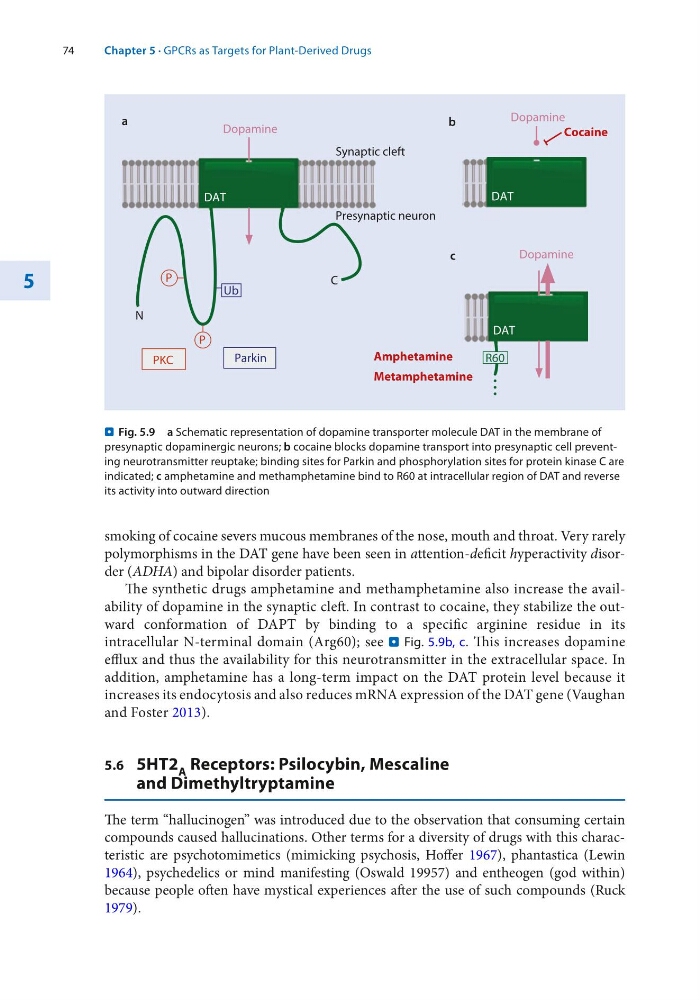
The synthetic drugs amphetamine and methamphetamine also increase the availability of dopamine in the synaptic cleft. In contrast to cocaine, they stabilize the outward conformation of DAPT by binding to a specific arginine residue in its
intracellular N- terminal domain (Arg60); see . Fig. 5.9b, c. This increases dopamine
efflux and thus the availability for this neurotransmitter in the extracellular space. In
addition, amphetamine has a long-term impact on the DAT protein level because it
increases its endocytosis and also reduces mRNA expression of the DAT gene (Vaughan
and Foster 2013).
5.6 5HT2 A Receptors: Psilocybin, Mescaline
and Dimethyltryptamine
The term “hallucinogen” was introduced due to the observation that consuming certain
compounds caused hallucinations. Other terms for a diversity of drugs with this characteristic are psychotomimetics (mimicking psychosis, Hoffer 1967), phantastica (Lewin
1964), psychedelics or mind manifesting (Oswald 19957) and entheogen (god within)
because people often have mystical experiences after the use of such compounds (Ruck
1979).
N
C
Presynaptic neuron
Synaptic cleft
PKC
P
P
Parkin
Ub
a
b
Dopamine
DAT
Dopamine
DAT
Cocaine
c
DAT
Amphetamine
R60
Metamphetamine
Dopamine
. Fig. 5.9 a Schematic representation of dopamine transporter molecule DAT in the membrane of
presynaptic dopaminergic neurons; b cocaine blocks dopamine transport into presynaptic cell preventing neurotransmitter reuptake; binding sites for Parkin and phosphorylation sites for protein kinase C are
indicated; c amphetamine and methamphetamine bind to R60 at intracellular region of DAT and reverse
its activity into outward direction
Chapter 5 · GPCRs as Targets for Plant-Derived Drugs
5
smoking of cocaine severs mucous membranes of the nose, mouth and throat. Very rarely
polymorphisms in the DAT gene have been seen in attention-deficit hyperactivity disorder (ADHA) and bipolar disorder patients.
The synthetic drugs amphetamine and methamphetamine also increase the availability of dopamine in the synaptic cleft. In contrast to cocaine, they stabilize the outward conformation of DAPT by binding to a specific arginine residue in its
intracellular N- terminal domain (Arg60); see . Fig. 5.9b, c. This increases dopamine
efflux and thus the availability for this neurotransmitter in the extracellular space. In
addition, amphetamine has a long-term impact on the DAT protein level because it
increases its endocytosis and also reduces mRNA expression of the DAT gene (Vaughan
and Foster 2013).
5.6 5HT2 A Receptors: Psilocybin, Mescaline
and Dimethyltryptamine
The term “hallucinogen” was introduced due to the observation that consuming certain
compounds caused hallucinations. Other terms for a diversity of drugs with this characteristic are psychotomimetics (mimicking psychosis, Hoffer 1967), phantastica (Lewin
1964), psychedelics or mind manifesting (Oswald 19957) and entheogen (god within)
because people often have mystical experiences after the use of such compounds (Ruck
1979).
N
C
Presynaptic neuron
Synaptic cleft
PKC
P
P
Parkin
Ub
a
b
Dopamine
DAT
Dopamine
DAT
Cocaine
c
DAT
Amphetamine
R60
Metamphetamine
Dopamine
. Fig. 5.9 a Schematic representation of dopamine transporter molecule DAT in the membrane of
presynaptic dopaminergic neurons; b cocaine blocks dopamine transport into presynaptic cell preventing neurotransmitter reuptake; binding sites for Parkin and phosphorylation sites for protein kinase C are
indicated; c amphetamine and methamphetamine bind to R60 at intracellular region of DAT and reverse
its activity into outward direction
Chapter 5 · GPCRs as Targets for Plant-Derived Drugs