

66
5
(Yeh 2012). A study analysing the activation of brain regions after caffeine consumption
shows that caffeine activates brain regions involved in the control of anxiety and vigilance
and in cardiovascular regulation. In contrast, brain areas involved in reinforcement and
reward were not activated (Nehlig et al. 2010). Nevertheless, symptoms of physical dependence can be experienced after caffeine withdrawal. These include headache, fatigue,
decrease in energy and depression of mood (see 7 Box 5.2).
ATP
ADP
AMP
5´-Nucleotidase
Adenosine kinase
high
Equilibrative adenosine transporter
Adenosine low
5´-Nucleotidase
high
Adenosine kinase
Adenosine high
Low energy demand
High energy demand
ATP
ADP
AMP
ATP
intracellular
intracellular
Extracellular
Intracellular
HO
OH OH
O
N
N
N
N
NH 2
Adenosine
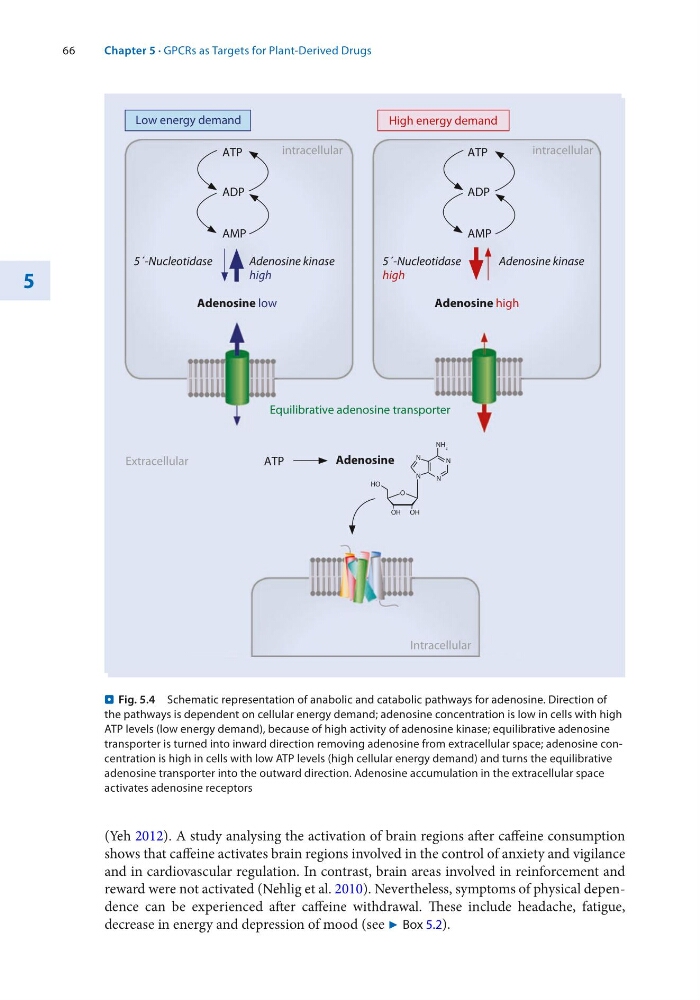
. Fig. 5.4 Schematic representation of anabolic and catabolic pathways for adenosine. Direction of
the pathways is dependent on cellular energy demand; adenosine concentration is low in cells with high
ATP levels (low energy demand), because of high activity of adenosine kinase; equilibrative adenosine
transporter is turned into inward direction removing adenosine from extracellular space; adenosine concentration is high in cells with low ATP levels (high cellular energy demand) and turns the equilibrative
adenosine transporter into the outward direction. Adenosine accumulation in the extracellular space
activates adenosine receptors
Chapter 5 · GPCRs as Targets for Plant-Derived Drugs
5
(Yeh 2012). A study analysing the activation of brain regions after caffeine consumption
shows that caffeine activates brain regions involved in the control of anxiety and vigilance
and in cardiovascular regulation. In contrast, brain areas involved in reinforcement and
reward were not activated (Nehlig et al. 2010). Nevertheless, symptoms of physical dependence can be experienced after caffeine withdrawal. These include headache, fatigue,
decrease in energy and depression of mood (see 7 Box 5.2).
ATP
ADP
AMP
5´-Nucleotidase
Adenosine kinase
high
Equilibrative adenosine transporter
Adenosine low
5´-Nucleotidase
high
Adenosine kinase
Adenosine high
Low energy demand
High energy demand
ATP
ADP
AMP
ATP
intracellular
intracellular
Extracellular
Intracellular
HO
OH OH
O
N
N
N
N
NH 2
Adenosine
. Fig. 5.4 Schematic representation of anabolic and catabolic pathways for adenosine. Direction of
the pathways is dependent on cellular energy demand; adenosine concentration is low in cells with high
ATP levels (low energy demand), because of high activity of adenosine kinase; equilibrative adenosine
transporter is turned into inward direction removing adenosine from extracellular space; adenosine concentration is high in cells with low ATP levels (high cellular energy demand) and turns the equilibrative
adenosine transporter into the outward direction. Adenosine accumulation in the extracellular space
activates adenosine receptors
Chapter 5 · GPCRs as Targets for Plant-Derived Drugs