

64
5
Proton outward flow synchronously allows neurotransmitter inward flow and leads to
accumulation of catecholamines inside neuronal storage vesicles. VMAT2 is expressed
in all monoaminergic neurons and does not show selectivity for dopamine, noradrenaline or serotonin. Reserpine binds the vesicular transporter with a very low off rate and
blocks neurotransmitter transport (Eiden and Weihe 2011). Therefore, it depletes neurons of catecholamine-containing granules that can be released at the synapse and thus
works as a sympatholytic. Reserpine has been used in the past to treat high blood pressure and at higher doses some kinds of psychosis (Shamon and Perez 2009). As side
effects, due to depletion of dopamine, depression and symptoms of Parkinson’s disease
are observed. This has been known for a long time (Lemieux et al. 1956).
5.3 Adenosine Receptors: Caffeine
Caffeine exerts a variety of effects in vertebrate as well as invertebrate species. Most commonly those are associated with sleep regulation, increased alertness and activity including locomotor activity and learning and memory. Some of the effects of caffeine are
conserved between invertebrate and vertebrate species.
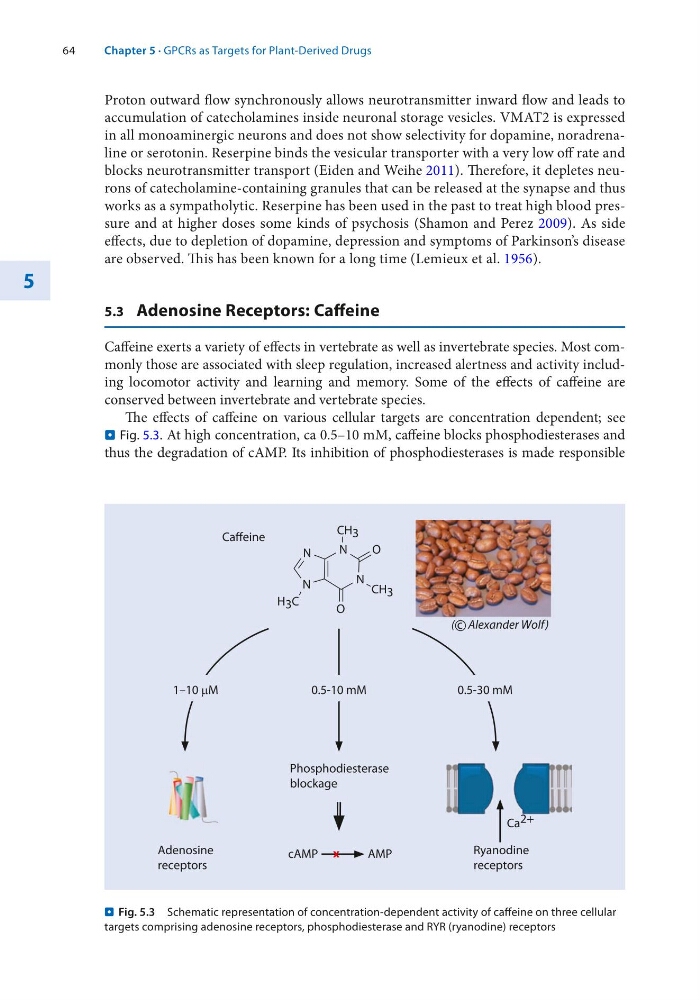
The effects of caffeine on various cellular targets are concentration dependent; see
. Fig. 5.3. At high concentration, ca 0.5–10 mM, caffeine blocks phosphodiesterases and
thus the degradation of cAMP. Its inhibition of phosphodiesterases is made responsible
. Fig. 5.3 Schematic representation of concentration-dependent activity of caffeine on three cellular
targets comprising adenosine receptors, phosphodiesterase and RYR (ryanodine) receptors
Chapter 5 · GPCRs as Targets for Plant-Derived Drugs
5
Proton outward flow synchronously allows neurotransmitter inward flow and leads to
accumulation of catecholamines inside neuronal storage vesicles. VMAT2 is expressed
in all monoaminergic neurons and does not show selectivity for dopamine, noradrenaline or serotonin. Reserpine binds the vesicular transporter with a very low off rate and
blocks neurotransmitter transport (Eiden and Weihe 2011). Therefore, it depletes neurons of catecholamine-containing granules that can be released at the synapse and thus
works as a sympatholytic. Reserpine has been used in the past to treat high blood pressure and at higher doses some kinds of psychosis (Shamon and Perez 2009). As side
effects, due to depletion of dopamine, depression and symptoms of Parkinson’s disease
are observed. This has been known for a long time (Lemieux et al. 1956).
5.3 Adenosine Receptors: Caffeine
Caffeine exerts a variety of effects in vertebrate as well as invertebrate species. Most commonly those are associated with sleep regulation, increased alertness and activity including locomotor activity and learning and memory. Some of the effects of caffeine are
conserved between invertebrate and vertebrate species.
The effects of caffeine on various cellular targets are concentration dependent; see
. Fig. 5.3. At high concentration, ca 0.5–10 mM, caffeine blocks phosphodiesterases and
thus the degradation of cAMP. Its inhibition of phosphodiesterases is made responsible
. Fig. 5.3 Schematic representation of concentration-dependent activity of caffeine on three cellular
targets comprising adenosine receptors, phosphodiesterase and RYR (ryanodine) receptors
Chapter 5 · GPCRs as Targets for Plant-Derived Drugs