

52
4
known, including RYR1 on skeletal muscle, RYR2 on the myocardium, and RYR3, which
is expressed in many cell types but was first identified in the brain (Zalk et al. 2007).
Opening of RYR1 for excitation-contraction coupling in muscle cells is believed to occur
by a direct physical interaction of membrane L-VOCs with RYR1 via a RYR site in its
second intracellular loop. Ca 2+ -influx after opening of L-VOC may also contribute,
because RYR channels are strongly regulated by Ca 2+ -ions and open in response to Ca 2+ -
signals. This is well described for RYR2 in the heart. However, high cytoplasmic Ca 2+ -
concentrations can trigger closing of these channels.
There are a number of genetic diseases associated with RYR mutations. These include
malignant hypothermia, a deadly rise in body temperature induced in patients with a
certain RYR-1 mutation under anesthesia. This mutation corresponds to a mutation in the
pig RYR1, which is known to cause porcine stress syndrome. Furthermore, some RYR1
mutations are implicated in congenital myopathies, atypical periodic paralysis and others
(Van Petegem 2012).
4.3.5 VOCs and Neurotransmitter Release
The neurotransmitter acetylcholine is stored in synaptic vesicles in the motor neuron
and released upon arrival of an action potential. This requires vesicle fusion with the
presynaptic membrane and Ca 2+ -influx mediated by the P/Q-type voltage-gated Ca 2+ -
Action
potential
Sarcoplasmic
reticulum
Acetylcholine
Voltage-gated
Na + channel
Nicotinergic
acetylcholine
receptor
Voltage-gated
Ca 2+ channel
Na +
Ca 2+
Na +
Ca 2+
Ca 2+ gated
Ca 2+ release
channel
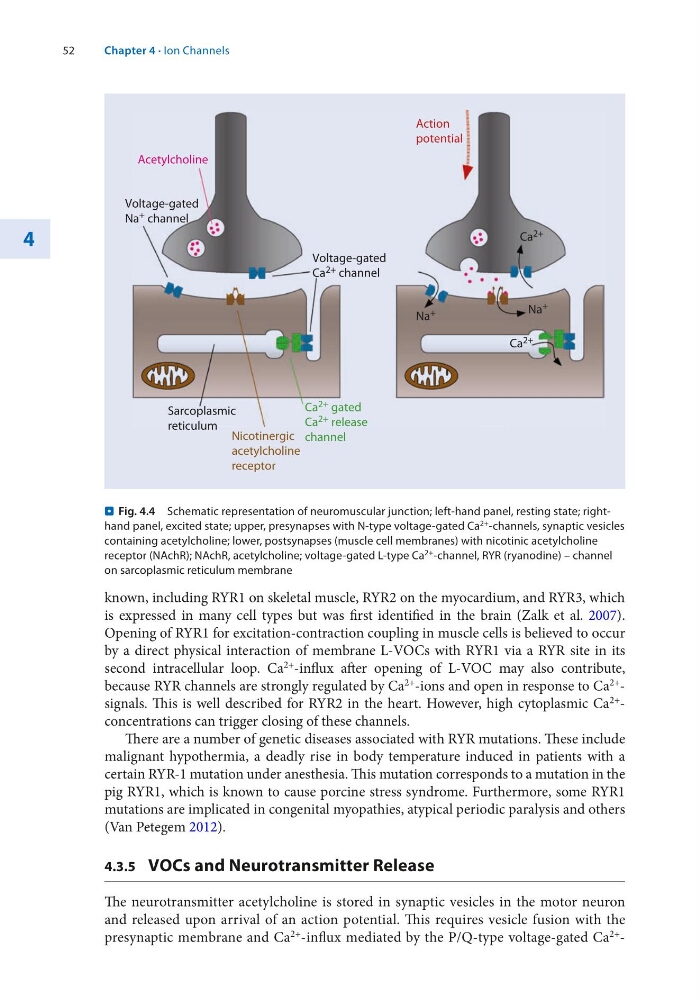
. Fig. 4.4 Schematic representation of neuromuscular junction; left-hand panel, resting state; righthand panel, excited state; upper, presynapses with N-type voltage-gated Ca 2+ -channels, synaptic vesicles
containing acetylcholine; lower, postsynapses (muscle cell membranes) with nicotinic acetylcholine
receptor (NAchR); NAchR, acetylcholine; voltage-gated L-type Ca 2+ -channel, RYR (ryanodine) – channel
on sarcoplasmic reticulum membrane
Chapter 4 · Ion Channels
4
known, including RYR1 on skeletal muscle, RYR2 on the myocardium, and RYR3, which
is expressed in many cell types but was first identified in the brain (Zalk et al. 2007).
Opening of RYR1 for excitation-contraction coupling in muscle cells is believed to occur
by a direct physical interaction of membrane L-VOCs with RYR1 via a RYR site in its
second intracellular loop. Ca 2+ -influx after opening of L-VOC may also contribute,
because RYR channels are strongly regulated by Ca 2+ -ions and open in response to Ca 2+ -
signals. This is well described for RYR2 in the heart. However, high cytoplasmic Ca 2+ -
concentrations can trigger closing of these channels.
There are a number of genetic diseases associated with RYR mutations. These include
malignant hypothermia, a deadly rise in body temperature induced in patients with a
certain RYR-1 mutation under anesthesia. This mutation corresponds to a mutation in the
pig RYR1, which is known to cause porcine stress syndrome. Furthermore, some RYR1
mutations are implicated in congenital myopathies, atypical periodic paralysis and others
(Van Petegem 2012).
4.3.5 VOCs and Neurotransmitter Release
The neurotransmitter acetylcholine is stored in synaptic vesicles in the motor neuron
and released upon arrival of an action potential. This requires vesicle fusion with the
presynaptic membrane and Ca 2+ -influx mediated by the P/Q-type voltage-gated Ca 2+ -
Action
potential
Sarcoplasmic
reticulum
Acetylcholine
Voltage-gated
Na + channel
Nicotinergic
acetylcholine
receptor
Voltage-gated
Ca 2+ channel
Na +
Ca 2+
Na +
Ca 2+
Ca 2+ gated
Ca 2+ release
channel
. Fig. 4.4 Schematic representation of neuromuscular junction; left-hand panel, resting state; righthand panel, excited state; upper, presynapses with N-type voltage-gated Ca 2+ -channels, synaptic vesicles
containing acetylcholine; lower, postsynapses (muscle cell membranes) with nicotinic acetylcholine
receptor (NAchR); NAchR, acetylcholine; voltage-gated L-type Ca 2+ -channel, RYR (ryanodine) – channel
on sarcoplasmic reticulum membrane
Chapter 4 · Ion Channels