

34
3
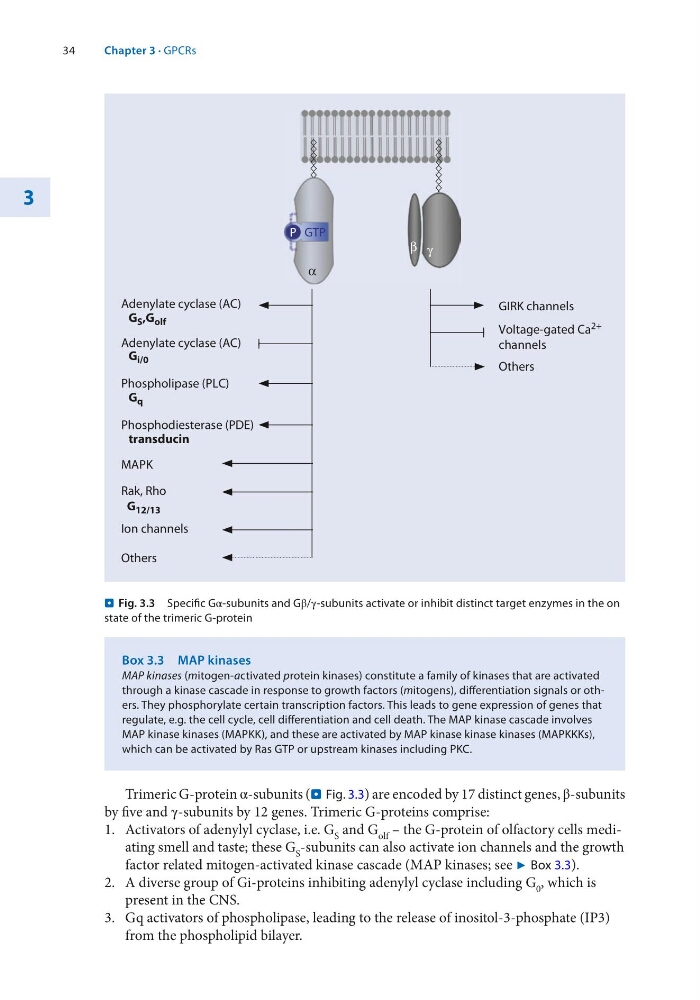
Trimeric G-protein α-subunits (. Fig. 3.3) are encoded by 17 distinct genes, β-subunits
by five and γ-subunits by 12 genes. Trimeric G-proteins comprise:
1. Activators of adenylyl cyclase, i.e. G S and G olf – the G-protein of olfactory cells mediating smell and taste; these G S -subunits can also activate ion channels and the growth
factor related mitogen-activated kinase cascade (MAP kinases; see 7 Box 3.3).
2. A diverse group of Gi-proteins inhibiting adenylyl cyclase including G 0 , which is
present in the CNS.
3. Gq activators of phospholipase, leading to the release of inositol- 3- phosphate (IP3)
from the phospholipid bilayer.
G S ,G olf
Adenylate cyclase (AC)
G i/0
Adenylate cyclase (AC)
G q
Phospholipase (PLC)
Rak, Rho
G 12/13
transducin
Phosphodiesterase (PDE)
GTP
α
β γ
P
MAPK
Ion channels
Others
GIRK channels
Voltage-gated Ca 2+
channels
Others
. Fig. 3.3 Specific Gα-subunits and Gβ/γ-subunits activate or inhibit distinct target enzymes in the on
state of the trimeric G-protein
Box 3.3 MAP kinases
MAP kinases (mitogen-activated protein kinases) constitute a family of kinases that are activated
through a kinase cascade in response to growth factors (mitogens), differentiation signals or others. They phosphorylate certain transcription factors. This leads to gene expression of genes that
regulate, e.g. the cell cycle, cell differentiation and cell death. The MAP kinase cascade involves
MAP kinase kinases (MAPKK), and these are activated by MAP kinase kinase kinases (MAPKKKs),
which can be activated by Ras GTP or upstream kinases including PKC.
Chapter 3 · GPCRs
3
Trimeric G-protein α-subunits (. Fig. 3.3) are encoded by 17 distinct genes, β-subunits
by five and γ-subunits by 12 genes. Trimeric G-proteins comprise:
1. Activators of adenylyl cyclase, i.e. G S and G olf – the G-protein of olfactory cells mediating smell and taste; these G S -subunits can also activate ion channels and the growth
factor related mitogen-activated kinase cascade (MAP kinases; see 7 Box 3.3).
2. A diverse group of Gi-proteins inhibiting adenylyl cyclase including G 0 , which is
present in the CNS.
3. Gq activators of phospholipase, leading to the release of inositol- 3- phosphate (IP3)
from the phospholipid bilayer.
G S ,G olf
Adenylate cyclase (AC)
G i/0
Adenylate cyclase (AC)
G q
Phospholipase (PLC)
Rak, Rho
G 12/13
transducin
Phosphodiesterase (PDE)
GTP
α
β γ
P
MAPK
Ion channels
Others
GIRK channels
Voltage-gated Ca 2+
channels
Others
. Fig. 3.3 Specific Gα-subunits and Gβ/γ-subunits activate or inhibit distinct target enzymes in the on
state of the trimeric G-protein
Box 3.3 MAP kinases
MAP kinases (mitogen-activated protein kinases) constitute a family of kinases that are activated
through a kinase cascade in response to growth factors (mitogens), differentiation signals or others. They phosphorylate certain transcription factors. This leads to gene expression of genes that
regulate, e.g. the cell cycle, cell differentiation and cell death. The MAP kinase cascade involves
MAP kinase kinases (MAPKK), and these are activated by MAP kinase kinase kinases (MAPKKKs),
which can be activated by Ras GTP or upstream kinases including PKC.
Chapter 3 · GPCRs