

21
2
other properties of these substances were tested more systematically, and the exact function of many natural products was determined and often traced back to specific single
metabolites. This then allowed the design and synthesis of more specific drugs.
With the advent of molecular biology, the molecular nature of the receptor targets
and their interaction with these compounds could be studied. In recent years, the availability of better analytical methods, chemical assays and high-throughput screening platforms has led to a modern form of bioprospecting. Samples of hundreds of plants can be
collected, extracted and analysed systematically in a reasonably short time. These methods allow the identification of the active compounds in plants that have been known and
used as herbal medicine for ages. Therefore, the collection of knowledge about natural
medicine that was gained by men over centuries of trial and error is an import asset in
these studies. However, bioprospecting can also be used to identify new, promising compounds for future medicinal applications. Paclitaxel, a diterpene, isolated initially from
bark of the Pacific yew (Taxus brevifolia) is a good example of a drug that was discovered
in a random screen for new, medically active compounds against cancer (Wani et al.
1971). Tools offered by genetic engineering have enabled the production of plant secondary metabolites in microorganisms and the targeted alteration of synthesis pathways in
order to produce new compounds. The inconspicuous flowering plant periwinkle
(Catharanthus roseus) produces more than 100 different terpenoid indole alkaloids. A
point mutation (V214 M) in strictosidine synthase, an important enzyme in the biosynthetic pathway of these compounds, has expanded its substrate specificity so that it now
accepts new substrates, leading to the production of novel, unnatural alkaloid compounds (Runguphan and O’Connor 2009). In other cases, however, chemical synthesis or
a
b
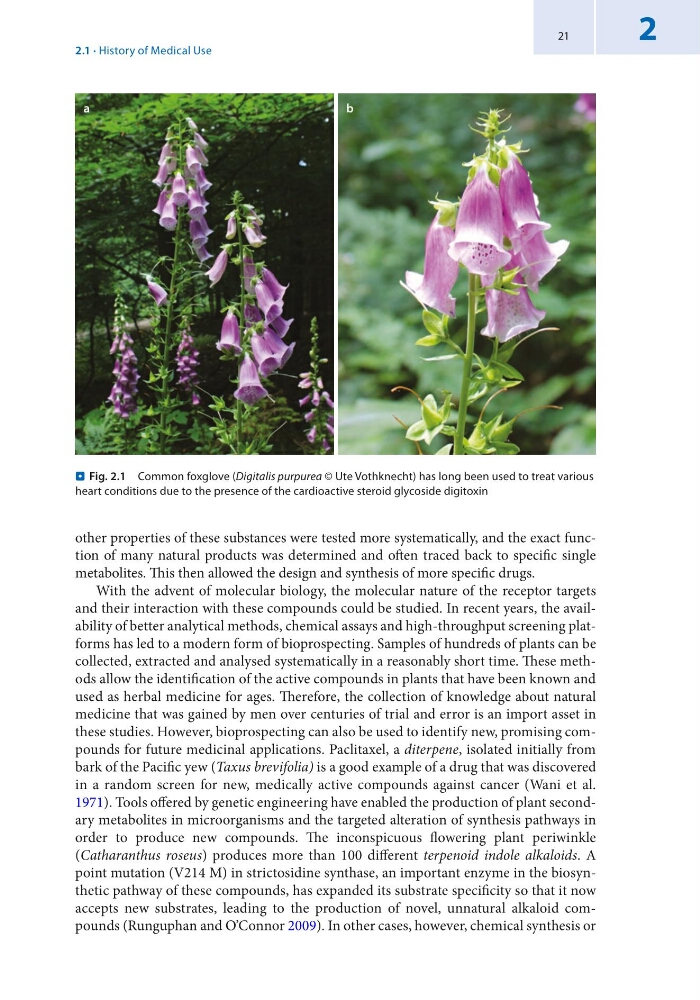
. Fig. 2.1 Common foxglove (Digitalis purpurea © Ute Vothknecht) has long been used to treat various
heart conditions due to the presence of the cardioactive steroid glycoside digitoxin
2.1 · History of Medical Use
2
other properties of these substances were tested more systematically, and the exact function of many natural products was determined and often traced back to specific single
metabolites. This then allowed the design and synthesis of more specific drugs.
With the advent of molecular biology, the molecular nature of the receptor targets
and their interaction with these compounds could be studied. In recent years, the availability of better analytical methods, chemical assays and high-throughput screening platforms has led to a modern form of bioprospecting. Samples of hundreds of plants can be
collected, extracted and analysed systematically in a reasonably short time. These methods allow the identification of the active compounds in plants that have been known and
used as herbal medicine for ages. Therefore, the collection of knowledge about natural
medicine that was gained by men over centuries of trial and error is an import asset in
these studies. However, bioprospecting can also be used to identify new, promising compounds for future medicinal applications. Paclitaxel, a diterpene, isolated initially from
bark of the Pacific yew (Taxus brevifolia) is a good example of a drug that was discovered
in a random screen for new, medically active compounds against cancer (Wani et al.
1971). Tools offered by genetic engineering have enabled the production of plant secondary metabolites in microorganisms and the targeted alteration of synthesis pathways in
order to produce new compounds. The inconspicuous flowering plant periwinkle
(Catharanthus roseus) produces more than 100 different terpenoid indole alkaloids. A
point mutation (V214 M) in strictosidine synthase, an important enzyme in the biosynthetic pathway of these compounds, has expanded its substrate specificity so that it now
accepts new substrates, leading to the production of novel, unnatural alkaloid compounds (Runguphan and O’Connor 2009). In other cases, however, chemical synthesis or
a
b
. Fig. 2.1 Common foxglove (Digitalis purpurea © Ute Vothknecht) has long been used to treat various
heart conditions due to the presence of the cardioactive steroid glycoside digitoxin
2.1 · History of Medical Use