

209
13
13.3.1 Polyacetylenes (e.g. Cicutoxin)
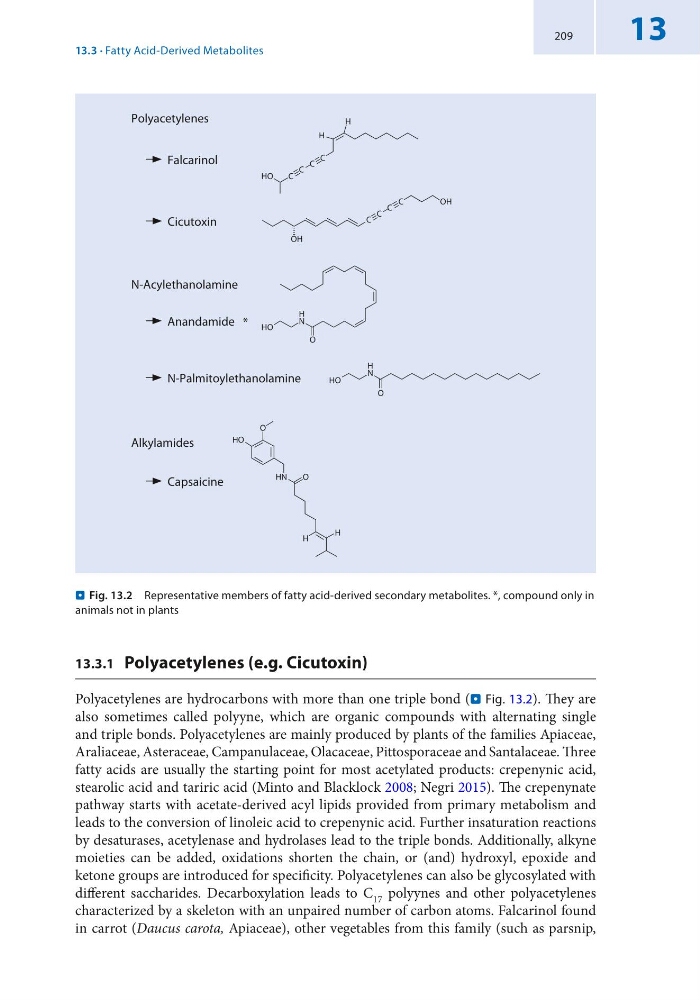
Polyacetylenes are hydrocarbons with more than one triple bond (. Fig. 13.2). They are
also sometimes called polyyne, which are organic compounds with alternating single
and triple bonds. Polyacetylenes are mainly produced by plants of the families Apiaceae,
Araliaceae, Asteraceae, Campanulaceae, Olacaceae, Pittosporaceae and Santalaceae. Three
fatty acids are usually the starting point for most acetylated products: crepenynic acid,
stearolic acid and tariric acid (Minto and Blacklock 2008; Negri 2015). The crepenynate
pathway starts with acetate-derived acyl lipids provided from primary metabolism and
leads to the conversion of linoleic acid to crepenynic acid. Further insaturation reactions
by desaturases, acetylenase and hydrolases lead to the triple bonds. Additionally, alkyne
moieties can be added, oxidations shorten the chain, or (and) hydroxyl, epoxide and
ketone groups are introduced for specificity. Polyacetylenes can also be glycosylated with
different saccharides. Decarboxylation leads to C 17 polyynes and other polyacetylenes
characterized by a skeleton with an unpaired number of carbon atoms. Falcarinol found
in carrot (Daucus carota, Apiaceae), other vegetables from this family (such as parsnip,
Polyacetylenes
Falcarinol
Cicutoxin
N-Acylethanolamine
Anandamide
N-Palmitoylethanolamine
Capsaicine
Alkylamides
*
OH
OH
C
C
C
C
C
H
H
HO
HO
HO
HO
HN
H
H
O
O
O
O
H
N
H
N
C
C
C
. Fig. 13.2 Representative members of fatty acid-derived secondary metabolites. *, compound only in
animals not in plants
13.3 · Fatty Acid-Derived Metabolites
13
13.3.1 Polyacetylenes (e.g. Cicutoxin)
Polyacetylenes are hydrocarbons with more than one triple bond (. Fig. 13.2). They are
also sometimes called polyyne, which are organic compounds with alternating single
and triple bonds. Polyacetylenes are mainly produced by plants of the families Apiaceae,
Araliaceae, Asteraceae, Campanulaceae, Olacaceae, Pittosporaceae and Santalaceae. Three
fatty acids are usually the starting point for most acetylated products: crepenynic acid,
stearolic acid and tariric acid (Minto and Blacklock 2008; Negri 2015). The crepenynate
pathway starts with acetate-derived acyl lipids provided from primary metabolism and
leads to the conversion of linoleic acid to crepenynic acid. Further insaturation reactions
by desaturases, acetylenase and hydrolases lead to the triple bonds. Additionally, alkyne
moieties can be added, oxidations shorten the chain, or (and) hydroxyl, epoxide and
ketone groups are introduced for specificity. Polyacetylenes can also be glycosylated with
different saccharides. Decarboxylation leads to C 17 polyynes and other polyacetylenes
characterized by a skeleton with an unpaired number of carbon atoms. Falcarinol found
in carrot (Daucus carota, Apiaceae), other vegetables from this family (such as parsnip,
Polyacetylenes
Falcarinol
Cicutoxin
N-Acylethanolamine
Anandamide
N-Palmitoylethanolamine
Capsaicine
Alkylamides
*
OH
OH
C
C
C
C
C
H
H
HO
HO
HO
HO
HN
H
H
O
O
O
O
H
N
H
N
C
C
C
. Fig. 13.2 Representative members of fatty acid-derived secondary metabolites. *, compound only in
animals not in plants
13.3 · Fatty Acid-Derived Metabolites