

207
13
in young plants. Propyl cannabinoids (cannabinoids with a C3 side chain, instead of a C5
side chain), such as tetrahydrocannabivarinic acid (THCVA), are synthetized from a divarinolic acid precursor instead of olivetolic acid. These have also been reported to be present in Cannabis (Hillig and Mahlberg 2004; Flores-Sanchez and Verpoorte 2008). Thus,
THCA is the major cannabinoid in the drug-type Cannabis, while CBDA predominates
in fibre- type hemps. These compounds are produced and accumulate in the trichomes
of Cannabis sativa, especially in glandular capitate-stalked and capitate sessile trichomes
(Kim and Mahlberg 2003). THCA is synthesized in the storage cavity, and the enzyme
THCAS is also transported to this compartment. This seems to be a protective measure for
the plant since accumulation of cannabinoids in cells induces apoptosis (Sirikantaramas
et al. 2005).
Hexanoyl-CoA
Malonyl-CoA
Olivetolic acid
Cannabichromene
3x
Cannabigerolic acid
Cannabidiol
GPP
Cannabidiolic acid
∆9 Tetrahydrocannabinolic acid Cannabichromenic acid
∆9 Tetrahydrocannabinol
S
S
CoA
CoA
O
O
O
O
O
OH
OH
OH
OH
OH
OH
OH
OH
HO
H
OH
O
O
O
OH
P
O
O
O P
O H
HO
HO
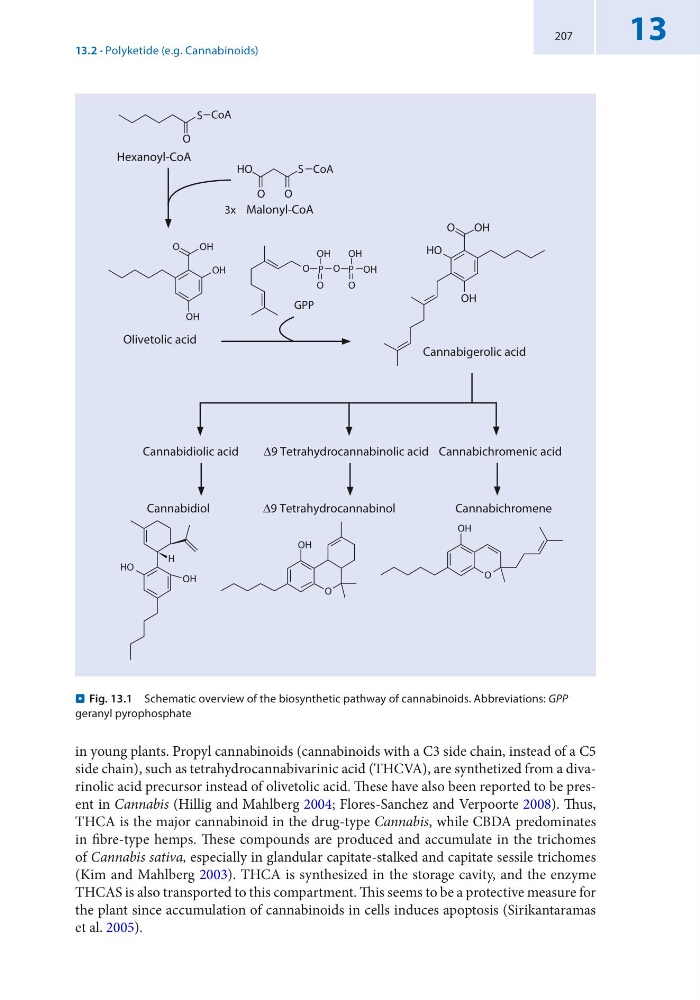
. Fig. 13.1 Schematic overview of the biosynthetic pathway of cannabinoids. Abbreviations: GPP
geranyl pyrophosphate
13.2 · Polyketide (e.g. Cannabinoids)
13
in young plants. Propyl cannabinoids (cannabinoids with a C3 side chain, instead of a C5
side chain), such as tetrahydrocannabivarinic acid (THCVA), are synthetized from a divarinolic acid precursor instead of olivetolic acid. These have also been reported to be present in Cannabis (Hillig and Mahlberg 2004; Flores-Sanchez and Verpoorte 2008). Thus,
THCA is the major cannabinoid in the drug-type Cannabis, while CBDA predominates
in fibre- type hemps. These compounds are produced and accumulate in the trichomes
of Cannabis sativa, especially in glandular capitate-stalked and capitate sessile trichomes
(Kim and Mahlberg 2003). THCA is synthesized in the storage cavity, and the enzyme
THCAS is also transported to this compartment. This seems to be a protective measure for
the plant since accumulation of cannabinoids in cells induces apoptosis (Sirikantaramas
et al. 2005).
Hexanoyl-CoA
Malonyl-CoA
Olivetolic acid
Cannabichromene
3x
Cannabigerolic acid
Cannabidiol
GPP
Cannabidiolic acid
∆9 Tetrahydrocannabinolic acid Cannabichromenic acid
∆9 Tetrahydrocannabinol
S
S
CoA
CoA
O
O
O
O
O
OH
OH
OH
OH
OH
OH
OH
OH
HO
H
OH
O
O
O
OH
P
O
O
O P
O H
HO
HO
. Fig. 13.1 Schematic overview of the biosynthetic pathway of cannabinoids. Abbreviations: GPP
geranyl pyrophosphate
13.2 · Polyketide (e.g. Cannabinoids)