

195
12
12.9 Purine Alkaloids (Derived from Xanthosine, e.g. Caffeine)
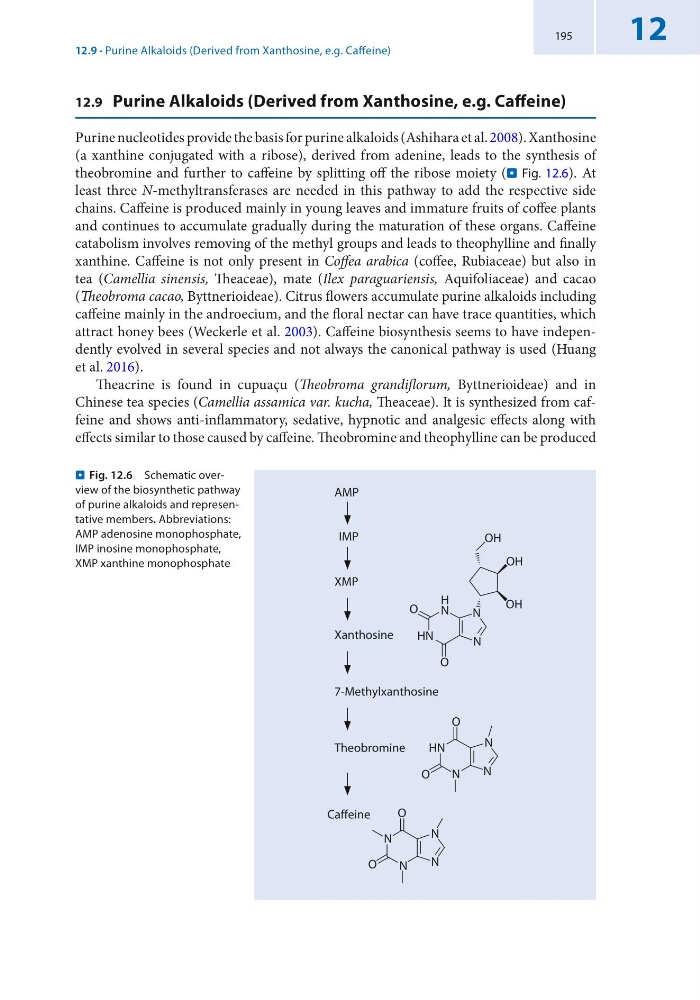
Purine nucleotides provide the basis for purine alkaloids (Ashihara et al. 2008). Xanthosine
(a xanthine conjugated with a ribose), derived from adenine, leads to the synthesis of
theobromine and further to caffeine by splitting off the ribose moiety (. Fig. 12.6). At
least three N-methyltransferases are needed in this pathway to add the respective side
chains. Caffeine is produced mainly in young leaves and immature fruits of coffee plants
and continues to accumulate gradually during the maturation of these organs. Caffeine
catabolism involves removing of the methyl groups and leads to theophylline and finally
xanthine. Caffeine is not only present in Coffea arabica (coffee, Rubiaceae) but also in
tea (Camellia sinensis, Theaceae), mate (Ilex paraguariensis, Aquifoliaceae) and cacao
(Theobroma cacao, Byttnerioideae). Citrus flowers accumulate purine alkaloids including
caffeine mainly in the androecium, and the floral nectar can have trace quantities, which
attract honey bees (Weckerle et al. 2003). Caffeine biosynthesis seems to have independently evolved in several species and not always the canonical pathway is used (Huang
et al. 2016).
Theacrine is found in cupuaçu (Theobroma grandiflorum, Byttnerioideae) and in
Chinese tea species (Camellia assamica var. kucha, Theaceae). It is synthesized from caffeine and shows anti-inflammatory, sedative, hypnotic and analgesic effects along with
effects similar to those caused by caffeine. Theobromine and theophylline can be produced
AMP
IMP
Xanthosine
XMP
7-Methylxanthosine
Theobromine
O
H
N
HN
HN
N
N
N
N
N
N
N
N
N
O
O
O
O
O
OH
OH
OH
Caffeine
. Fig. 12.6 Schematic overview of the biosynthetic pathway
of purine alkaloids and representative members. Abbreviations:
AMP adenosine monophosphate,
IMP inosine monophosphate,
XMP xanthine monophosphate
12.9 · Purine Alkaloids (Derived from Xanthosine, e.g. Caffeine)
12
12.9 Purine Alkaloids (Derived from Xanthosine, e.g. Caffeine)
Purine nucleotides provide the basis for purine alkaloids (Ashihara et al. 2008). Xanthosine
(a xanthine conjugated with a ribose), derived from adenine, leads to the synthesis of
theobromine and further to caffeine by splitting off the ribose moiety (. Fig. 12.6). At
least three N-methyltransferases are needed in this pathway to add the respective side
chains. Caffeine is produced mainly in young leaves and immature fruits of coffee plants
and continues to accumulate gradually during the maturation of these organs. Caffeine
catabolism involves removing of the methyl groups and leads to theophylline and finally
xanthine. Caffeine is not only present in Coffea arabica (coffee, Rubiaceae) but also in
tea (Camellia sinensis, Theaceae), mate (Ilex paraguariensis, Aquifoliaceae) and cacao
(Theobroma cacao, Byttnerioideae). Citrus flowers accumulate purine alkaloids including
caffeine mainly in the androecium, and the floral nectar can have trace quantities, which
attract honey bees (Weckerle et al. 2003). Caffeine biosynthesis seems to have independently evolved in several species and not always the canonical pathway is used (Huang
et al. 2016).
Theacrine is found in cupuaçu (Theobroma grandiflorum, Byttnerioideae) and in
Chinese tea species (Camellia assamica var. kucha, Theaceae). It is synthesized from caffeine and shows anti-inflammatory, sedative, hypnotic and analgesic effects along with
effects similar to those caused by caffeine. Theobromine and theophylline can be produced
AMP
IMP
Xanthosine
XMP
7-Methylxanthosine
Theobromine
O
H
N
HN
HN
N
N
N
N
N
N
N
N
N
O
O
O
O
O
OH
OH
OH
Caffeine
. Fig. 12.6 Schematic overview of the biosynthetic pathway
of purine alkaloids and representative members. Abbreviations:
AMP adenosine monophosphate,
IMP inosine monophosphate,
XMP xanthine monophosphate
12.9 · Purine Alkaloids (Derived from Xanthosine, e.g. Caffeine)