

183
12
synthase (. Fig. 9.2f). This enzyme is localized within the vacuole of leaf epidermis cells,
which means that both, tryptamine and secologanin have to be imported into the vacuole.
In contrast, the MEP pathway genes of Catharanthus roseus were shown to be preferentially expressed in internal phloem-associated parenchyma (IPAP) cells of aerial (above
ground) organs.
Tryptophan
Geraniol
vacuole
T ryptamine
Secologanin
Strictosidineglucoside
Tabersonine
V indoline
Catharanthine
Ajmalicine
Serpentine
Ajmaline
Yohimbine
Reserpine
Strychnine
Campothecine
Quinine
Physostigmine
Ibogaine
V inblastine
Iridoids
Physostigmine
Dimethyltryptamine
Psilocybin
Cathenamine
Strictosidine
SGD
N
H
N
H
N
H
NH 2
COOH
OH
NH 2
–O
O
O
O
O
O
O
O
– Glucose
H
H
O
NH
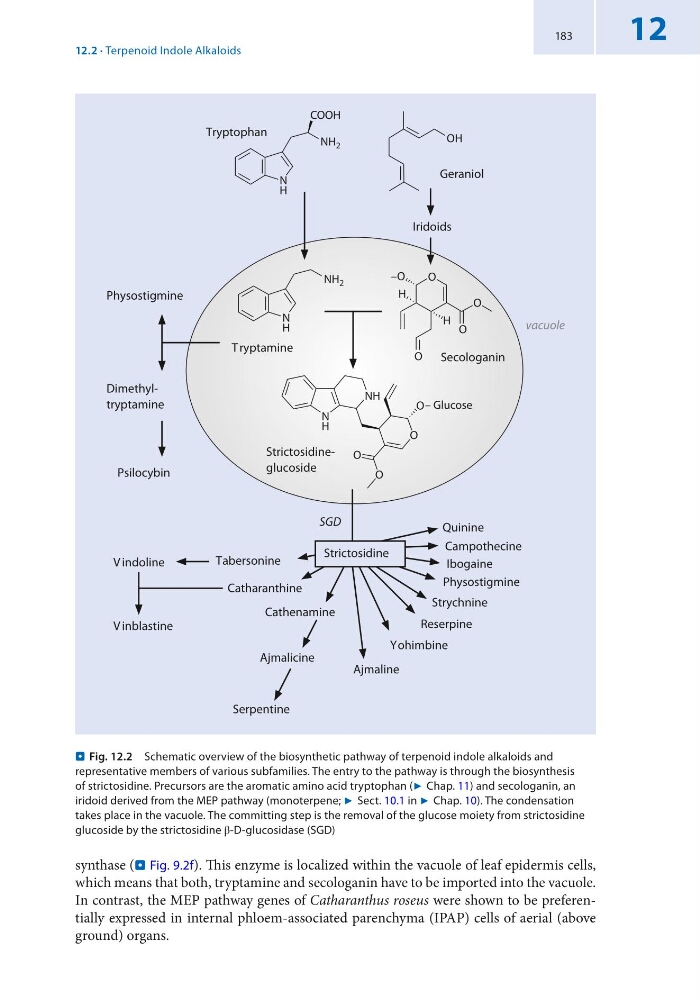
. Fig. 12.2 Schematic overview of the biosynthetic pathway of terpenoid indole alkaloids and
representative members of various subfamilies. The entry to the pathway is through the biosynthesis
of strictosidine. Precursors are the aromatic amino acid tryptophan (7 Chap. 11) and secologanin, an
iridoid derived from the MEP pathway (monoterpene; 7 Sect. 10.1 in 7 Chap. 10). The condensation
takes place in the vacuole. The committing step is the removal of the glucose moiety from strictosidine
glucoside by the strictosidine β-D-glucosidase (SGD)
12.2 · Terpenoid Indole Alkaloids
12
synthase (. Fig. 9.2f). This enzyme is localized within the vacuole of leaf epidermis cells,
which means that both, tryptamine and secologanin have to be imported into the vacuole.
In contrast, the MEP pathway genes of Catharanthus roseus were shown to be preferentially expressed in internal phloem-associated parenchyma (IPAP) cells of aerial (above
ground) organs.
Tryptophan
Geraniol
vacuole
T ryptamine
Secologanin
Strictosidineglucoside
Tabersonine
V indoline
Catharanthine
Ajmalicine
Serpentine
Ajmaline
Yohimbine
Reserpine
Strychnine
Campothecine
Quinine
Physostigmine
Ibogaine
V inblastine
Iridoids
Physostigmine
Dimethyltryptamine
Psilocybin
Cathenamine
Strictosidine
SGD
N
H
N
H
N
H
NH 2
COOH
OH
NH 2
–O
O
O
O
O
O
O
O
– Glucose
H
H
O
NH
. Fig. 12.2 Schematic overview of the biosynthetic pathway of terpenoid indole alkaloids and
representative members of various subfamilies. The entry to the pathway is through the biosynthesis
of strictosidine. Precursors are the aromatic amino acid tryptophan (7 Chap. 11) and secologanin, an
iridoid derived from the MEP pathway (monoterpene; 7 Sect. 10.1 in 7 Chap. 10). The condensation
takes place in the vacuole. The committing step is the removal of the glucose moiety from strictosidine
glucoside by the strictosidine β-D-glucosidase (SGD)
12.2 · Terpenoid Indole Alkaloids