

164
10
(cloves, Myrtaceae), Cannabis sativa (Cannabaceae), Rosmarinus officinalis (rosemary,
Lamiaceae), Piper nigrum (black pepper, Piperaceae) and hops (Humulus lupulus,
Cannabaceae). β-caryophyllene is emitted from plants, e.g. from maize roots that are
attacked by insects. This in turn attracts nematodes that prey on the attacking insect
larvae (Rasmann and Turlings 2016). β-caryophyllene is also an agonist of cannabinoid
receptor type-2 (CB2) in humans, which perhaps contributes to the calming effect of
cloves on toothache (Gertsch et al. 2010; Alberti et al. 2017).
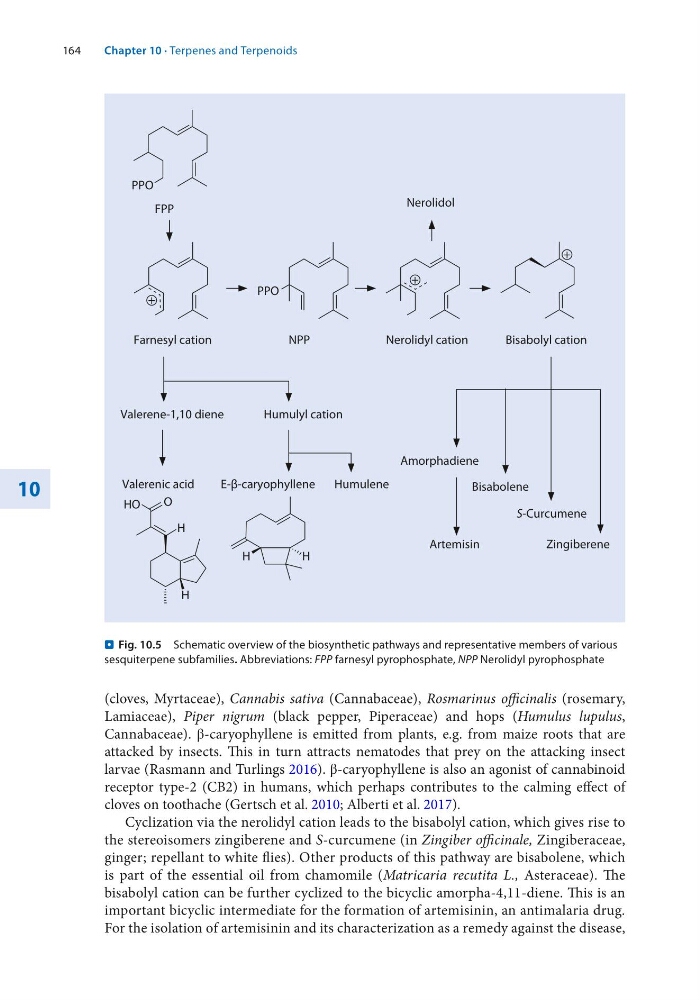
Cyclization via the nerolidyl cation leads to the bisabolyl cation, which gives rise to
the stereoisomers zingiberene and S-curcumene (in Zingiber officinale, Zingiberaceae,
ginger; repellant to white flies). Other products of this pathway are bisabolene, which
is part of the essential oil from chamomile (Matricaria recutita L., Asteraceae). The
bisabolyl cation can be further cyclized to the bicyclic amorpha-4,11-diene. This is an
important bicyclic intermediate for the formation of artemisinin, an antimalaria drug.
For the isolation of artemisinin and its characterization as a remedy against the disease,
FPP
PPO
PPO
NPP
HO
O
H
Farnesyl cation
Nerolidyl cation
B isabolyl cation
Valerenic acid
Valerene-1,10 diene
Humulyl cation
E-β-caryophyllene
Humulene
Nerolidol
Zingiberene
S-Curcumene
Bisabolene
Amorphadiene
Artemisin
+
+
+
H
H
H
. Fig. 10.5 Schematic overview of the biosynthetic pathways and representative members of various
sesquiterpene subfamilies. Abbreviations: FPP farnesyl pyrophosphate, NPP Nerolidyl pyrophosphate
Chapter 10 · Terpenes and Terpenoids
10
(cloves, Myrtaceae), Cannabis sativa (Cannabaceae), Rosmarinus officinalis (rosemary,
Lamiaceae), Piper nigrum (black pepper, Piperaceae) and hops (Humulus lupulus,
Cannabaceae). β-caryophyllene is emitted from plants, e.g. from maize roots that are
attacked by insects. This in turn attracts nematodes that prey on the attacking insect
larvae (Rasmann and Turlings 2016). β-caryophyllene is also an agonist of cannabinoid
receptor type-2 (CB2) in humans, which perhaps contributes to the calming effect of
cloves on toothache (Gertsch et al. 2010; Alberti et al. 2017).
Cyclization via the nerolidyl cation leads to the bisabolyl cation, which gives rise to
the stereoisomers zingiberene and S-curcumene (in Zingiber officinale, Zingiberaceae,
ginger; repellant to white flies). Other products of this pathway are bisabolene, which
is part of the essential oil from chamomile (Matricaria recutita L., Asteraceae). The
bisabolyl cation can be further cyclized to the bicyclic amorpha-4,11-diene. This is an
important bicyclic intermediate for the formation of artemisinin, an antimalaria drug.
For the isolation of artemisinin and its characterization as a remedy against the disease,
FPP
PPO
PPO
NPP
HO
O
H
Farnesyl cation
Nerolidyl cation
B isabolyl cation
Valerenic acid
Valerene-1,10 diene
Humulyl cation
E-β-caryophyllene
Humulene
Nerolidol
Zingiberene
S-Curcumene
Bisabolene
Amorphadiene
Artemisin
+
+
+
H
H
H
. Fig. 10.5 Schematic overview of the biosynthetic pathways and representative members of various
sesquiterpene subfamilies. Abbreviations: FPP farnesyl pyrophosphate, NPP Nerolidyl pyrophosphate
Chapter 10 · Terpenes and Terpenoids