

161
10
10.3 Diterpene (From MEP Pathway, C20, e.g. Salvinorin A
and Ryanodine)
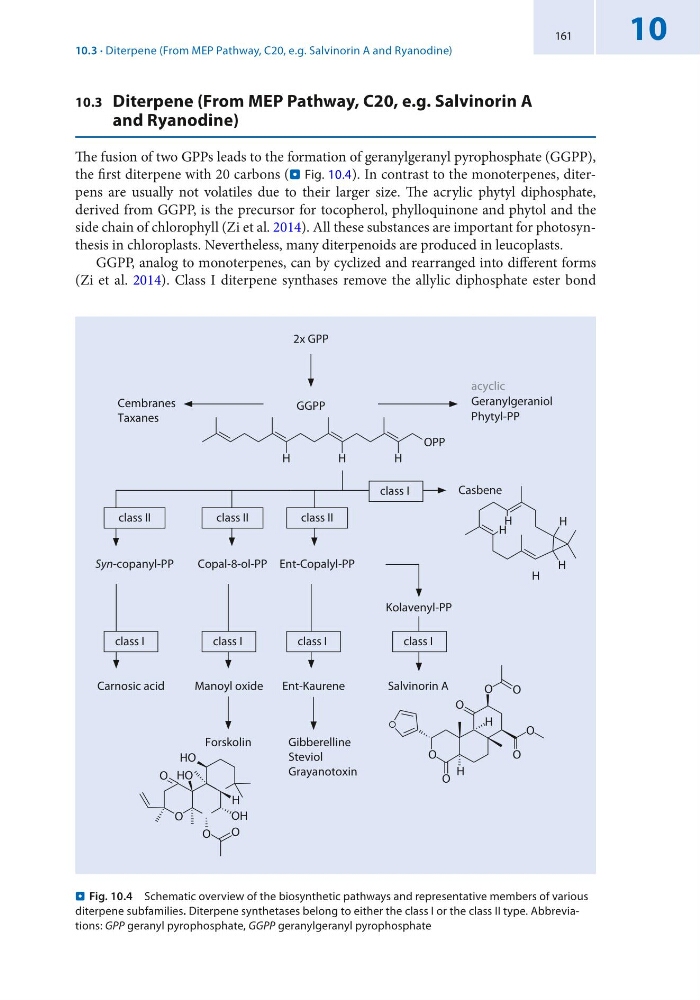
The fusion of two GPPs leads to the formation of geranylgeranyl pyrophosphate (GGPP),
the first diterpene with 20 carbons (. Fig. 10.4). In contrast to the monoterpenes, diterpens are usually not volatiles due to their larger size. The acrylic phytyl diphosphate,
derived from GGPP, is the precursor for tocopherol, phylloquinone and phytol and the
side chain of chlorophyll (Zi et al. 2014). All these substances are important for photosynthesis in chloroplasts. Nevertheless, many diterpenoids are produced in leucoplasts.
GGPP, analog to monoterpenes, can by cyclized and rearranged into different forms
(Zi et al. 2014). Class I diterpene synthases remove the allylic diphosphate ester bond
2x GPP
acyclic
GGPP
Cembranes
Taxanes
Geranylgeraniol
Phytyl-PP
Syn-copanyl-PP
Carnosic acid
Copal-8-ol-PP Ent-Copalyl-PP
Kolavenyl-PP
Manoyl oxide
Ent-Kaurene
Salvinorin A
Forskolin
Gibberelline
Steviol
Grayanotoxin
Casbene
class II
class I
class I
class I
class I
class I
class II
class II
H
H
H
H
H
H
H
H
OPP
O
O
O
O HO
HO
OH
H
O
O
H
H
O
O
O
O
O
. Fig. 10.4 Schematic overview of the biosynthetic pathways and representative members of various
diterpene subfamilies. Diterpene synthetases belong to either the class I or the class II type. Abbreviations: GPP geranyl pyrophosphate, GGPP geranylgeranyl pyrophosphate
10.3 · Diterpene (From MEP Pathway, C20, e.g. Salvinorin A and Ryanodine)
10
10.3 Diterpene (From MEP Pathway, C20, e.g. Salvinorin A
and Ryanodine)
The fusion of two GPPs leads to the formation of geranylgeranyl pyrophosphate (GGPP),
the first diterpene with 20 carbons (. Fig. 10.4). In contrast to the monoterpenes, diterpens are usually not volatiles due to their larger size. The acrylic phytyl diphosphate,
derived from GGPP, is the precursor for tocopherol, phylloquinone and phytol and the
side chain of chlorophyll (Zi et al. 2014). All these substances are important for photosynthesis in chloroplasts. Nevertheless, many diterpenoids are produced in leucoplasts.
GGPP, analog to monoterpenes, can by cyclized and rearranged into different forms
(Zi et al. 2014). Class I diterpene synthases remove the allylic diphosphate ester bond
2x GPP
acyclic
GGPP
Cembranes
Taxanes
Geranylgeraniol
Phytyl-PP
Syn-copanyl-PP
Carnosic acid
Copal-8-ol-PP Ent-Copalyl-PP
Kolavenyl-PP
Manoyl oxide
Ent-Kaurene
Salvinorin A
Forskolin
Gibberelline
Steviol
Grayanotoxin
Casbene
class II
class I
class I
class I
class I
class I
class II
class II
H
H
H
H
H
H
H
H
OPP
O
O
O
O HO
HO
OH
H
O
O
H
H
O
O
O
O
O
. Fig. 10.4 Schematic overview of the biosynthetic pathways and representative members of various
diterpene subfamilies. Diterpene synthetases belong to either the class I or the class II type. Abbreviations: GPP geranyl pyrophosphate, GGPP geranylgeranyl pyrophosphate
10.3 · Diterpene (From MEP Pathway, C20, e.g. Salvinorin A and Ryanodine)