

145
9
fruit is protected from predators by the secondary metabolites or the ripe fruit contains
metabolites to attract distributors (Jaakola 2013; Rodriguez et al. 2013).
9.2 Regulation of the Biosynthesis of Secondary Metabolites
Stresses such as drought, extreme temperatures, salinity and high light or UV light modulate the responses that lead to the accumulation of secondary metabolites. However,
defence mechanisms against herbivores and other predators seem to constitute the strongest inducers of secondary metabolite production. For their regulation, the hormone jasmonate (JA) plays a pivotal role (Memelink 2009; Zhou and Memelink 2016). Upon
contact with pathogens, the endogenous JA levels rise. Furthermore, JA is described as a
volatile that can also act on neighbouring plants or more distant plant parts without using
internal transport pathways, for instance, through the phloem. JA, by registering the presence or absence of specific stresses, is one of the factors that allow balancing defence sysPhloem
Xylem
Laticifers
(sieve cells,
companion cells)
Phloem
Xylem
Cortex
Pericycle
Endodermis
Epidermis cell
Cuticula
Glandular trichome
Stigma
Floral
nectaries
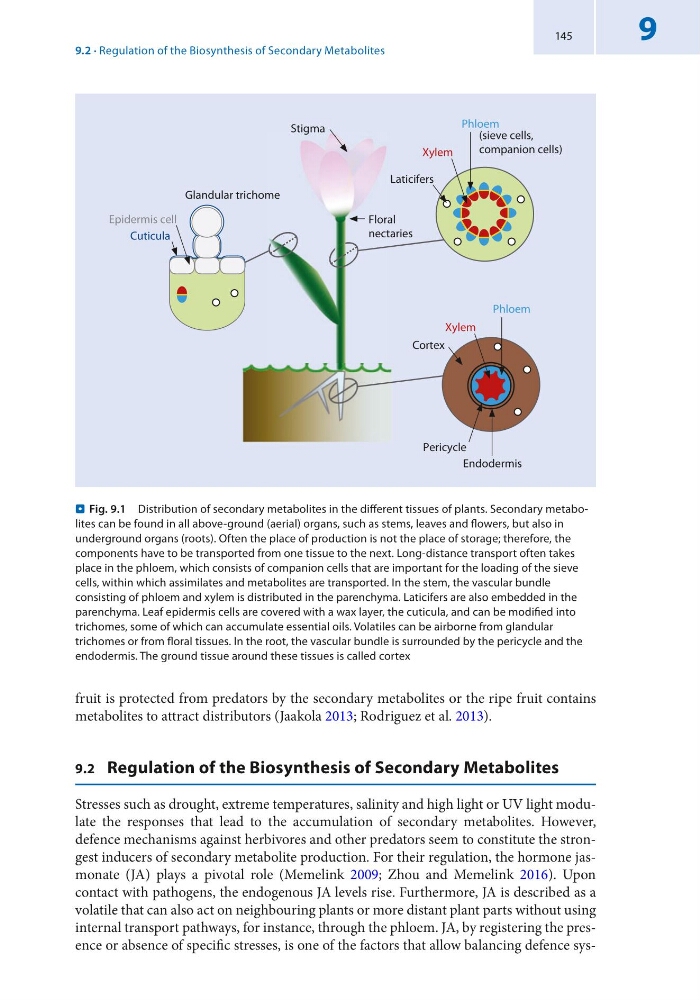
. Fig. 9.1 Distribution of secondary metabolites in the different tissues of plants. Secondary metabolites can be found in all above-ground (aerial) organs, such as stems, leaves and flowers, but also in
underground organs (roots). Often the place of production is not the place of storage; therefore, the
components have to be transported from one tissue to the next. Long-distance transport often takes
place in the phloem, which consists of companion cells that are important for the loading of the sieve
cells, within which assimilates and metabolites are transported. In the stem, the vascular bundle
consisting of phloem and xylem is distributed in the parenchyma. Laticifers are also embedded in the
parenchyma. Leaf epidermis cells are covered with a wax layer, the cuticula, and can be modified into
trichomes, some of which can accumulate essential oils. Volatiles can be airborne from glandular
trichomes or from floral tissues. In the root, the vascular bundle is surrounded by the pericycle and the
endodermis. The ground tissue around these tissues is called cortex
9.2 · Regulation of the Biosynthesis of Secondary Metabolites
9
fruit is protected from predators by the secondary metabolites or the ripe fruit contains
metabolites to attract distributors (Jaakola 2013; Rodriguez et al. 2013).
9.2 Regulation of the Biosynthesis of Secondary Metabolites
Stresses such as drought, extreme temperatures, salinity and high light or UV light modulate the responses that lead to the accumulation of secondary metabolites. However,
defence mechanisms against herbivores and other predators seem to constitute the strongest inducers of secondary metabolite production. For their regulation, the hormone jasmonate (JA) plays a pivotal role (Memelink 2009; Zhou and Memelink 2016). Upon
contact with pathogens, the endogenous JA levels rise. Furthermore, JA is described as a
volatile that can also act on neighbouring plants or more distant plant parts without using
internal transport pathways, for instance, through the phloem. JA, by registering the presence or absence of specific stresses, is one of the factors that allow balancing defence sysPhloem
Xylem
Laticifers
(sieve cells,
companion cells)
Phloem
Xylem
Cortex
Pericycle
Endodermis
Epidermis cell
Cuticula
Glandular trichome
Stigma
Floral
nectaries
. Fig. 9.1 Distribution of secondary metabolites in the different tissues of plants. Secondary metabolites can be found in all above-ground (aerial) organs, such as stems, leaves and flowers, but also in
underground organs (roots). Often the place of production is not the place of storage; therefore, the
components have to be transported from one tissue to the next. Long-distance transport often takes
place in the phloem, which consists of companion cells that are important for the loading of the sieve
cells, within which assimilates and metabolites are transported. In the stem, the vascular bundle
consisting of phloem and xylem is distributed in the parenchyma. Laticifers are also embedded in the
parenchyma. Leaf epidermis cells are covered with a wax layer, the cuticula, and can be modified into
trichomes, some of which can accumulate essential oils. Volatiles can be airborne from glandular
trichomes or from floral tissues. In the root, the vascular bundle is surrounded by the pericycle and the
endodermis. The ground tissue around these tissues is called cortex
9.2 · Regulation of the Biosynthesis of Secondary Metabolites