

136
8
Menthol also has analgesic properties; however, in contrast to capsaicin, they are not
related to its interaction with the TRPV1 receptor but because it also activates κ-opioid
receptors (Galeotti et al. 2002). Mint oil can also be used as a natural pesticide, but this is
rather due to its pulegone and menthone content, both of which have been identified as the
major cause for its insecticidal and genotoxic properties, respectively (Franzios et al. 1997).
So, what is the role of these TRPM8 agonists for the plants? It has been suggested that
as part of herbivore-induced plant volatiles, menthol can help to attract natural enemies of
insect herbivores. Furthermore, it was shown recently for Arabidopsis that menthol was
part of those volatiles that that were emitted upon Lipaphis erysimi Kaltenbach infestation.
In this case, these volatiles did not attract an enemy of the aphid but instead increased the
performance of the entomopathogenic fungus Lecanicillium lecanii (Lin et al. 2017),
thereby helping the plant to fight off the herbivore attack.
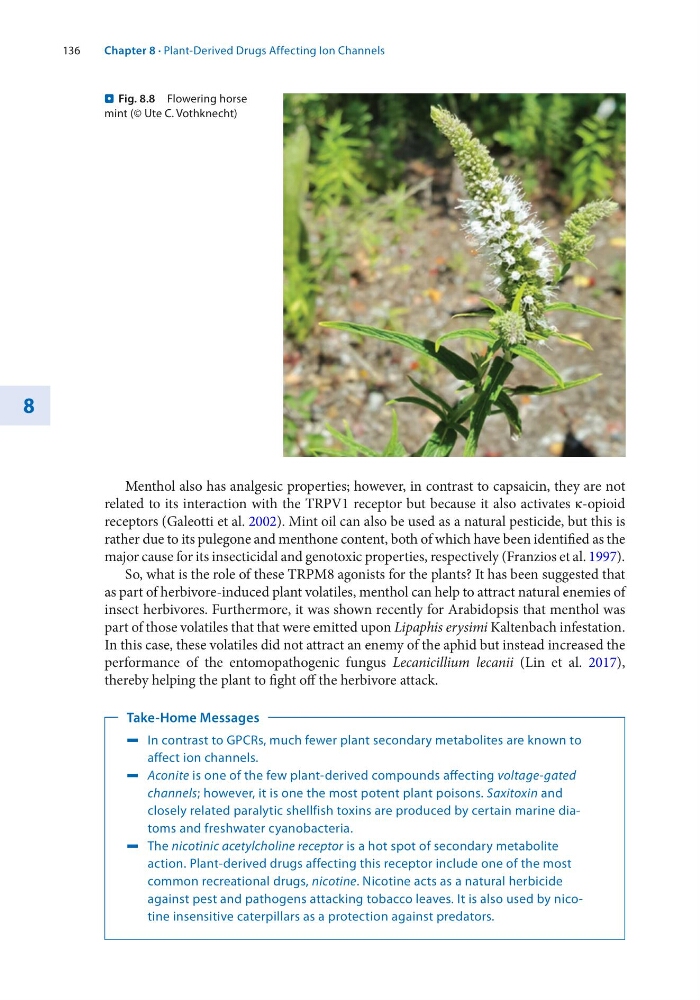
. Fig. 8.8 Flowering horse
mint (© Ute C. Vothknecht)
Take-Home Messages
5 In contrast to GPCRs, much fewer plant secondary metabolites are known to
affect ion channels.
5 Aconite is one of the few plant-derived compounds affecting voltage-gated
channels; however, it is one the most potent plant poisons. Saxitoxin and
closely related paralytic shellfish toxins are produced by certain marine diatoms and freshwater cyanobacteria.
5 The nicotinic acetylcholine receptor is a hot spot of secondary metabolite
action. Plant- derived drugs affecting this receptor include one of the most
common recreational drugs, nicotine. Nicotine acts as a natural herbicide
against pest and pathogens attacking tobacco leaves. It is also used by nicotine insensitive caterpillars as a protection against predators.
Chapter 8 · Plant-Derived Drugs Affecting Ion Channels
8
Menthol also has analgesic properties; however, in contrast to capsaicin, they are not
related to its interaction with the TRPV1 receptor but because it also activates κ-opioid
receptors (Galeotti et al. 2002). Mint oil can also be used as a natural pesticide, but this is
rather due to its pulegone and menthone content, both of which have been identified as the
major cause for its insecticidal and genotoxic properties, respectively (Franzios et al. 1997).
So, what is the role of these TRPM8 agonists for the plants? It has been suggested that
as part of herbivore-induced plant volatiles, menthol can help to attract natural enemies of
insect herbivores. Furthermore, it was shown recently for Arabidopsis that menthol was
part of those volatiles that that were emitted upon Lipaphis erysimi Kaltenbach infestation.
In this case, these volatiles did not attract an enemy of the aphid but instead increased the
performance of the entomopathogenic fungus Lecanicillium lecanii (Lin et al. 2017),
thereby helping the plant to fight off the herbivore attack.
. Fig. 8.8 Flowering horse
mint (© Ute C. Vothknecht)
Take-Home Messages
5 In contrast to GPCRs, much fewer plant secondary metabolites are known to
affect ion channels.
5 Aconite is one of the few plant-derived compounds affecting voltage-gated
channels; however, it is one the most potent plant poisons. Saxitoxin and
closely related paralytic shellfish toxins are produced by certain marine diatoms and freshwater cyanobacteria.
5 The nicotinic acetylcholine receptor is a hot spot of secondary metabolite
action. Plant- derived drugs affecting this receptor include one of the most
common recreational drugs, nicotine. Nicotine acts as a natural herbicide
against pest and pathogens attacking tobacco leaves. It is also used by nicotine insensitive caterpillars as a protection against predators.
Chapter 8 · Plant-Derived Drugs Affecting Ion Channels