

134
8
2010). For example, the use of Naga chilli (C. chinense Jacq.) is well described in India as
herbal medicine to treat ailments such as tooth ache or muscle pain. Until today, capsaicin
is used as an analgesic in many ointments. It was suggested that its function as pain reliever
is caused by desensitization of the TRPV1 receptor by constant activation. This might also
explain other uses of capsaicin as treatment for certain inflammatory diseases, since malfunction of the TRPV1 receptors is believed to be the cause for these afflictions. Capsaicin
is also on the Olympic list of forbidden substances for horses. This is due to the effect of
hypersensitization of the TRPV1 receptor, which increases the animals loathing of touching the obstacles and is thus considered a doping offence. It can also be a doping offence
due to its pain-relieving properties.
So how does the plant profit from the presence of such a pain-inducing substance?
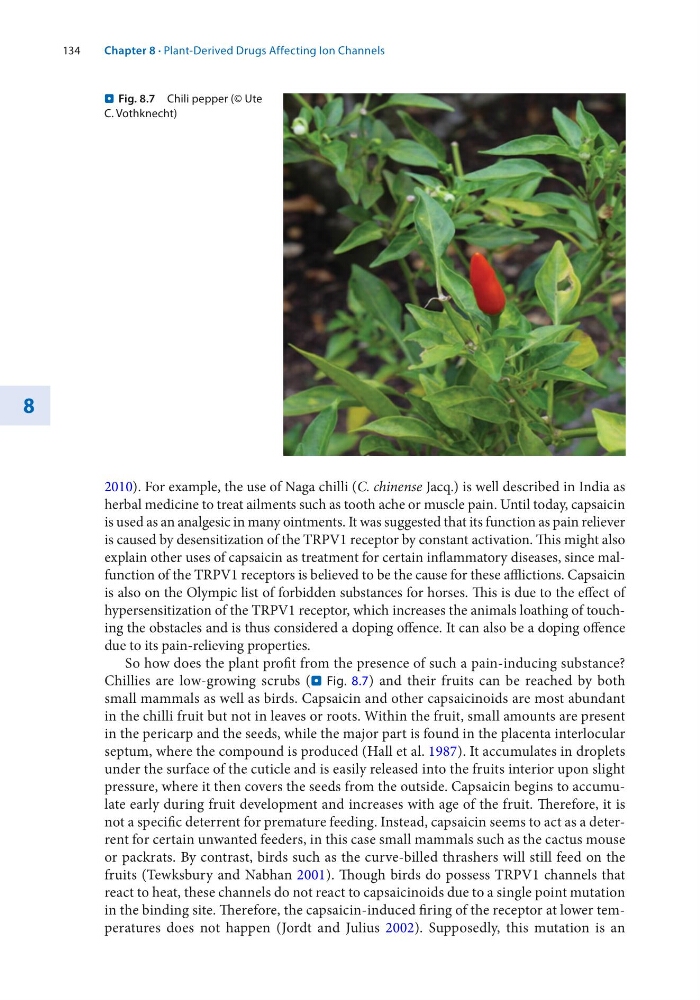
Chillies are low-growing scrubs (. Fig. 8.7) and their fruits can be reached by both
small mammals as well as birds. Capsaicin and other capsaicinoids are most abundant
in the chilli fruit but not in leaves or roots. Within the fruit, small amounts are present
in the pericarp and the seeds, while the major part is found in the placenta interlocular
septum, where the compound is produced (Hall et al. 1987). It accumulates in droplets
under the surface of the cuticle and is easily released into the fruits interior upon slight
pressure, where it then covers the seeds from the outside. Capsaicin begins to accumulate early during fruit development and increases with age of the fruit. Therefore, it is
not a specific deterrent for premature feeding. Instead, capsaicin seems to act as a deterrent for certain unwanted feeders, in this case small mammals such as the cactus mouse
or packrats. By contrast, birds such as the curve-billed thrashers will still feed on the
fruits (Tewksbury and Nabhan 2001). Though birds do possess TRPV1 channels that
react to heat, these channels do not react to capsaicinoids due to a single point mutation
in the binding site. Therefore, the capsaicin-induced firing of the receptor at lower temperatures does not happen (Jordt and Julius 2002). Supposedly, this mutation is an
. Fig. 8.7 Chili pepper (© Ute
C. Vothknecht)
Chapter 8 · Plant-Derived Drugs Affecting Ion Channels
8
2010). For example, the use of Naga chilli (C. chinense Jacq.) is well described in India as
herbal medicine to treat ailments such as tooth ache or muscle pain. Until today, capsaicin
is used as an analgesic in many ointments. It was suggested that its function as pain reliever
is caused by desensitization of the TRPV1 receptor by constant activation. This might also
explain other uses of capsaicin as treatment for certain inflammatory diseases, since malfunction of the TRPV1 receptors is believed to be the cause for these afflictions. Capsaicin
is also on the Olympic list of forbidden substances for horses. This is due to the effect of
hypersensitization of the TRPV1 receptor, which increases the animals loathing of touching the obstacles and is thus considered a doping offence. It can also be a doping offence
due to its pain-relieving properties.
So how does the plant profit from the presence of such a pain-inducing substance?
Chillies are low-growing scrubs (. Fig. 8.7) and their fruits can be reached by both
small mammals as well as birds. Capsaicin and other capsaicinoids are most abundant
in the chilli fruit but not in leaves or roots. Within the fruit, small amounts are present
in the pericarp and the seeds, while the major part is found in the placenta interlocular
septum, where the compound is produced (Hall et al. 1987). It accumulates in droplets
under the surface of the cuticle and is easily released into the fruits interior upon slight
pressure, where it then covers the seeds from the outside. Capsaicin begins to accumulate early during fruit development and increases with age of the fruit. Therefore, it is
not a specific deterrent for premature feeding. Instead, capsaicin seems to act as a deterrent for certain unwanted feeders, in this case small mammals such as the cactus mouse
or packrats. By contrast, birds such as the curve-billed thrashers will still feed on the
fruits (Tewksbury and Nabhan 2001). Though birds do possess TRPV1 channels that
react to heat, these channels do not react to capsaicinoids due to a single point mutation
in the binding site. Therefore, the capsaicin-induced firing of the receptor at lower temperatures does not happen (Jordt and Julius 2002). Supposedly, this mutation is an
. Fig. 8.7 Chili pepper (© Ute
C. Vothknecht)
Chapter 8 · Plant-Derived Drugs Affecting Ion Channels