

130
8
8.4 Glycine Receptors: Strychnine and Tutin
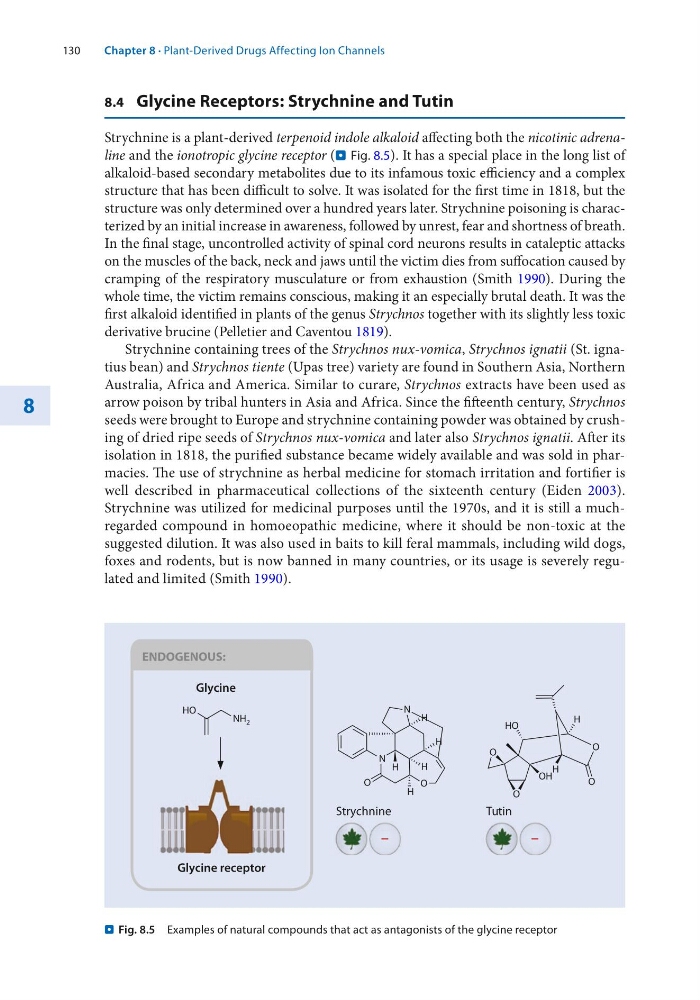
Strychnine is a plant-derived terpenoid indole alkaloid affecting both the nicotinic adrenaline and the ionotropic glycine receptor (. Fig. 8.5). It has a special place in the long list of
alkaloid- based secondary metabolites due to its infamous toxic efficiency and a complex
structure that has been difficult to solve. It was isolated for the first time in 1818, but the
structure was only determined over a hundred years later. Strychnine poisoning is characterized by an initial increase in awareness, followed by unrest, fear and shortness of breath.
In the final stage, uncontrolled activity of spinal cord neurons results in cataleptic attacks
on the muscles of the back, neck and jaws until the victim dies from suffocation caused by
cramping of the respiratory musculature or from exhaustion (Smith 1990). During the
whole time, the victim remains conscious, making it an especially brutal death. It was the
first alkaloid identified in plants of the genus Strychnos together with its slightly less toxic
derivative brucine (Pelletier and Caventou 1819).
Strychnine containing trees of the Strychnos nux-vomica, Strychnos ignatii (St. ignatius bean) and Strychnos tiente (Upas tree) variety are found in Southern Asia, Northern
Australia, Africa and America. Similar to curare, Strychnos extracts have been used as
arrow poison by tribal hunters in Asia and Africa. Since the fifteenth century, Strychnos
seeds were brought to Europe and strychnine containing powder was obtained by crushing of dried ripe seeds of Strychnos nux-vomica and later also Strychnos ignatii. After its
isolation in 1818, the purified substance became widely available and was sold in pharmacies. The use of strychnine as herbal medicine for stomach irritation and fortifier is
well described in pharmaceutical collections of the sixteenth century (Eiden 2003).
Strychnine was utilized for medicinal purposes until the 1970s, and it is still a muchregarded compound in homoeopathic medicine, where it should be non-toxic at the
suggested dilution. It was also used in baits to kill feral mammals, including wild dogs,
foxes and rodents, but is now banned in many countries, or its usage is severely regulated and limited (Smith 1990).
Tutin
-
Glycine receptor
Glycine
ENDOGENOUS:
Strychnine
-
HO
O
O
O
O
O
O
H
H
HO
OH
H
H
H
H
H
N
N
NH 2
. Fig. 8.5 Examples of natural compounds that act as antagonists of the glycine receptor
Chapter 8 · Plant-Derived Drugs Affecting Ion Channels
8
8.4 Glycine Receptors: Strychnine and Tutin
Strychnine is a plant-derived terpenoid indole alkaloid affecting both the nicotinic adrenaline and the ionotropic glycine receptor (. Fig. 8.5). It has a special place in the long list of
alkaloid- based secondary metabolites due to its infamous toxic efficiency and a complex
structure that has been difficult to solve. It was isolated for the first time in 1818, but the
structure was only determined over a hundred years later. Strychnine poisoning is characterized by an initial increase in awareness, followed by unrest, fear and shortness of breath.
In the final stage, uncontrolled activity of spinal cord neurons results in cataleptic attacks
on the muscles of the back, neck and jaws until the victim dies from suffocation caused by
cramping of the respiratory musculature or from exhaustion (Smith 1990). During the
whole time, the victim remains conscious, making it an especially brutal death. It was the
first alkaloid identified in plants of the genus Strychnos together with its slightly less toxic
derivative brucine (Pelletier and Caventou 1819).
Strychnine containing trees of the Strychnos nux-vomica, Strychnos ignatii (St. ignatius bean) and Strychnos tiente (Upas tree) variety are found in Southern Asia, Northern
Australia, Africa and America. Similar to curare, Strychnos extracts have been used as
arrow poison by tribal hunters in Asia and Africa. Since the fifteenth century, Strychnos
seeds were brought to Europe and strychnine containing powder was obtained by crushing of dried ripe seeds of Strychnos nux-vomica and later also Strychnos ignatii. After its
isolation in 1818, the purified substance became widely available and was sold in pharmacies. The use of strychnine as herbal medicine for stomach irritation and fortifier is
well described in pharmaceutical collections of the sixteenth century (Eiden 2003).
Strychnine was utilized for medicinal purposes until the 1970s, and it is still a muchregarded compound in homoeopathic medicine, where it should be non-toxic at the
suggested dilution. It was also used in baits to kill feral mammals, including wild dogs,
foxes and rodents, but is now banned in many countries, or its usage is severely regulated and limited (Smith 1990).
Tutin
-
Glycine receptor
Glycine
ENDOGENOUS:
Strychnine
-
HO
O
O
O
O
O
O
H
H
HO
OH
H
H
H
H
H
N
N
NH 2
. Fig. 8.5 Examples of natural compounds that act as antagonists of the glycine receptor
Chapter 8 · Plant-Derived Drugs Affecting Ion Channels