

122
8
What You Will Learn in This Chapter
Compared to GPCRs, the set of plant-derived compounds that target ion channels appears
much more limited. For voltage-gated channels, most known toxins are derived from animals such as snails, spiders and snakes. Also, many ligand-gated channels are targeted by
few to none known plant-derived drugs. Nevertheless, ion channels are the target of some
of the most potent plant poisons and most commonly used plant-derived drugs.
8.1 Voltage-Gated Ion Channels: Aconitine, Saxitoxin
and Ryanodine
While there are several non-plant toxins that affect voltage-gated ion channels, the number
of plant secondary metabolites known to inhibit these channels is rather small. However,
one of the most potent plant poisons, the terpenoid alkaloid aconitine, targets voltage-gated
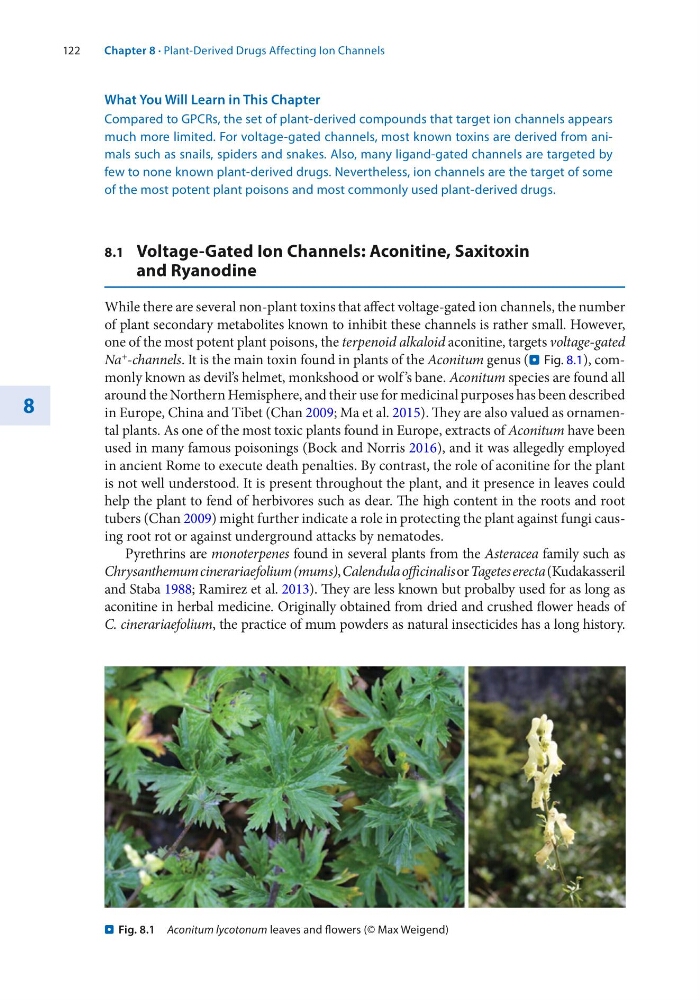
Na + -channels. It is the main toxin found in plants of the Aconitum genus (. Fig. 8.1), commonly known as devil’s helmet, monkshood or wolf ’s bane. Aconitum species are found all
around the Northern Hemisphere, and their use for medicinal purposes has been described
in Europe, China and Tibet (Chan 2009; Ma et al. 2015). They are also valued as ornamental plants. As one of the most toxic plants found in Europe, extracts of Aconitum have been
used in many famous poisonings (Bock and Norris 2016), and it was allegedly employed
in ancient Rome to execute death penalties. By contrast, the role of aconitine for the plant
is not well understood. It is present throughout the plant, and it presence in leaves could
help the plant to fend of herbivores such as dear. The high content in the roots and root
tubers (Chan 2009) might further indicate a role in protecting the plant against fungi causing root rot or against underground attacks by nematodes.
Pyrethrins are monoterpenes found in several plants from the Asteracea family such as
Chrysanthemum cinerariaefolium (mums), Calendula officinalis or Tagetes erecta (Kudakasseril
and Staba 1988; Ramirez et al. 2013). They are less known but probalby used for as long as
aconitine in herbal medicine. Originally obtained from dried and crushed flower heads of
C. cinerariaefolium, the practice of mum powders as natural insecticides has a long history.
. Fig. 8.1 Aconitum lycotonum leaves and flowers (© Max Weigend)
Chapter 8 · Plant-Derived Drugs Affecting Ion Channels
8
What You Will Learn in This Chapter
Compared to GPCRs, the set of plant-derived compounds that target ion channels appears
much more limited. For voltage-gated channels, most known toxins are derived from animals such as snails, spiders and snakes. Also, many ligand-gated channels are targeted by
few to none known plant-derived drugs. Nevertheless, ion channels are the target of some
of the most potent plant poisons and most commonly used plant-derived drugs.
8.1 Voltage-Gated Ion Channels: Aconitine, Saxitoxin
and Ryanodine
While there are several non-plant toxins that affect voltage-gated ion channels, the number
of plant secondary metabolites known to inhibit these channels is rather small. However,
one of the most potent plant poisons, the terpenoid alkaloid aconitine, targets voltage-gated
Na + -channels. It is the main toxin found in plants of the Aconitum genus (. Fig. 8.1), commonly known as devil’s helmet, monkshood or wolf ’s bane. Aconitum species are found all
around the Northern Hemisphere, and their use for medicinal purposes has been described
in Europe, China and Tibet (Chan 2009; Ma et al. 2015). They are also valued as ornamental plants. As one of the most toxic plants found in Europe, extracts of Aconitum have been
used in many famous poisonings (Bock and Norris 2016), and it was allegedly employed
in ancient Rome to execute death penalties. By contrast, the role of aconitine for the plant
is not well understood. It is present throughout the plant, and it presence in leaves could
help the plant to fend of herbivores such as dear. The high content in the roots and root
tubers (Chan 2009) might further indicate a role in protecting the plant against fungi causing root rot or against underground attacks by nematodes.
Pyrethrins are monoterpenes found in several plants from the Asteracea family such as
Chrysanthemum cinerariaefolium (mums), Calendula officinalis or Tagetes erecta (Kudakasseril
and Staba 1988; Ramirez et al. 2013). They are less known but probalby used for as long as
aconitine in herbal medicine. Originally obtained from dried and crushed flower heads of
C. cinerariaefolium, the practice of mum powders as natural insecticides has a long history.
. Fig. 8.1 Aconitum lycotonum leaves and flowers (© Max Weigend)
Chapter 8 · Plant-Derived Drugs Affecting Ion Channels