

114
7
Morphine was also the first alkaloid to have ever being isolated when in 1804 the German
chemist Friedrich Sertürner succeeded with its extraction. Due to its medicinal properties,
he called it “morphium” in honour of Morpheus, the Greek god of dreams (Serturner 1805).
Opiates are not present throughout all parts of the poppy plant, but they rather accumulate in the latex, the cytoplasm of specialized internal secretory cells called laticifers that
are closely associated with vascular bundles (Kutchan et al. 1985). Opiate synthesis is an
excellent example for cellular compartmentalization of synthesis pathways (see 7 Chap. 1).
Immunolocalization of different enzymes involved in morphine biosynthesis together with
shotgun proteomics data indicates that early synthesis steps up to thebaine take place in
sieve elements of the phloem (Onoyovwe et al. 2013; Weid et al. 2004). While the synthesis
of morphine and codeine can be finalized in the sieve cell, the later stages predominantly
take place in adjoining laticifers, where the compounds are then stored.
The function of morphine (and other opiates) for the poppy plant is not well understood.
It is not even clear whether the psychoactive properties of morphine are part of a defence
mechanism. It is known that after morphium is released from the laticifers upon mechanical
damage, it undergoes oxidation and dimerization to bismorphine (Morimoto et al. 2001).
Bismorphine can cross-link pectin, thereby making it more stable against hydrolysis, indicating a role of morphine in protection against mechanical damage.
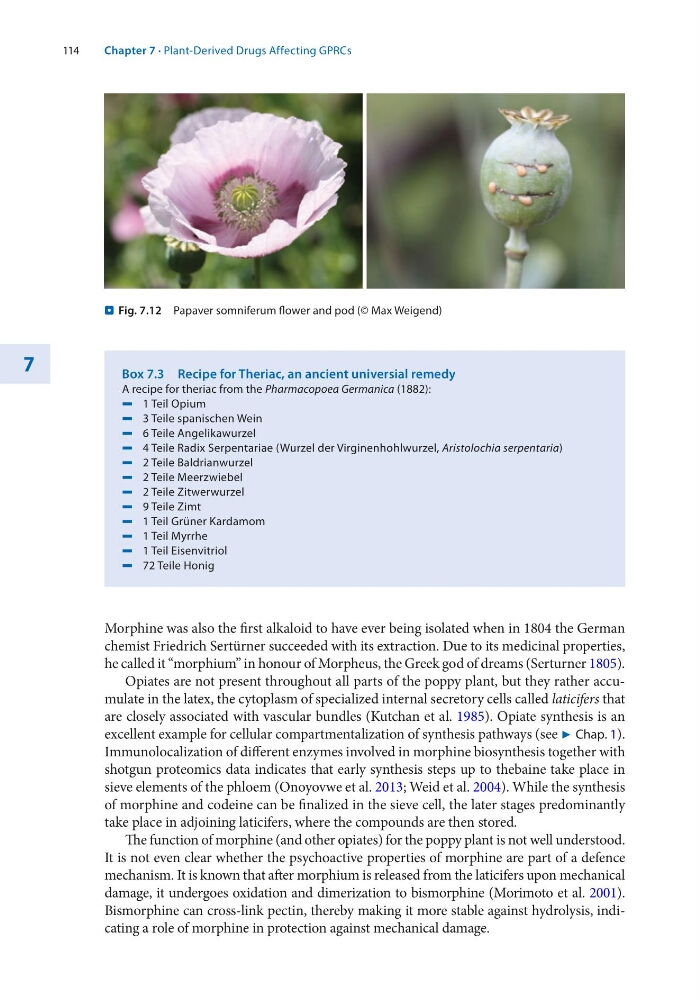
. Fig. 7.12 Papaver somniferum flower and pod (© Max Weigend)
Box 7.3 Recipe for Theriac, an ancient universial remedy
A recipe for theriac from the Pharmacopoea Germanica (1882):
5 1 Teil Opium
5 3 Teile spanischen Wein
5 6 Teile Angelikawurzel
5 4 Teile Radix Serpentariae (Wurzel der Virginenhohlwurzel, Aristolochia serpentaria)
5 2 Teile Baldrianwurzel
5 2 Teile Meerzwiebel
5 2 Teile Zitwerwurzel
5 9 Teile Zimt
5 1 Teil Grüner Kardamom
5 1 Teil Myrrhe
5 1 Teil Eisenvitriol
5 72 Teile Honig
Chapter 7 · Plant-Derived Drugs Affecting GPRCs
7
Morphine was also the first alkaloid to have ever being isolated when in 1804 the German
chemist Friedrich Sertürner succeeded with its extraction. Due to its medicinal properties,
he called it “morphium” in honour of Morpheus, the Greek god of dreams (Serturner 1805).
Opiates are not present throughout all parts of the poppy plant, but they rather accumulate in the latex, the cytoplasm of specialized internal secretory cells called laticifers that
are closely associated with vascular bundles (Kutchan et al. 1985). Opiate synthesis is an
excellent example for cellular compartmentalization of synthesis pathways (see 7 Chap. 1).
Immunolocalization of different enzymes involved in morphine biosynthesis together with
shotgun proteomics data indicates that early synthesis steps up to thebaine take place in
sieve elements of the phloem (Onoyovwe et al. 2013; Weid et al. 2004). While the synthesis
of morphine and codeine can be finalized in the sieve cell, the later stages predominantly
take place in adjoining laticifers, where the compounds are then stored.
The function of morphine (and other opiates) for the poppy plant is not well understood.
It is not even clear whether the psychoactive properties of morphine are part of a defence
mechanism. It is known that after morphium is released from the laticifers upon mechanical
damage, it undergoes oxidation and dimerization to bismorphine (Morimoto et al. 2001).
Bismorphine can cross-link pectin, thereby making it more stable against hydrolysis, indicating a role of morphine in protection against mechanical damage.
. Fig. 7.12 Papaver somniferum flower and pod (© Max Weigend)
Box 7.3 Recipe for Theriac, an ancient universial remedy
A recipe for theriac from the Pharmacopoea Germanica (1882):
5 1 Teil Opium
5 3 Teile spanischen Wein
5 6 Teile Angelikawurzel
5 4 Teile Radix Serpentariae (Wurzel der Virginenhohlwurzel, Aristolochia serpentaria)
5 2 Teile Baldrianwurzel
5 2 Teile Meerzwiebel
5 2 Teile Zitwerwurzel
5 9 Teile Zimt
5 1 Teil Grüner Kardamom
5 1 Teil Myrrhe
5 1 Teil Eisenvitriol
5 72 Teile Honig
Chapter 7 · Plant-Derived Drugs Affecting GPRCs