

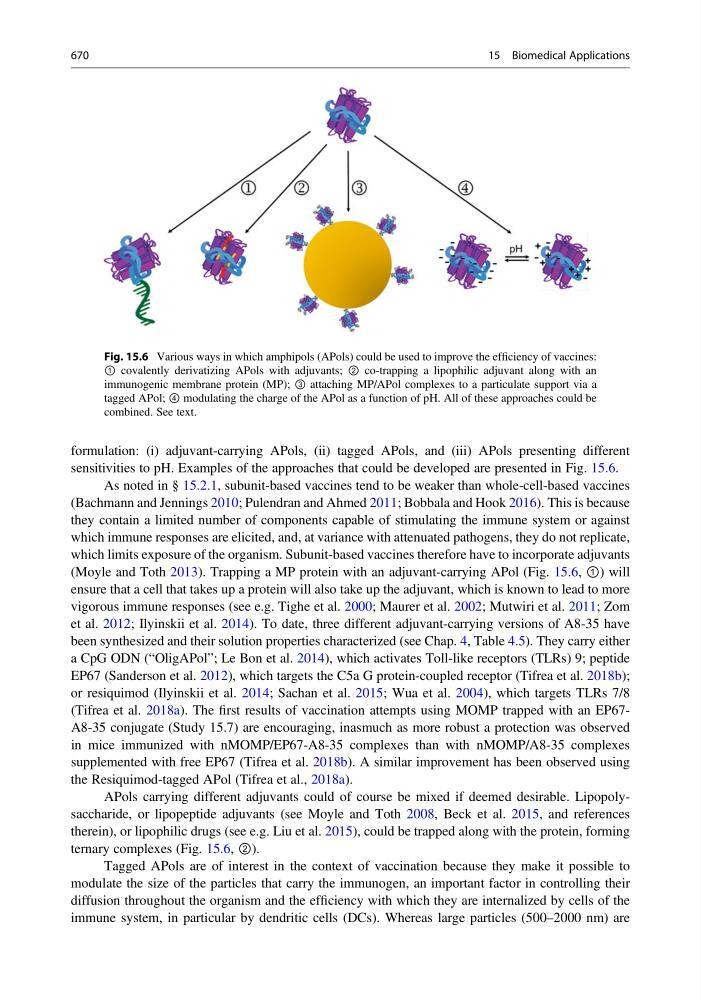
formulation: (i) adjuvant-carrying APols, (ii) tagged APols, and (iii) APols presenting different
sensitivities to pH. Examples of the approaches that could be developed are presented in Fig. 15.6.
As noted in § 15.2.1, subunit-based vaccines tend to be weaker than whole-cell-based vaccines
(Bachmann and Jennings 2010; Pulendran and Ahmed 2011; Bobbala and Hook 2016). This is because
they contain a limited number of components capable of stimulating the immune system or against
which immune responses are elicited, and, at variance with attenuated pathogens, they do not replicate,
which limits exposure of the organism. Subunit-based vaccines therefore have to incorporate adjuvants
(Moyle and Toth 2013). Trapping a MP protein with an adjuvant-carrying APol (Fig. 15.6, ①) will
ensure that a cell that takes up a protein will also take up the adjuvant, which is known to lead to more
vigorous immune responses (see e.g. Tighe et al. 2000; Maurer et al. 2002; Mutwiri et al. 2011; Zom
et al. 2012; Ilyinskii et al. 2014). To date, three different adjuvant-carrying versions of A8-35 have
been synthesized and their solution properties characterized (see Chap. 4, Table 4.5). They carry either
a CpG ODN (“OligAPol”; Le Bon et al. 2014), which activates Toll-like receptors (TLRs) 9; peptide
EP67 (Sanderson et al. 2012), which targets the C5a G protein-coupled receptor (Tifrea et al. 2018b);
or resiquimod (Ilyinskii et al. 2014; Sachan et al. 2015; Wua et al. 2004), which targets TLRs 7/8
(Tifrea et al. 2018a). The first results of vaccination attempts using MOMP trapped with an EP67A8-35 conjugate (Study 15.7) are encouraging, inasmuch as more robust a protection was observed
in mice immunized with nMOMP/EP67-A8-35 complexes than with nMOMP/A8-35 complexes
supplemented with free EP67 (Tifrea et al. 2018b). A similar improvement has been observed using
the Resiquimod-tagged APol (Tifrea et al., 2018a).
APols carrying different adjuvants could of course be mixed if deemed desirable. Lipopolysaccharide, or lipopeptide adjuvants (see Moyle and Toth 2008, Beck et al. 2015, and references
therein), or lipophilic drugs (see e.g. Liu et al. 2015), could be trapped along with the protein, forming
ternary complexes (Fig. 15.6, ②).
Tagged APols are of interest in the context of vaccination because they make it possible to
modulate the size of the particles that carry the immunogen, an important factor in controlling their
diffusion throughout the organism and the efficiency with which they are internalized by cells of the
immune system, in particular by dendritic cells (DCs). Whereas large particles (500–2000 nm) are
Fig. 15.6 Various ways in which amphipols (APols) could be used to improve the efficiency of vaccines:
① covalently derivatizing APols with adjuvants; ② co-trapping a lipophilic adjuvant along with an
immunogenic membrane protein (MP); ③ attaching MP/APol complexes to a particulate support via a
tagged APol; ④ modulating the charge of the APol as a function of pH. All of these approaches could be
combined. See text.
670
15 Biomedical Applications