

12.4 Protocol 12.1: Preparation of Amphipol-Trapped Membrane Proteins
for Cryo-EM Studies
12.4.1 Introduction
Recent advancements in single-particle cryo-EM, collectively termed the “resolution revolution,” have
made it possible to determine near-atomic resolution structures of a number of MPs, including ion
channels (see above, § 12.2.3, and Table 12.1). To characterize MPs using structural methods,
including cryo-EM, they must first be extracted from the membrane and stabilized in aqueous solution
by a surfactant, typically a detergent (Chap. 2), nanodiscs (NDs; Chap. 3, § 3.3), or APols (Chaps. 4
and 5). As a rule, MPs are initially solubilized and purified in detergents, e.g. DDM or neopentyl glycol
maltosides (see Chap. 2), after which they are generally transferred to a more stabilizing surfactant,
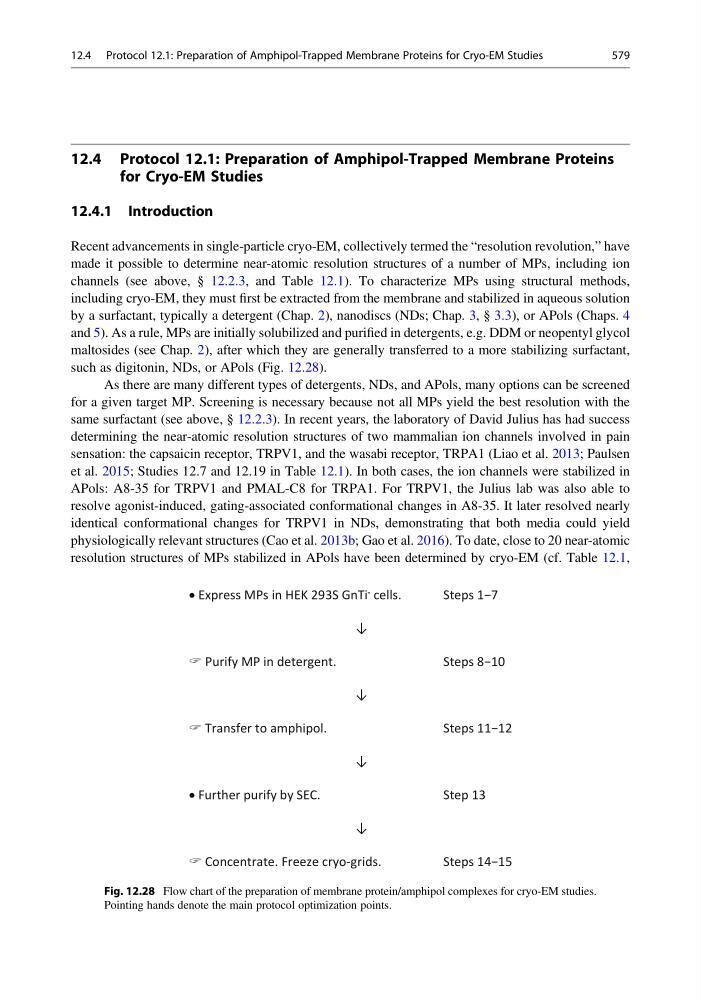
such as digitonin, NDs, or APols (Fig. 12.28).
As there are many different types of detergents, NDs, and APols, many options can be screened
for a given target MP. Screening is necessary because not all MPs yield the best resolution with the
same surfactant (see above, § 12.2.3). In recent years, the laboratory of David Julius has had success
determining the near-atomic resolution structures of two mammalian ion channels involved in pain
sensation: the capsaicin receptor, TRPV1, and the wasabi receptor, TRPA1 (Liao et al. 2013; Paulsen
et al. 2015; Studies 12.7 and 12.19 in Table 12.1). In both cases, the ion channels were stabilized in
APols: A8-35 for TRPV1 and PMAL-C8 for TRPA1. For TRPV1, the Julius lab was also able to
resolve agonist-induced, gating-associated conformational changes in A8-35. It later resolved nearly
identical conformational changes for TRPV1 in NDs, demonstrating that both media could yield
physiologically relevant structures (Cao et al. 2013b; Gao et al. 2016). To date, close to 20 near-atomic
resolution structures of MPs stabilized in APols have been determined by cryo-EM (cf. Table 12.1,
• Express MPs in HEK 293S GnTi - cells.
Steps 1−7
↓
Purify MP in detergent.
Steps 8−10
↓
Transfer to amphipol.
Steps 11−12
↓
• Further purify by SEC.
Step 13
↓
Concentrate. Freeze cryo-grids.
Steps 14−15
Fig. 12.28 Flow chart of the preparation of membrane protein/amphipol complexes for cryo-EM studies.
Pointing hands denote the main protocol optimization points.
12.4 Protocol 12.1: Preparation of Amphipol-Trapped Membrane Proteins for Cryo-EM Studies
579
for Cryo-EM Studies
12.4.1 Introduction
Recent advancements in single-particle cryo-EM, collectively termed the “resolution revolution,” have
made it possible to determine near-atomic resolution structures of a number of MPs, including ion
channels (see above, § 12.2.3, and Table 12.1). To characterize MPs using structural methods,
including cryo-EM, they must first be extracted from the membrane and stabilized in aqueous solution
by a surfactant, typically a detergent (Chap. 2), nanodiscs (NDs; Chap. 3, § 3.3), or APols (Chaps. 4
and 5). As a rule, MPs are initially solubilized and purified in detergents, e.g. DDM or neopentyl glycol
maltosides (see Chap. 2), after which they are generally transferred to a more stabilizing surfactant,
such as digitonin, NDs, or APols (Fig. 12.28).
As there are many different types of detergents, NDs, and APols, many options can be screened
for a given target MP. Screening is necessary because not all MPs yield the best resolution with the
same surfactant (see above, § 12.2.3). In recent years, the laboratory of David Julius has had success
determining the near-atomic resolution structures of two mammalian ion channels involved in pain
sensation: the capsaicin receptor, TRPV1, and the wasabi receptor, TRPA1 (Liao et al. 2013; Paulsen
et al. 2015; Studies 12.7 and 12.19 in Table 12.1). In both cases, the ion channels were stabilized in
APols: A8-35 for TRPV1 and PMAL-C8 for TRPA1. For TRPV1, the Julius lab was also able to
resolve agonist-induced, gating-associated conformational changes in A8-35. It later resolved nearly
identical conformational changes for TRPV1 in NDs, demonstrating that both media could yield
physiologically relevant structures (Cao et al. 2013b; Gao et al. 2016). To date, close to 20 near-atomic
resolution structures of MPs stabilized in APols have been determined by cryo-EM (cf. Table 12.1,
• Express MPs in HEK 293S GnTi - cells.
Steps 1−7
↓
Purify MP in detergent.
Steps 8−10
↓
Transfer to amphipol.
Steps 11−12
↓
• Further purify by SEC.
Step 13
↓
Concentrate. Freeze cryo-grids.
Steps 14−15
Fig. 12.28 Flow chart of the preparation of membrane protein/amphipol complexes for cryo-EM studies.
Pointing hands denote the main protocol optimization points.
12.4 Protocol 12.1: Preparation of Amphipol-Trapped Membrane Proteins for Cryo-EM Studies
579