

There are relatively few statements in published papers regarding the orientation behavior of
MP/APol complexes in liquid films. In Study 12.19, it was noted that the ryanodine receptor-1
tended, when complexed with pure A8-35, to orient with its long axis normal to the plane of the
film, that is with the APol belt away from the interface (see above, Fig 12.26B). Supplementing
the sample with a submicellar concentration of OG brought about a more random distribution of
orientations (Fig. 12.26C; Baker et al. 2015). The origin of this phenomenon is not clear. At
one-tenth its CMC, one can expect that OG will represent, in mass, ca. 10% of the surfactant
surrounding the TM region of RyR1 (see Tribet et al. 2009; Zoonens et al. 2007, and discussion in
Chap. 5, Box 5.3). This will lower by about as much the surface charge density of the belt, and
make it possible for it to adjust the distribution of surface charges in response to the local electric
field, but it does not seem enough of an effect to have such major consequences. Another possible
effect is that the presence of OG will permit the rapid reformation of a surface film following
blotting, lowering the surface tension and, perhaps, bringing about some thinning, which could
have a mechanical effect on the orientation of the particles. Whatever the mechanism, this is a
very interesting observation, which could be of practical use in the EM study of other complexes
and deserves further study.
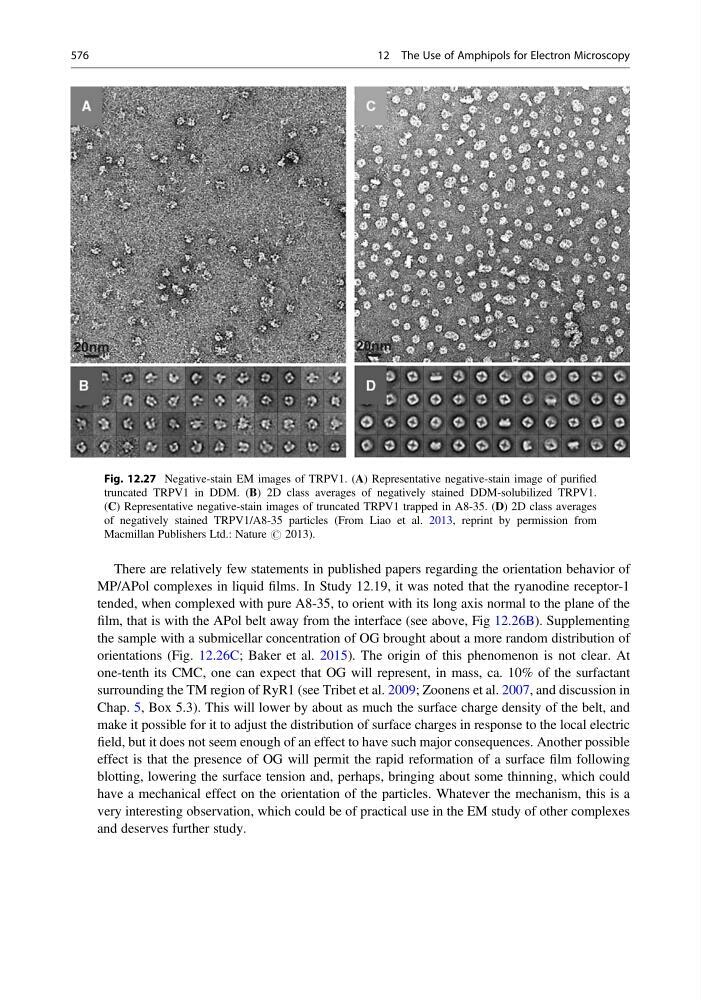
Fig. 12.27 Negative-stain EM images of TRPV1. (A) Representative negative-stain image of purified
truncated TRPV1 in DDM. (B) 2D class averages of negatively stained DDM-solubilized TRPV1.
(C) Representative negative-stain images of truncated TRPV1 trapped in A8-35. (D) 2D class averages
of negatively stained TRPV1/A8-35 particles (From Liao et al. 2013, reprint by permission from
Macmillan Publishers Ltd.: Nature # 2013).
576
12 The Use of Amphipols for Electron Microscopy
MP/APol complexes in liquid films. In Study 12.19, it was noted that the ryanodine receptor-1
tended, when complexed with pure A8-35, to orient with its long axis normal to the plane of the
film, that is with the APol belt away from the interface (see above, Fig 12.26B). Supplementing
the sample with a submicellar concentration of OG brought about a more random distribution of
orientations (Fig. 12.26C; Baker et al. 2015). The origin of this phenomenon is not clear. At
one-tenth its CMC, one can expect that OG will represent, in mass, ca. 10% of the surfactant
surrounding the TM region of RyR1 (see Tribet et al. 2009; Zoonens et al. 2007, and discussion in
Chap. 5, Box 5.3). This will lower by about as much the surface charge density of the belt, and
make it possible for it to adjust the distribution of surface charges in response to the local electric
field, but it does not seem enough of an effect to have such major consequences. Another possible
effect is that the presence of OG will permit the rapid reformation of a surface film following
blotting, lowering the surface tension and, perhaps, bringing about some thinning, which could
have a mechanical effect on the orientation of the particles. Whatever the mechanism, this is a
very interesting observation, which could be of practical use in the EM study of other complexes
and deserves further study.
Fig. 12.27 Negative-stain EM images of TRPV1. (A) Representative negative-stain image of purified
truncated TRPV1 in DDM. (B) 2D class averages of negatively stained DDM-solubilized TRPV1.
(C) Representative negative-stain images of truncated TRPV1 trapped in A8-35. (D) 2D class averages
of negatively stained TRPV1/A8-35 particles (From Liao et al. 2013, reprint by permission from
Macmillan Publishers Ltd.: Nature # 2013).
576
12 The Use of Amphipols for Electron Microscopy