

applying APols to a non-membrane system (Study 12.20). Seven of these MP studies reached
resolutions close to or better than 4 Å, at which molecular models can be directly fitted into density
maps (Fig. 12.20). A rapid survey will be presented, focusing, as before, on observations that can be of
technological interest for cryo-EM studies of MP/APol complexes rather than on the biological
aspects.
The first single-particle cryo-EM study ever to breach the 4-Å barrier bore on another channel of
the TRP family, TRPV1, studied by David Julius, Yifan Cheng, and colleagues (Study 12.9 in
Table 12.1; Cao et al. 2013b; Liao et al. 2013). Solving the structure of TRPV1 to high resolution
was achieved thanks to the technological progress described in § 12.2.3. It was facilitated by stabilizing
TRPV1 by transferring it from DDM to A8-35 (for reviews, see Huynh et al. 2014b; Liao et al. 2014;
Madej and Ziegler 2018 and, for a detailed protocol, § 12.4 below). TRPV1, the Type 1 vanilloid
receptor TRP channel, is the target of capsaicin, the agent from chili peppers that elicits burning pain. It
is the prototype of a subfamily of thermosensitive TRP channels that enable somatosensory neurons, or
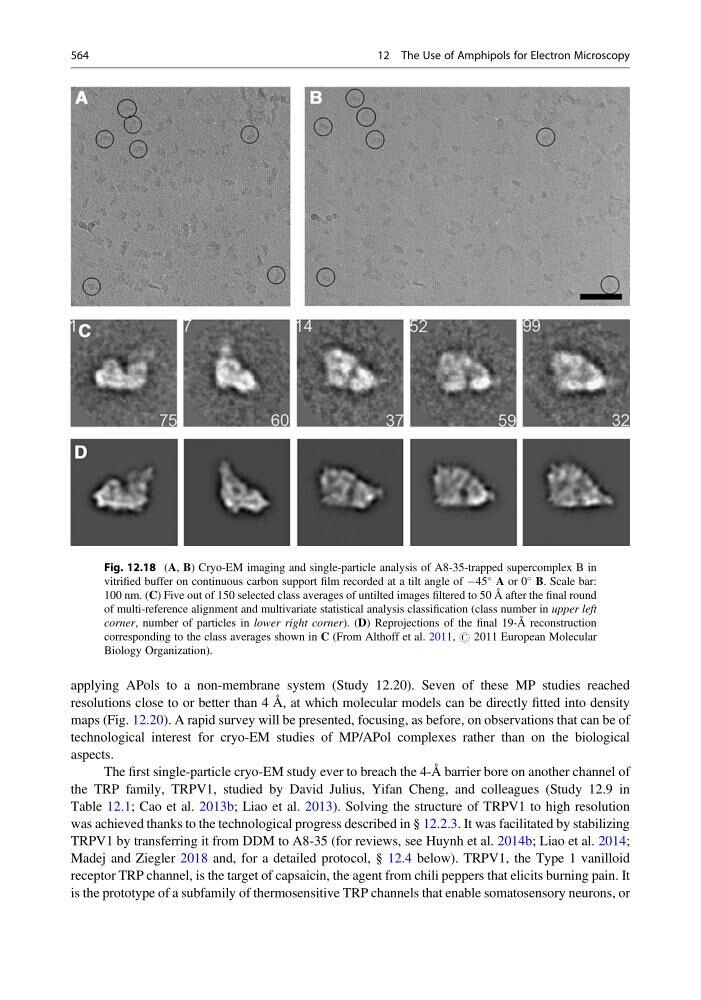
Fig. 12.18 (A, B) Cryo-EM imaging and single-particle analysis of A8-35-trapped supercomplex B in
vitrified buffer on continuous carbon support film recorded at a tilt angle of À45
A or 0
B. Scale bar:
100 nm. (C) Five out of 150 selected class averages of untilted images filtered to 50 Å after the final round
of multi-reference alignment and multivariate statistical analysis classification (class number in upper left
corner, number of particles in lower right corner). (D) Reprojections of the final 19-Å reconstruction
corresponding to the class averages shown in C (From Althoff et al. 2011, # 2011 European Molecular
Biology Organization).
564
12 The Use of Amphipols for Electron Microscopy
resolutions close to or better than 4 Å, at which molecular models can be directly fitted into density
maps (Fig. 12.20). A rapid survey will be presented, focusing, as before, on observations that can be of
technological interest for cryo-EM studies of MP/APol complexes rather than on the biological
aspects.
The first single-particle cryo-EM study ever to breach the 4-Å barrier bore on another channel of
the TRP family, TRPV1, studied by David Julius, Yifan Cheng, and colleagues (Study 12.9 in
Table 12.1; Cao et al. 2013b; Liao et al. 2013). Solving the structure of TRPV1 to high resolution
was achieved thanks to the technological progress described in § 12.2.3. It was facilitated by stabilizing
TRPV1 by transferring it from DDM to A8-35 (for reviews, see Huynh et al. 2014b; Liao et al. 2014;
Madej and Ziegler 2018 and, for a detailed protocol, § 12.4 below). TRPV1, the Type 1 vanilloid
receptor TRP channel, is the target of capsaicin, the agent from chili peppers that elicits burning pain. It
is the prototype of a subfamily of thermosensitive TRP channels that enable somatosensory neurons, or
Fig. 12.18 (A, B) Cryo-EM imaging and single-particle analysis of A8-35-trapped supercomplex B in
vitrified buffer on continuous carbon support film recorded at a tilt angle of À45
A or 0
B. Scale bar:
100 nm. (C) Five out of 150 selected class averages of untilted images filtered to 50 Å after the final round
of multi-reference alignment and multivariate statistical analysis classification (class number in upper left
corner, number of particles in lower right corner). (D) Reprojections of the final 19-Å reconstruction
corresponding to the class averages shown in C (From Althoff et al. 2011, # 2011 European Molecular
Biology Organization).
564
12 The Use of Amphipols for Electron Microscopy