

9.3.6
Determination of Rotational Correlation Times by Solution NMR
Solution NMR can be used to estimate the hydrodynamic radius of particles, thanks to the determination of their rotational correlation time, τ c , which can be deduced from relaxation measurements (see
Chap. 10, Fig. 10.9). The two values are related by the following formula:
τ c ¼ 4πη 0 R H
3
=3kT
where η 0 is the viscosity of the solvent.
This approach has been applied to tOmpA/A8-35 (Study 9.9) and OmpX/A8-35 complexes
(Studies 9.14 and 9.33). It revealed that (i) the tumbling of OmpX/A8-35 complexes is significantly
slower (τ c ¼ 31 Æ 4 ns) (Catoire et al. 2010) than that of OmpX/diC 6 PC ones (τ c ¼ 23 Æ 2 ns)
(Fernández et al. 2001), consistent with a larger R H , and (ii) when EDTA is omitted from the buffer, the
rate of tumbling of OmpX/A8-35 complexes slows down, their rotational correlation time increasing
from τ c ¼ 31 Æ 4 ns (Catoire et al. 2010) to τ c ¼ 39 Æ 5 ns (Etzkorn et al. 2014). This observation
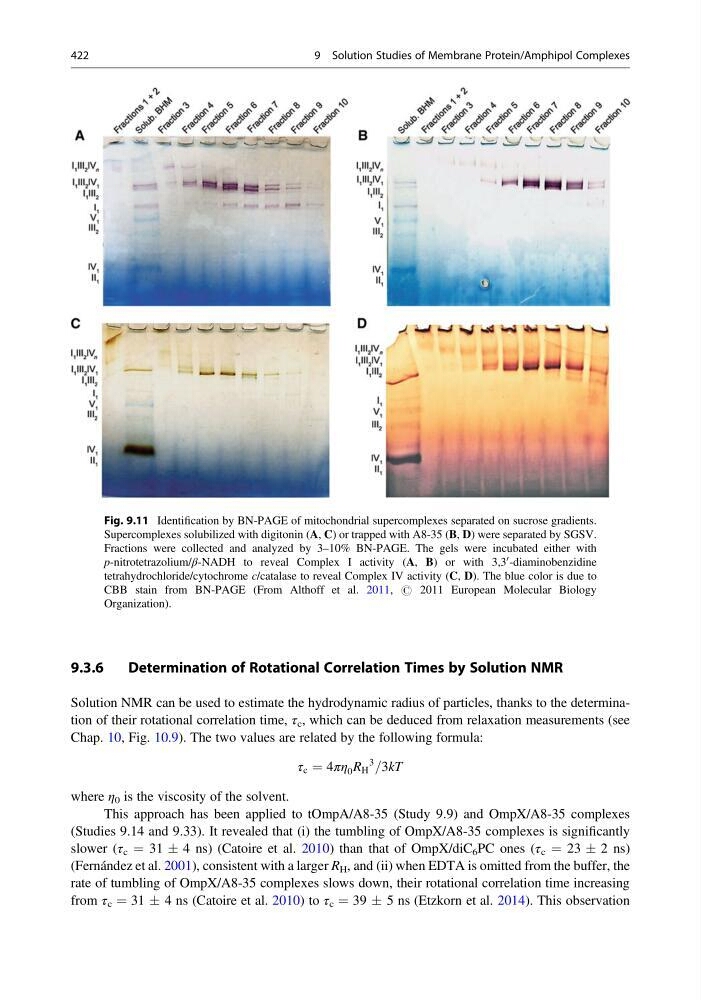
Fig. 9.11 Identification by BN-PAGE of mitochondrial supercomplexes separated on sucrose gradients.
Supercomplexes solubilized with digitonin (A, C) or trapped with A8-35 (B, D) were separated by SGSV.
Fractions were collected and analyzed by 3–10% BN-PAGE. The gels were incubated either with
p-nitrotetrazolium/β-NADH to reveal Complex I activity (A, B) or with 3,3
0 -diaminobenzidine
tetrahydrochloride/cytochrome c/catalase to reveal Complex IV activity (C, D). The blue color is due to
CBB stain from BN-PAGE (From Althoff et al. 2011, # 2011 European Molecular Biology
Organization).
422
9 Solution Studies of Membrane Protein/Amphipol Complexes
Determination of Rotational Correlation Times by Solution NMR
Solution NMR can be used to estimate the hydrodynamic radius of particles, thanks to the determination of their rotational correlation time, τ c , which can be deduced from relaxation measurements (see
Chap. 10, Fig. 10.9). The two values are related by the following formula:
τ c ¼ 4πη 0 R H
3
=3kT
where η 0 is the viscosity of the solvent.
This approach has been applied to tOmpA/A8-35 (Study 9.9) and OmpX/A8-35 complexes
(Studies 9.14 and 9.33). It revealed that (i) the tumbling of OmpX/A8-35 complexes is significantly
slower (τ c ¼ 31 Æ 4 ns) (Catoire et al. 2010) than that of OmpX/diC 6 PC ones (τ c ¼ 23 Æ 2 ns)
(Fernández et al. 2001), consistent with a larger R H , and (ii) when EDTA is omitted from the buffer, the
rate of tumbling of OmpX/A8-35 complexes slows down, their rotational correlation time increasing
from τ c ¼ 31 Æ 4 ns (Catoire et al. 2010) to τ c ¼ 39 Æ 5 ns (Etzkorn et al. 2014). This observation
Fig. 9.11 Identification by BN-PAGE of mitochondrial supercomplexes separated on sucrose gradients.
Supercomplexes solubilized with digitonin (A, C) or trapped with A8-35 (B, D) were separated by SGSV.
Fractions were collected and analyzed by 3–10% BN-PAGE. The gels were incubated either with
p-nitrotetrazolium/β-NADH to reveal Complex I activity (A, B) or with 3,3
0 -diaminobenzidine
tetrahydrochloride/cytochrome c/catalase to reveal Complex IV activity (C, D). The blue color is due to
CBB stain from BN-PAGE (From Althoff et al. 2011, # 2011 European Molecular Biology
Organization).
422
9 Solution Studies of Membrane Protein/Amphipol Complexes