

the protocol of Zubay (1973), as modified by Kim et al. (2006): PEG-8000 was omitted during the S30
preparation, and CFE was carried out either in the presence or absence of 20 gÁL
-1 PEG-8000. The
effect of supplementing the lysate with 0.5 mM EDTA was also tested, so as to prevent the interaction
of traces of Ca
2+ with A8-35 (Picard et al. 2006; Catoire et al. 2010; see Chap. 4, § 4.3.1.2.2). None of
these modifications yielded any improvement in the production of the various test MPs.
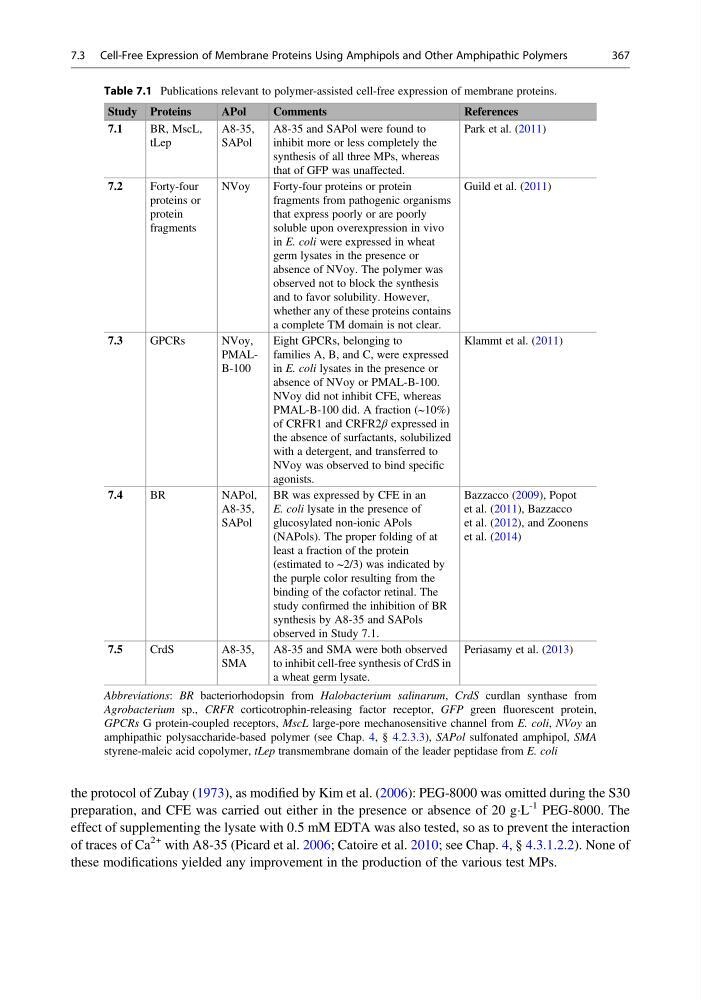
Table 7.1 Publications relevant to polymer-assisted cell-free expression of membrane proteins.
Study Proteins
APol
Comments
References
7.1
BR, MscL,
tLep
A8-35,
SAPol
A8-35 and SAPol were found to
inhibit more or less completely the
synthesis of all three MPs, whereas
that of GFP was unaffected.
Park et al. (2011)
7.2
Forty-four
proteins or
protein
fragments
NVoy
Forty-four proteins or protein
fragments from pathogenic organisms
that express poorly or are poorly
soluble upon overexpression in vivo
in E. coli were expressed in wheat
germ lysates in the presence or
absence of NVoy. The polymer was
observed not to block the synthesis
and to favor solubility. However,
whether any of these proteins contains
a complete TM domain is not clear.
Guild et al. (2011)
7.3
GPCRs
NVoy,
PMALB-100
Eight GPCRs, belonging to
families A, B, and C, were expressed
in E. coli lysates in the presence or
absence of NVoy or PMAL-B-100.
NVoy did not inhibit CFE, whereas
PMAL-B-100 did. A fraction (~10%)
of CRFR1 and CRFR2β expressed in
the absence of surfactants, solubilized
with a detergent, and transferred to
NVoy was observed to bind specific
agonists.
Klammt et al. (2011)
7.4
BR
NAPol,
A8-35,
SAPol
BR was expressed by CFE in an
E. coli lysate in the presence of
glucosylated non-ionic APols
(NAPols). The proper folding of at
least a fraction of the protein
(estimated to ~2/3) was indicated by
the purple color resulting from the
binding of the cofactor retinal. The
study confirmed the inhibition of BR
synthesis by A8-35 and SAPols
observed in Study 7.1.
Bazzacco (2009), Popot
et al. (2011), Bazzacco
et al. (2012), and Zoonens
et al. (2014)
7.5
CrdS
A8-35,
SMA
A8-35 and SMA were both observed
to inhibit cell-free synthesis of CrdS in
a wheat germ lysate.
Periasamy et al. (2013)
Abbreviations: BR bacteriorhodopsin from Halobacterium salinarum, CrdS curdlan synthase from
Agrobacterium sp., CRFR corticotrophin-releasing factor receptor, GFP green fluorescent protein,
GPCRs G protein-coupled receptors, MscL large-pore mechanosensitive channel from E. coli, NVoy an
amphipathic polysaccharide-based polymer (see Chap. 4, § 4.2.3.3), SAPol sulfonated amphipol, SMA
styrene-maleic acid copolymer, tLep transmembrane domain of the leader peptidase from E. coli
7.3 Cell-Free Expression of Membrane Proteins Using Amphipols and Other Amphipathic Polymers
367
preparation, and CFE was carried out either in the presence or absence of 20 gÁL
-1 PEG-8000. The
effect of supplementing the lysate with 0.5 mM EDTA was also tested, so as to prevent the interaction
of traces of Ca
2+ with A8-35 (Picard et al. 2006; Catoire et al. 2010; see Chap. 4, § 4.3.1.2.2). None of
these modifications yielded any improvement in the production of the various test MPs.
Table 7.1 Publications relevant to polymer-assisted cell-free expression of membrane proteins.
Study Proteins
APol
Comments
References
7.1
BR, MscL,
tLep
A8-35,
SAPol
A8-35 and SAPol were found to
inhibit more or less completely the
synthesis of all three MPs, whereas
that of GFP was unaffected.
Park et al. (2011)
7.2
Forty-four
proteins or
protein
fragments
NVoy
Forty-four proteins or protein
fragments from pathogenic organisms
that express poorly or are poorly
soluble upon overexpression in vivo
in E. coli were expressed in wheat
germ lysates in the presence or
absence of NVoy. The polymer was
observed not to block the synthesis
and to favor solubility. However,
whether any of these proteins contains
a complete TM domain is not clear.
Guild et al. (2011)
7.3
GPCRs
NVoy,
PMALB-100
Eight GPCRs, belonging to
families A, B, and C, were expressed
in E. coli lysates in the presence or
absence of NVoy or PMAL-B-100.
NVoy did not inhibit CFE, whereas
PMAL-B-100 did. A fraction (~10%)
of CRFR1 and CRFR2β expressed in
the absence of surfactants, solubilized
with a detergent, and transferred to
NVoy was observed to bind specific
agonists.
Klammt et al. (2011)
7.4
BR
NAPol,
A8-35,
SAPol
BR was expressed by CFE in an
E. coli lysate in the presence of
glucosylated non-ionic APols
(NAPols). The proper folding of at
least a fraction of the protein
(estimated to ~2/3) was indicated by
the purple color resulting from the
binding of the cofactor retinal. The
study confirmed the inhibition of BR
synthesis by A8-35 and SAPols
observed in Study 7.1.
Bazzacco (2009), Popot
et al. (2011), Bazzacco
et al. (2012), and Zoonens
et al. (2014)
7.5
CrdS
A8-35,
SMA
A8-35 and SMA were both observed
to inhibit cell-free synthesis of CrdS in
a wheat germ lysate.
Periasamy et al. (2013)
Abbreviations: BR bacteriorhodopsin from Halobacterium salinarum, CrdS curdlan synthase from
Agrobacterium sp., CRFR corticotrophin-releasing factor receptor, GFP green fluorescent protein,
GPCRs G protein-coupled receptors, MscL large-pore mechanosensitive channel from E. coli, NVoy an
amphipathic polysaccharide-based polymer (see Chap. 4, § 4.2.3.3), SAPol sulfonated amphipol, SMA
styrene-maleic acid copolymer, tLep transmembrane domain of the leader peptidase from E. coli
7.3 Cell-Free Expression of Membrane Proteins Using Amphipols and Other Amphipathic Polymers
367