

in photosynthesis or respiration, where the growth of the organism is limited by the production of
energy and/or reducing equivalents by a certain set of MPs, the membrane surface available is greatly
multiplied by the formation of tubes or sacculi that densely pack in the cytosol of the bacterium or the
matrix of the chloroplast or mitochondrion. Beyond these favorable cases, however, gaining access to
sizable (mg) amounts of MPs is generally impossible starting from natural sources. This has led,
starting in the late 1980s (see Grisshammer and Tate 1995), to the development of overexpression
methods.
As noted in the introduction to Chap. 6 (§ 6.1), overexpressing MPs in vivo in either homologous
or heterologous systems is far from a trivial endeavor, because (i) in most cells, the volume of
membrane that can be used to store overexpressed MPs is limited and (ii) overexpression of MPs
tends to be toxic, either because it perturbs the membrane or it overloads the expression machinery, not
to mention cases where the target proteins are intrinsically toxic. A fine line has to be walked between
expressing too little protein for practical use and expressing too much of it and killing the cells, which
also results in poor yields. In addition, the target proteins can undergo proteolysis, and they must be
separated from the other proteins present in the cells. The various approaches that have been developed
to circumvent these difficulties have been summarized in Chap. 1, § 1.7.2. The use of amphipols
(APols) for folding MPs expressed in vivo in an inactive form accumulated in so-called inclusion
bodies, so as to limit toxicity effects and increase yields, has been described in Chap. 6, § 6.3.
An alternative to in vivo overexpression is cell-free expression (CFE), in which the target protein is
produced in vitro, in a lysate that contains all of the translation machinery (and, usually, the transcription
machinery as well) and is supplied with amino acids, ATP, GTP, energy substrates, an energyregenerating system, and, usually, T7 RNA polymerase, along with a plasmid encoding the target protein
(see e.g. Nirenberg and Matthaei 1961; Zubay 1973; Spirin et al. 1988; Shirokov et al. 2007; Ge and Xu
2012; Kai et al. 2012; Shadiac et al. 2013; Zemella et al. 2015; and references therein). CFE can be
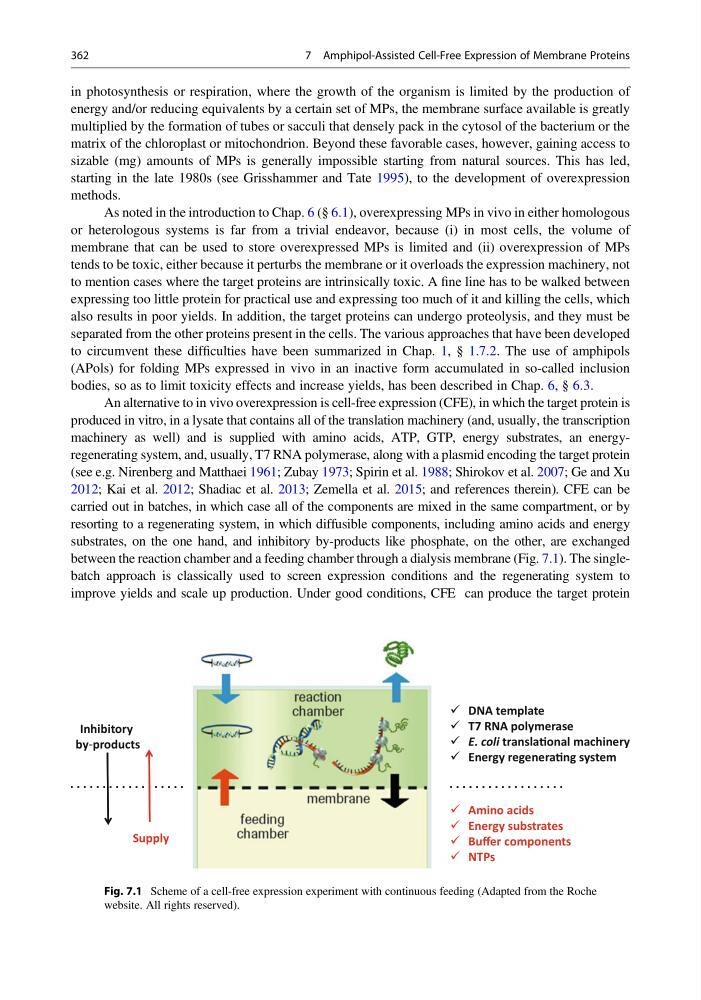
carried out in batches, in which case all of the components are mixed in the same compartment, or by
resorting to a regenerating system, in which diffusible components, including amino acids and energy
substrates, on the one hand, and inhibitory by-products like phosphate, on the other, are exchanged
between the reaction chamber and a feeding chamber through a dialysis membrane (Fig. 7.1). The singlebatch approach is classically used to screen expression conditions and the regenerating system to
improve yields and scale up production. Under good conditions, CFE can produce the target protein
Supply
Inhibitory
by‐products
DNA template
T7 RNA polymerase
E. coli translaƟonal machinery
Energy regeneraƟng system
Amino acids
Energy substrates
Buffer components
NTPs
Fig. 7.1 Scheme of a cell-free expression experiment with continuous feeding (Adapted from the Roche
website. All rights reserved).
362
7 Amphipol-Assisted Cell-Free Expression of Membrane Proteins
energy and/or reducing equivalents by a certain set of MPs, the membrane surface available is greatly
multiplied by the formation of tubes or sacculi that densely pack in the cytosol of the bacterium or the
matrix of the chloroplast or mitochondrion. Beyond these favorable cases, however, gaining access to
sizable (mg) amounts of MPs is generally impossible starting from natural sources. This has led,
starting in the late 1980s (see Grisshammer and Tate 1995), to the development of overexpression
methods.
As noted in the introduction to Chap. 6 (§ 6.1), overexpressing MPs in vivo in either homologous
or heterologous systems is far from a trivial endeavor, because (i) in most cells, the volume of
membrane that can be used to store overexpressed MPs is limited and (ii) overexpression of MPs
tends to be toxic, either because it perturbs the membrane or it overloads the expression machinery, not
to mention cases where the target proteins are intrinsically toxic. A fine line has to be walked between
expressing too little protein for practical use and expressing too much of it and killing the cells, which
also results in poor yields. In addition, the target proteins can undergo proteolysis, and they must be
separated from the other proteins present in the cells. The various approaches that have been developed
to circumvent these difficulties have been summarized in Chap. 1, § 1.7.2. The use of amphipols
(APols) for folding MPs expressed in vivo in an inactive form accumulated in so-called inclusion
bodies, so as to limit toxicity effects and increase yields, has been described in Chap. 6, § 6.3.
An alternative to in vivo overexpression is cell-free expression (CFE), in which the target protein is
produced in vitro, in a lysate that contains all of the translation machinery (and, usually, the transcription
machinery as well) and is supplied with amino acids, ATP, GTP, energy substrates, an energyregenerating system, and, usually, T7 RNA polymerase, along with a plasmid encoding the target protein
(see e.g. Nirenberg and Matthaei 1961; Zubay 1973; Spirin et al. 1988; Shirokov et al. 2007; Ge and Xu
2012; Kai et al. 2012; Shadiac et al. 2013; Zemella et al. 2015; and references therein). CFE can be
carried out in batches, in which case all of the components are mixed in the same compartment, or by
resorting to a regenerating system, in which diffusible components, including amino acids and energy
substrates, on the one hand, and inhibitory by-products like phosphate, on the other, are exchanged
between the reaction chamber and a feeding chamber through a dialysis membrane (Fig. 7.1). The singlebatch approach is classically used to screen expression conditions and the regenerating system to
improve yields and scale up production. Under good conditions, CFE can produce the target protein
Supply
Inhibitory
by‐products
DNA template
T7 RNA polymerase
E. coli translaƟonal machinery
Energy regeneraƟng system
Amino acids
Energy substrates
Buffer components
NTPs
Fig. 7.1 Scheme of a cell-free expression experiment with continuous feeding (Adapted from the Roche
website. All rights reserved).
362
7 Amphipol-Assisted Cell-Free Expression of Membrane Proteins