

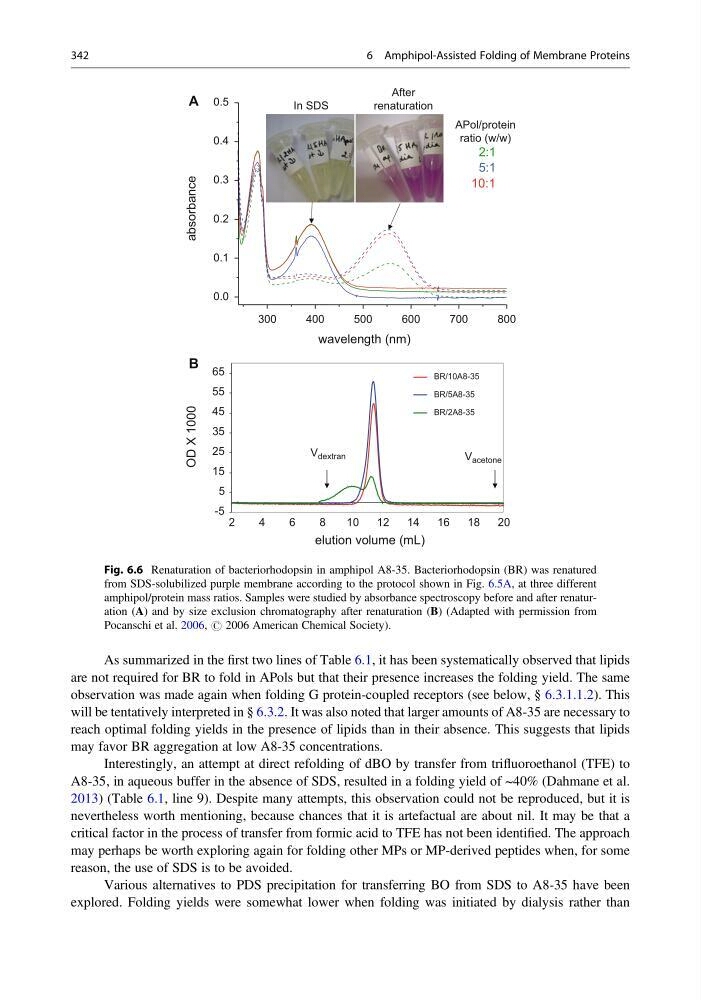
As summarized in the first two lines of Table 6.1, it has been systematically observed that lipids
are not required for BR to fold in APols but that their presence increases the folding yield. The same
observation was made again when folding G protein-coupled receptors (see below, § 6.3.1.1.2). This
will be tentatively interpreted in § 6.3.2. It was also noted that larger amounts of A8-35 are necessary to
reach optimal folding yields in the presence of lipids than in their absence. This suggests that lipids
may favor BR aggregation at low A8-35 concentrations.
Interestingly, an attempt at direct refolding of dBO by transfer from trifluoroethanol (TFE) to
A8-35, in aqueous buffer in the absence of SDS, resulted in a folding yield of ~40% (Dahmane et al.
2013) (Table 6.1, line 9). Despite many attempts, this observation could not be reproduced, but it is
nevertheless worth mentioning, because chances that it is artefactual are about nil. It may be that a
critical factor in the process of transfer from formic acid to TFE has not been identified. The approach
may perhaps be worth exploring again for folding other MPs or MP-derived peptides when, for some
reason, the use of SDS is to be avoided.
Various alternatives to PDS precipitation for transferring BO from SDS to A8-35 have been
explored. Folding yields were somewhat lower when folding was initiated by dialysis rather than
APol/protein
ratio (w/w)
2:1
5:1
10:1
300
400
500
600
700
800
0.0
0.1
0.2
0.3
0.4
0.5
absorbance
wavelength (nm)
In SDS
After
renaturation
elution volume (mL)
-5
5
15
25
35
45
55
65
2
4
6
8
10
12
14
16
18
20
BR/10A8-35
BR/5A8-35
BR/2A8-35
V dextran
V acetone
OD X 1000
B
A
Fig. 6.6 Renaturation of bacteriorhodopsin in amphipol A8-35. Bacteriorhodopsin (BR) was renatured
from SDS-solubilized purple membrane according to the protocol shown in Fig. 6.5A, at three different
amphipol/protein mass ratios. Samples were studied by absorbance spectroscopy before and after renaturation (A) and by size exclusion chromatography after renaturation (B) (Adapted with permission from
Pocanschi et al. 2006, # 2006 American Chemical Society).
342
6 Amphipol-Assisted Folding of Membrane Proteins
are not required for BR to fold in APols but that their presence increases the folding yield. The same
observation was made again when folding G protein-coupled receptors (see below, § 6.3.1.1.2). This
will be tentatively interpreted in § 6.3.2. It was also noted that larger amounts of A8-35 are necessary to
reach optimal folding yields in the presence of lipids than in their absence. This suggests that lipids
may favor BR aggregation at low A8-35 concentrations.
Interestingly, an attempt at direct refolding of dBO by transfer from trifluoroethanol (TFE) to
A8-35, in aqueous buffer in the absence of SDS, resulted in a folding yield of ~40% (Dahmane et al.
2013) (Table 6.1, line 9). Despite many attempts, this observation could not be reproduced, but it is
nevertheless worth mentioning, because chances that it is artefactual are about nil. It may be that a
critical factor in the process of transfer from formic acid to TFE has not been identified. The approach
may perhaps be worth exploring again for folding other MPs or MP-derived peptides when, for some
reason, the use of SDS is to be avoided.
Various alternatives to PDS precipitation for transferring BO from SDS to A8-35 have been
explored. Folding yields were somewhat lower when folding was initiated by dialysis rather than
APol/protein
ratio (w/w)
2:1
5:1
10:1
300
400
500
600
700
800
0.0
0.1
0.2
0.3
0.4
0.5
absorbance
wavelength (nm)
In SDS
After
renaturation
elution volume (mL)
-5
5
15
25
35
45
55
65
2
4
6
8
10
12
14
16
18
20
BR/10A8-35
BR/5A8-35
BR/2A8-35
V dextran
V acetone
OD X 1000
B
A
Fig. 6.6 Renaturation of bacteriorhodopsin in amphipol A8-35. Bacteriorhodopsin (BR) was renatured
from SDS-solubilized purple membrane according to the protocol shown in Fig. 6.5A, at three different
amphipol/protein mass ratios. Samples were studied by absorbance spectroscopy before and after renaturation (A) and by size exclusion chromatography after renaturation (B) (Adapted with permission from
Pocanschi et al. 2006, # 2006 American Chemical Society).
342
6 Amphipol-Assisted Folding of Membrane Proteins