

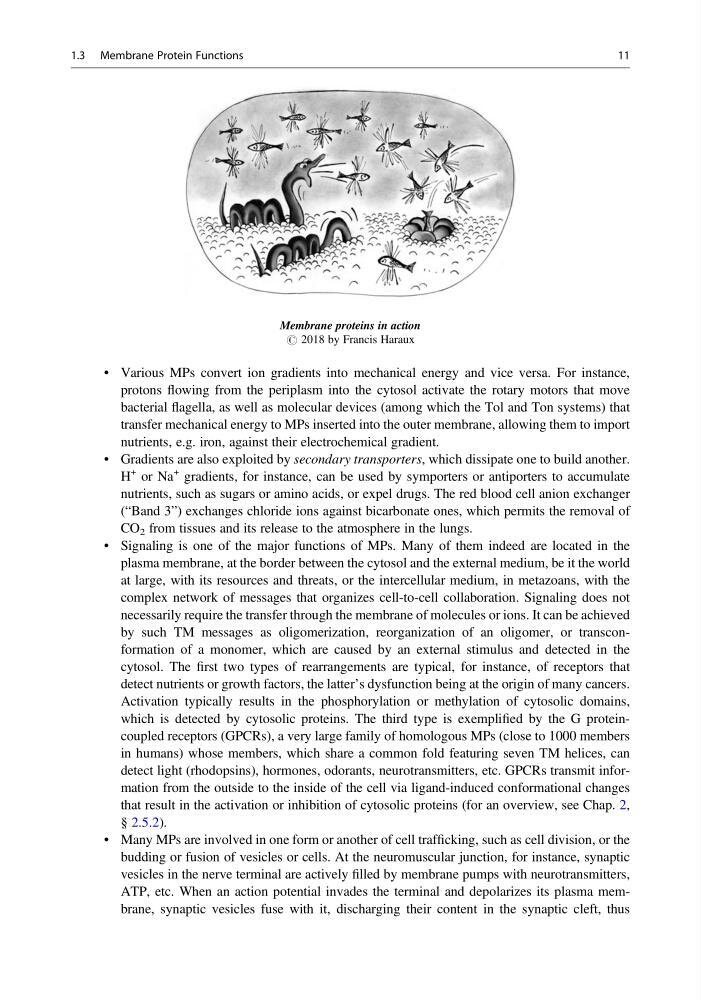
Membrane proteins in action
# 2018 by Francis Haraux
• Various MPs convert ion gradients into mechanical energy and vice versa. For instance,
protons flowing from the periplasm into the cytosol activate the rotary motors that move
bacterial flagella, as well as molecular devices (among which the Tol and Ton systems) that
transfer mechanical energy to MPs inserted into the outer membrane, allowing them to import
nutrients, e.g. iron, against their electrochemical gradient.
• Gradients are also exploited by secondary transporters, which dissipate one to build another.
H
+ or Na
+ gradients, for instance, can be used by symporters or antiporters to accumulate
nutrients, such as sugars or amino acids, or expel drugs. The red blood cell anion exchanger
(“Band 3”) exchanges chloride ions against bicarbonate ones, which permits the removal of
CO 2 from tissues and its release to the atmosphere in the lungs.
• Signaling is one of the major functions of MPs. Many of them indeed are located in the
plasma membrane, at the border between the cytosol and the external medium, be it the world
at large, with its resources and threats, or the intercellular medium, in metazoans, with the
complex network of messages that organizes cell-to-cell collaboration. Signaling does not
necessarily require the transfer through the membrane of molecules or ions. It can be achieved
by such TM messages as oligomerization, reorganization of an oligomer, or transconformation of a monomer, which are caused by an external stimulus and detected in the
cytosol. The first two types of rearrangements are typical, for instance, of receptors that
detect nutrients or growth factors, the latter’s dysfunction being at the origin of many cancers.
Activation typically results in the phosphorylation or methylation of cytosolic domains,
which is detected by cytosolic proteins. The third type is exemplified by the G proteincoupled receptors (GPCRs), a very large family of homologous MPs (close to 1000 members
in humans) whose members, which share a common fold featuring seven TM helices, can
detect light (rhodopsins), hormones, odorants, neurotransmitters, etc. GPCRs transmit information from the outside to the inside of the cell via ligand-induced conformational changes
that result in the activation or inhibition of cytosolic proteins (for an overview, see Chap. 2,
§ 2.5.2).
• Many MPs are involved in one form or another of cell trafficking, such as cell division, or the
budding or fusion of vesicles or cells. At the neuromuscular junction, for instance, synaptic
vesicles in the nerve terminal are actively filled by membrane pumps with neurotransmitters,
ATP, etc. When an action potential invades the terminal and depolarizes its plasma membrane, synaptic vesicles fuse with it, discharging their content in the synaptic cleft, thus
1.3 Membrane Protein Functions
11
# 2018 by Francis Haraux
• Various MPs convert ion gradients into mechanical energy and vice versa. For instance,
protons flowing from the periplasm into the cytosol activate the rotary motors that move
bacterial flagella, as well as molecular devices (among which the Tol and Ton systems) that
transfer mechanical energy to MPs inserted into the outer membrane, allowing them to import
nutrients, e.g. iron, against their electrochemical gradient.
• Gradients are also exploited by secondary transporters, which dissipate one to build another.
H
+ or Na
+ gradients, for instance, can be used by symporters or antiporters to accumulate
nutrients, such as sugars or amino acids, or expel drugs. The red blood cell anion exchanger
(“Band 3”) exchanges chloride ions against bicarbonate ones, which permits the removal of
CO 2 from tissues and its release to the atmosphere in the lungs.
• Signaling is one of the major functions of MPs. Many of them indeed are located in the
plasma membrane, at the border between the cytosol and the external medium, be it the world
at large, with its resources and threats, or the intercellular medium, in metazoans, with the
complex network of messages that organizes cell-to-cell collaboration. Signaling does not
necessarily require the transfer through the membrane of molecules or ions. It can be achieved
by such TM messages as oligomerization, reorganization of an oligomer, or transconformation of a monomer, which are caused by an external stimulus and detected in the
cytosol. The first two types of rearrangements are typical, for instance, of receptors that
detect nutrients or growth factors, the latter’s dysfunction being at the origin of many cancers.
Activation typically results in the phosphorylation or methylation of cytosolic domains,
which is detected by cytosolic proteins. The third type is exemplified by the G proteincoupled receptors (GPCRs), a very large family of homologous MPs (close to 1000 members
in humans) whose members, which share a common fold featuring seven TM helices, can
detect light (rhodopsins), hormones, odorants, neurotransmitters, etc. GPCRs transmit information from the outside to the inside of the cell via ligand-induced conformational changes
that result in the activation or inhibition of cytosolic proteins (for an overview, see Chap. 2,
§ 2.5.2).
• Many MPs are involved in one form or another of cell trafficking, such as cell division, or the
budding or fusion of vesicles or cells. At the neuromuscular junction, for instance, synaptic
vesicles in the nerve terminal are actively filled by membrane pumps with neurotransmitters,
ATP, etc. When an action potential invades the terminal and depolarizes its plasma membrane, synaptic vesicles fuse with it, discharging their content in the synaptic cleft, thus
1.3 Membrane Protein Functions
11