

therefore required. There is no need, however, to increase the concentration of APols beyond the
minimal concentration yielding an acceptable monodispersity, because, due to the hydrophobic sink
effect, this may compromise the stability of fragile MPs (§ 5.5).
Protocol prepared by Manuela Zoonens on the basis of Zoonens et al. (2007), Gohon et al.
(2008), and laboratory notes.
5.9.2
Protocol 5.2. Determining the Amount of MP-Bound APol
APols specifically adsorb onto the transmembrane region of MPs, where they form a compact layer
1.5–2 nm thick (§ 5.3.2). The mass of APol constituting the protein-bound belt has been estimated in
several studies (§ 5.3.1.1), the most detailed of which used BR, cytochrome bc 1 , and tOmpA as model
MPs. The first determination is mostly based on extensive physical measurements carried out on BR
complexed with either plain or deuterated A8-35, using primarily SANS and AUC (Gohon et al. 2008).
It is thought to give a relatively accurate measurement of the amount of A8-35 bound per BR monomer,
but is extremely work-intensive. The second and third studies relied on the use of a radioactively
labeled APol ([
3 H]A8-35) and a fluorescently labeled one (FAPol), respectively. Free APol was
separated from MP/APol complexes either by SEC or sucrose gradient centrifugation (Charvolin
et al. 2014) or by separating polyhistidine-tagged MP/APol complexes from free APol by IMAC
(Zoonens et al. 2007). Under the conditions used in Zoonens et al. (2007), it yielded, for reasons to be
discussed below, what is thought to be a lower limit to the amount of A8-35 bound to the tOmpA
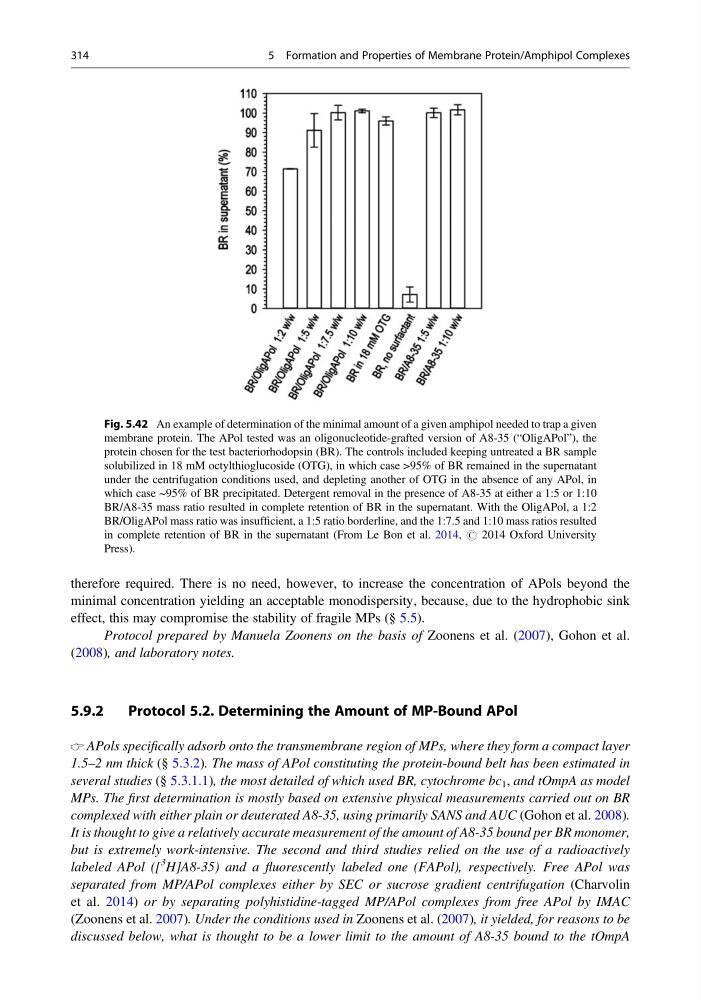
Fig. 5.42 An example of determination of the minimal amount of a given amphipol needed to trap a given
membrane protein. The APol tested was an oligonucleotide-grafted version of A8-35 (“OligAPol”), the
protein chosen for the test bacteriorhodopsin (BR). The controls included keeping untreated a BR sample
solubilized in 18 mM octylthioglucoside (OTG), in which case >95% of BR remained in the supernatant
under the centrifugation conditions used, and depleting another of OTG in the absence of any APol, in
which case ~95% of BR precipitated. Detergent removal in the presence of A8-35 at either a 1:5 or 1:10
BR/A8-35 mass ratio resulted in complete retention of BR in the supernatant. With the OligAPol, a 1:2
BR/OligAPol mass ratio was insufficient, a 1:5 ratio borderline, and the 1:7.5 and 1:10 mass ratios resulted
in complete retention of BR in the supernatant (From Le Bon et al. 2014, # 2014 Oxford University
Press).
314
5 Formation and Properties of Membrane Protein/Amphipol Complexes
minimal concentration yielding an acceptable monodispersity, because, due to the hydrophobic sink
effect, this may compromise the stability of fragile MPs (§ 5.5).
Protocol prepared by Manuela Zoonens on the basis of Zoonens et al. (2007), Gohon et al.
(2008), and laboratory notes.
5.9.2
Protocol 5.2. Determining the Amount of MP-Bound APol
APols specifically adsorb onto the transmembrane region of MPs, where they form a compact layer
1.5–2 nm thick (§ 5.3.2). The mass of APol constituting the protein-bound belt has been estimated in
several studies (§ 5.3.1.1), the most detailed of which used BR, cytochrome bc 1 , and tOmpA as model
MPs. The first determination is mostly based on extensive physical measurements carried out on BR
complexed with either plain or deuterated A8-35, using primarily SANS and AUC (Gohon et al. 2008).
It is thought to give a relatively accurate measurement of the amount of A8-35 bound per BR monomer,
but is extremely work-intensive. The second and third studies relied on the use of a radioactively
labeled APol ([
3 H]A8-35) and a fluorescently labeled one (FAPol), respectively. Free APol was
separated from MP/APol complexes either by SEC or sucrose gradient centrifugation (Charvolin
et al. 2014) or by separating polyhistidine-tagged MP/APol complexes from free APol by IMAC
(Zoonens et al. 2007). Under the conditions used in Zoonens et al. (2007), it yielded, for reasons to be
discussed below, what is thought to be a lower limit to the amount of A8-35 bound to the tOmpA
Fig. 5.42 An example of determination of the minimal amount of a given amphipol needed to trap a given
membrane protein. The APol tested was an oligonucleotide-grafted version of A8-35 (“OligAPol”), the
protein chosen for the test bacteriorhodopsin (BR). The controls included keeping untreated a BR sample
solubilized in 18 mM octylthioglucoside (OTG), in which case >95% of BR remained in the supernatant
under the centrifugation conditions used, and depleting another of OTG in the absence of any APol, in
which case ~95% of BR precipitated. Detergent removal in the presence of A8-35 at either a 1:5 or 1:10
BR/A8-35 mass ratio resulted in complete retention of BR in the supernatant. With the OligAPol, a 1:2
BR/OligAPol mass ratio was insufficient, a 1:5 ratio borderline, and the 1:7.5 and 1:10 mass ratios resulted
in complete retention of BR in the supernatant (From Le Bon et al. 2014, # 2014 Oxford University
Press).
314
5 Formation and Properties of Membrane Protein/Amphipol Complexes