

5.7
Transferring Membrane Proteins from Amphipols to Other
Environments
As will be described in Chaps. 8, 9, 10, 11, 12, 13, 14, and 15, MP/APol complexes lend themselves to
a whole gamut of applications ranging from biophysical studies to biomedical applications. There are
cases, however, where another environment is either mandatory or desirable. Such is the case, for
instance, when transport or permeability measurements have to be carried out. The protein, in such
cases, has to be transferred to a medium endowed with separate compartments, such as a vesicle, a
black lipid film, or a cell. Similarly, studies of the functional effects of lipids can probably be carried
out, to some extent, by trapping the target proteins in APols in the presence of various lipids, but it may
be preferable to reconstitute a more bilayer-like environment, such as a lipid membrane or a nanodisc,
possibly a lipid-rich SMALP or bicelle. Another case in point is that of crystallization: at this point,
despite some fractional successes, crystallizing MP/APol complexes remains a difficult goal
(Charvolin et al. 2014; see Chap. 11, § 11.3.1). On the contrary, excellent crystals have been grown
after transferring an APol-trapped MP to a lipid cubic phase (Polovinkin et al. 2014b; ibid., § 11.3.2).
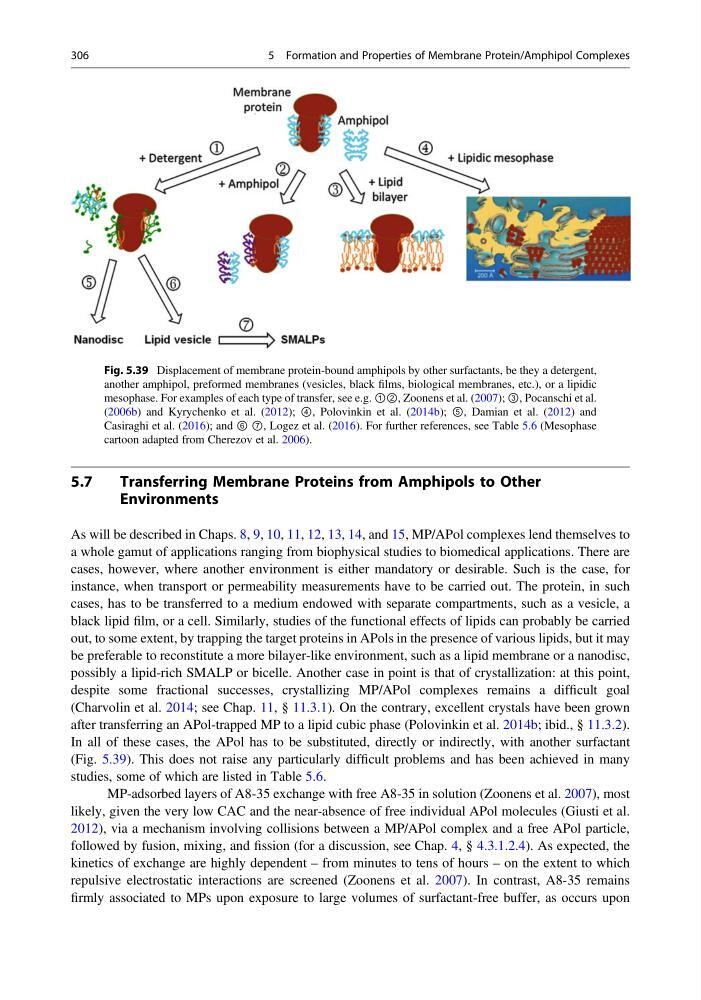
In all of these cases, the APol has to be substituted, directly or indirectly, with another surfactant
(Fig. 5.39). This does not raise any particularly difficult problems and has been achieved in many
studies, some of which are listed in Table 5.6.
MP-adsorbed layers of A8-35 exchange with free A8-35 in solution (Zoonens et al. 2007), most
likely, given the very low CAC and the near-absence of free individual APol molecules (Giusti et al.
2012), via a mechanism involving collisions between a MP/APol complex and a free APol particle,
followed by fusion, mixing, and fission (for a discussion, see Chap. 4, § 4.3.1.2.4). As expected, the
kinetics of exchange are highly dependent – from minutes to tens of hours – on the extent to which
repulsive electrostatic interactions are screened (Zoonens et al. 2007). In contrast, A8-35 remains
firmly associated to MPs upon exposure to large volumes of surfactant-free buffer, as occurs upon
Fig. 5.39 Displacement of membrane protein-bound amphipols by other surfactants, be they a detergent,
another amphipol, preformed membranes (vesicles, black films, biological membranes, etc.), or a lipidic
mesophase. For examples of each type of transfer, see e.g. ①②, Zoonens et al. (2007); ③, Pocanschi et al.
(2006b) and Kyrychenko et al. (2012); ④, Polovinkin et al. (2014b); ⑤, Damian et al. (2012) and
Casiraghi et al. (2016); and ⑥ ⑦, Logez et al. (2016). For further references, see Table 5.6 (Mesophase
cartoon adapted from Cherezov et al. 2006).
306
5 Formation and Properties of Membrane Protein/Amphipol Complexes
Transferring Membrane Proteins from Amphipols to Other
Environments
As will be described in Chaps. 8, 9, 10, 11, 12, 13, 14, and 15, MP/APol complexes lend themselves to
a whole gamut of applications ranging from biophysical studies to biomedical applications. There are
cases, however, where another environment is either mandatory or desirable. Such is the case, for
instance, when transport or permeability measurements have to be carried out. The protein, in such
cases, has to be transferred to a medium endowed with separate compartments, such as a vesicle, a
black lipid film, or a cell. Similarly, studies of the functional effects of lipids can probably be carried
out, to some extent, by trapping the target proteins in APols in the presence of various lipids, but it may
be preferable to reconstitute a more bilayer-like environment, such as a lipid membrane or a nanodisc,
possibly a lipid-rich SMALP or bicelle. Another case in point is that of crystallization: at this point,
despite some fractional successes, crystallizing MP/APol complexes remains a difficult goal
(Charvolin et al. 2014; see Chap. 11, § 11.3.1). On the contrary, excellent crystals have been grown
after transferring an APol-trapped MP to a lipid cubic phase (Polovinkin et al. 2014b; ibid., § 11.3.2).
In all of these cases, the APol has to be substituted, directly or indirectly, with another surfactant
(Fig. 5.39). This does not raise any particularly difficult problems and has been achieved in many
studies, some of which are listed in Table 5.6.
MP-adsorbed layers of A8-35 exchange with free A8-35 in solution (Zoonens et al. 2007), most
likely, given the very low CAC and the near-absence of free individual APol molecules (Giusti et al.
2012), via a mechanism involving collisions between a MP/APol complex and a free APol particle,
followed by fusion, mixing, and fission (for a discussion, see Chap. 4, § 4.3.1.2.4). As expected, the
kinetics of exchange are highly dependent – from minutes to tens of hours – on the extent to which
repulsive electrostatic interactions are screened (Zoonens et al. 2007). In contrast, A8-35 remains
firmly associated to MPs upon exposure to large volumes of surfactant-free buffer, as occurs upon
Fig. 5.39 Displacement of membrane protein-bound amphipols by other surfactants, be they a detergent,
another amphipol, preformed membranes (vesicles, black films, biological membranes, etc.), or a lipidic
mesophase. For examples of each type of transfer, see e.g. ①②, Zoonens et al. (2007); ③, Pocanschi et al.
(2006b) and Kyrychenko et al. (2012); ④, Polovinkin et al. (2014b); ⑤, Damian et al. (2012) and
Casiraghi et al. (2016); and ⑥ ⑦, Logez et al. (2016). For further references, see Table 5.6 (Mesophase
cartoon adapted from Cherezov et al. 2006).
306
5 Formation and Properties of Membrane Protein/Amphipol Complexes