

are. Thus, BR is more stable when trapped in A8-35 than in A8-75, a very similar poly(acrylic acid)derived APol that carries ~75% free carboxylate groups rather than ~35% (Tribet et al. 1996, and
C. Tribet, unpublished data). Similarly, SERCA1a is more stable in A8-35 than in SAPols, which also
carry ~75% of charged groups (Picard et al. 2006; see Fig. 5.34). Cytochrome b 6 f, a highly detergentsensitive complex (Breyton et al. 1997), is not very stable in A8-35 or A8-75, particularly in the
absence of lipids (Tribet et al. 1996, 1998; Bazzacco et al. 2012), but much more so in NAPols,
whether glycosylated or not (Prata et al. 2001; Bazzacco et al. 2012). The stability of BR in SAPols is
much greater in the presence of 100 mM NaCl than in its absence (Dahmane et al. 2009). A simple
rationale for these effects is that, as may be the case for detergents, the presence of a net charge on the
surfactant bound to a MP tends to favor, due to electrostatic repulsion, the formation of particles with a
small radius of curvature. This would drive the opening of the protein’s structure or, in the case of a
multi-subunit assembly like cytochrome b 6 f, fragmentation. Note, however, that the tetrameric ion
channel TRAP1 has been reported to be more stable in SAPols than in A8-35 (Huynh et al. 2014). It is
to be expected that, depending on the mechanism of denaturation of individual MPs, on the APol they
are transferred to and on experimental conditions, such as the ionic strength and the presence or
absence of lipids, different stabilization mechanisms will come into play to different extents, and it
may be more or less relevant to favor one type of APol over another.
On the basis of currently available data, we can identify at least two, probably three, mechanisms
as likely to contribute to the stabilizing effect of APols. The first two are classical:
(i) APols are intrinsically less disruptive, to most proteins, than most detergents, as shown by
the fact that, at equal mass ratios of protein and surfactant, MPs are, usually, much more
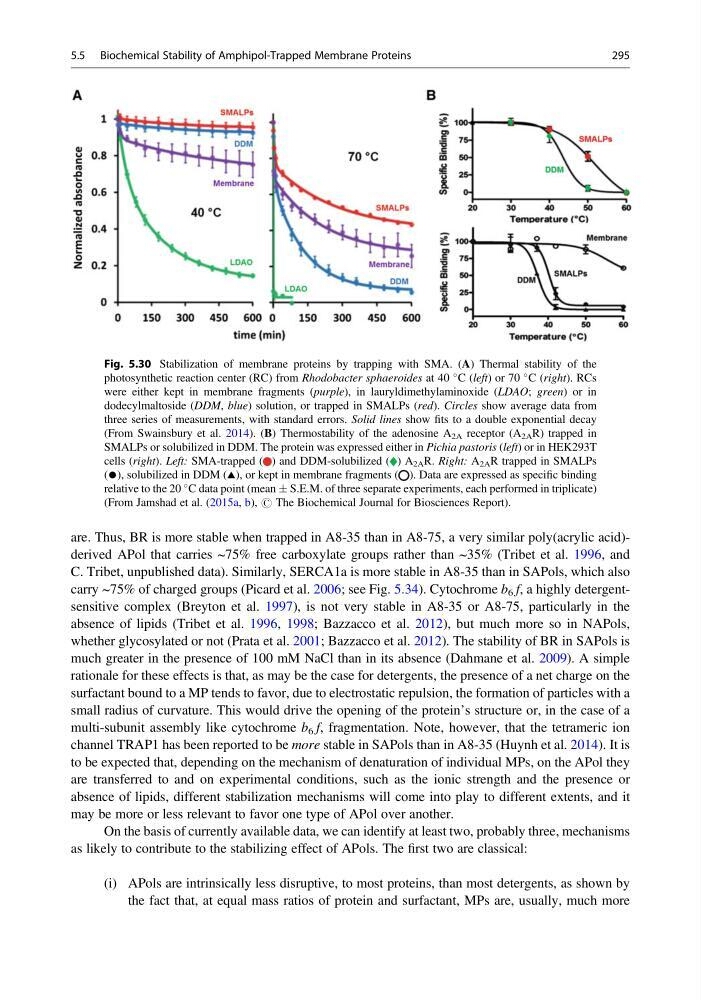
Fig. 5.30 Stabilization of membrane proteins by trapping with SMA. (A) Thermal stability of the
photosynthetic reaction center (RC) from Rhodobacter sphaeroides at 40
C (left) or 70
C (right). RCs
were either kept in membrane fragments (purple), in lauryldimethylaminoxide (LDAO; green) or in
dodecylmaltoside (DDM, blue) solution, or trapped in SMALPs (red). Circles show average data from
three series of measurements, with standard errors. Solid lines show fits to a double exponential decay
(From Swainsbury et al. 2014). (B) Thermostability of the adenosine A 2A receptor (A 2A R) trapped in
SMALPs or solubilized in DDM. The protein was expressed either in Pichia pastoris (left) or in HEK293T
cells (right). Left: SMA-trapped ( ) and DDM-solubilized ( ) A 2A R. Right: A 2A R trapped in SMALPs
(●), solubilized in DDM (~), or kept in membrane fragments ( ). Data are expressed as specific binding
relative to the 20
C data point (mean Æ S.E.M. of three separate experiments, each performed in triplicate)
(From Jamshad et al. (2015a, b), # The Biochemical Journal for Biosciences Report).
5.5 Biochemical Stability of Amphipol-Trapped Membrane Proteins
295
C. Tribet, unpublished data). Similarly, SERCA1a is more stable in A8-35 than in SAPols, which also
carry ~75% of charged groups (Picard et al. 2006; see Fig. 5.34). Cytochrome b 6 f, a highly detergentsensitive complex (Breyton et al. 1997), is not very stable in A8-35 or A8-75, particularly in the
absence of lipids (Tribet et al. 1996, 1998; Bazzacco et al. 2012), but much more so in NAPols,
whether glycosylated or not (Prata et al. 2001; Bazzacco et al. 2012). The stability of BR in SAPols is
much greater in the presence of 100 mM NaCl than in its absence (Dahmane et al. 2009). A simple
rationale for these effects is that, as may be the case for detergents, the presence of a net charge on the
surfactant bound to a MP tends to favor, due to electrostatic repulsion, the formation of particles with a
small radius of curvature. This would drive the opening of the protein’s structure or, in the case of a
multi-subunit assembly like cytochrome b 6 f, fragmentation. Note, however, that the tetrameric ion
channel TRAP1 has been reported to be more stable in SAPols than in A8-35 (Huynh et al. 2014). It is
to be expected that, depending on the mechanism of denaturation of individual MPs, on the APol they
are transferred to and on experimental conditions, such as the ionic strength and the presence or
absence of lipids, different stabilization mechanisms will come into play to different extents, and it
may be more or less relevant to favor one type of APol over another.
On the basis of currently available data, we can identify at least two, probably three, mechanisms
as likely to contribute to the stabilizing effect of APols. The first two are classical:
(i) APols are intrinsically less disruptive, to most proteins, than most detergents, as shown by
the fact that, at equal mass ratios of protein and surfactant, MPs are, usually, much more
Fig. 5.30 Stabilization of membrane proteins by trapping with SMA. (A) Thermal stability of the
photosynthetic reaction center (RC) from Rhodobacter sphaeroides at 40
C (left) or 70
C (right). RCs
were either kept in membrane fragments (purple), in lauryldimethylaminoxide (LDAO; green) or in
dodecylmaltoside (DDM, blue) solution, or trapped in SMALPs (red). Circles show average data from
three series of measurements, with standard errors. Solid lines show fits to a double exponential decay
(From Swainsbury et al. 2014). (B) Thermostability of the adenosine A 2A receptor (A 2A R) trapped in
SMALPs or solubilized in DDM. The protein was expressed either in Pichia pastoris (left) or in HEK293T
cells (right). Left: SMA-trapped ( ) and DDM-solubilized ( ) A 2A R. Right: A 2A R trapped in SMALPs
(●), solubilized in DDM (~), or kept in membrane fragments ( ). Data are expressed as specific binding
relative to the 20
C data point (mean Æ S.E.M. of three separate experiments, each performed in triplicate)
(From Jamshad et al. (2015a, b), # The Biochemical Journal for Biosciences Report).
5.5 Biochemical Stability of Amphipol-Trapped Membrane Proteins
295