

5.2.2.1 Styrene-Maleic Acid Copolymers
The use of styrene-maleic acid copolymer (SMA) to disperse lipids into bicelle-like SMA/lipid
particles (SMALPs, also called by the trade name Lipodisqs®) has been introduced in Chap. 4,
§ 4.3.2. When MP-containing native or artificial membranes are supplemented with SMA, MP/lipid/
SMA particles are formed. In the princeps demonstration that SMA can be used to extract MPs from a
lipid environment, by T.R. Dafforn, M. Overduin, and their collaborators (Knowles et al. 2009),
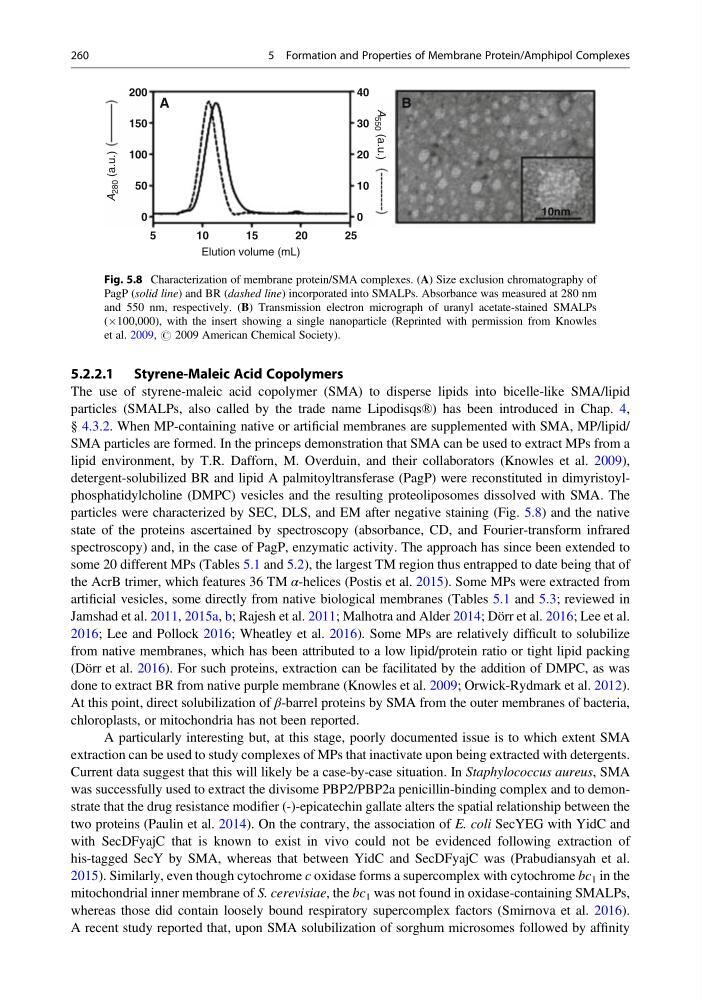
detergent-solubilized BR and lipid A palmitoyltransferase (PagP) were reconstituted in dimyristoylphosphatidylcholine (DMPC) vesicles and the resulting proteoliposomes dissolved with SMA. The
particles were characterized by SEC, DLS, and EM after negative staining (Fig. 5.8) and the native
state of the proteins ascertained by spectroscopy (absorbance, CD, and Fourier-transform infrared
spectroscopy) and, in the case of PagP, enzymatic activity. The approach has since been extended to
some 20 different MPs (Tables 5.1 and 5.2), the largest TM region thus entrapped to date being that of
the AcrB trimer, which features 36 TM α-helices (Postis et al. 2015). Some MPs were extracted from
artificial vesicles, some directly from native biological membranes (Tables 5.1 and 5.3; reviewed in
Jamshad et al. 2011, 2015a, b; Rajesh et al. 2011; Malhotra and Alder 2014; Dörr et al. 2016; Lee et al.
2016; Lee and Pollock 2016; Wheatley et al. 2016). Some MPs are relatively difficult to solubilize
from native membranes, which has been attributed to a low lipid/protein ratio or tight lipid packing
(Dörr et al. 2016). For such proteins, extraction can be facilitated by the addition of DMPC, as was
done to extract BR from native purple membrane (Knowles et al. 2009; Orwick-Rydmark et al. 2012).
At this point, direct solubilization of β-barrel proteins by SMA from the outer membranes of bacteria,
chloroplasts, or mitochondria has not been reported.
A particularly interesting but, at this stage, poorly documented issue is to which extent SMA
extraction can be used to study complexes of MPs that inactivate upon being extracted with detergents.
Current data suggest that this will likely be a case-by-case situation. In Staphylococcus aureus, SMA
was successfully used to extract the divisome PBP2/PBP2a penicillin-binding complex and to demonstrate that the drug resistance modifier (-)-epicatechin gallate alters the spatial relationship between the
two proteins (Paulin et al. 2014). On the contrary, the association of E. coli SecYEG with YidC and
with SecDFyajC that is known to exist in vivo could not be evidenced following extraction of
his-tagged SecY by SMA, whereas that between YidC and SecDFyajC was (Prabudiansyah et al.
2015). Similarly, even though cytochrome c oxidase forms a supercomplex with cytochrome bc 1 in the
mitochondrial inner membrane of S. cerevisiae, the bc 1 was not found in oxidase-containing SMALPs,
whereas those did contain loosely bound respiratory supercomplex factors (Smirnova et al. 2016).
A recent study reported that, upon SMA solubilization of sorghum microsomes followed by affinity
5
1 0
1 5
2 0
2 5
10nm
0
10
20
30
40
0
50
A
280 (a.u.)
Elution volume (mL)
A
B
A 550 (a.u.)
100
150
200
Fig. 5.8 Characterization of membrane protein/SMA complexes. (A) Size exclusion chromatography of
PagP (solid line) and BR (dashed line) incorporated into SMALPs. Absorbance was measured at 280 nm
and 550 nm, respectively. (B) Transmission electron micrograph of uranyl acetate-stained SMALPs
(Â100,000), with the insert showing a single nanoparticle (Reprinted with permission from Knowles
et al. 2009, # 2009 American Chemical Society).
260
5 Formation and Properties of Membrane Protein/Amphipol Complexes
The use of styrene-maleic acid copolymer (SMA) to disperse lipids into bicelle-like SMA/lipid
particles (SMALPs, also called by the trade name Lipodisqs®) has been introduced in Chap. 4,
§ 4.3.2. When MP-containing native or artificial membranes are supplemented with SMA, MP/lipid/
SMA particles are formed. In the princeps demonstration that SMA can be used to extract MPs from a
lipid environment, by T.R. Dafforn, M. Overduin, and their collaborators (Knowles et al. 2009),
detergent-solubilized BR and lipid A palmitoyltransferase (PagP) were reconstituted in dimyristoylphosphatidylcholine (DMPC) vesicles and the resulting proteoliposomes dissolved with SMA. The
particles were characterized by SEC, DLS, and EM after negative staining (Fig. 5.8) and the native
state of the proteins ascertained by spectroscopy (absorbance, CD, and Fourier-transform infrared
spectroscopy) and, in the case of PagP, enzymatic activity. The approach has since been extended to
some 20 different MPs (Tables 5.1 and 5.2), the largest TM region thus entrapped to date being that of
the AcrB trimer, which features 36 TM α-helices (Postis et al. 2015). Some MPs were extracted from
artificial vesicles, some directly from native biological membranes (Tables 5.1 and 5.3; reviewed in
Jamshad et al. 2011, 2015a, b; Rajesh et al. 2011; Malhotra and Alder 2014; Dörr et al. 2016; Lee et al.
2016; Lee and Pollock 2016; Wheatley et al. 2016). Some MPs are relatively difficult to solubilize
from native membranes, which has been attributed to a low lipid/protein ratio or tight lipid packing
(Dörr et al. 2016). For such proteins, extraction can be facilitated by the addition of DMPC, as was
done to extract BR from native purple membrane (Knowles et al. 2009; Orwick-Rydmark et al. 2012).
At this point, direct solubilization of β-barrel proteins by SMA from the outer membranes of bacteria,
chloroplasts, or mitochondria has not been reported.
A particularly interesting but, at this stage, poorly documented issue is to which extent SMA
extraction can be used to study complexes of MPs that inactivate upon being extracted with detergents.
Current data suggest that this will likely be a case-by-case situation. In Staphylococcus aureus, SMA
was successfully used to extract the divisome PBP2/PBP2a penicillin-binding complex and to demonstrate that the drug resistance modifier (-)-epicatechin gallate alters the spatial relationship between the
two proteins (Paulin et al. 2014). On the contrary, the association of E. coli SecYEG with YidC and
with SecDFyajC that is known to exist in vivo could not be evidenced following extraction of
his-tagged SecY by SMA, whereas that between YidC and SecDFyajC was (Prabudiansyah et al.
2015). Similarly, even though cytochrome c oxidase forms a supercomplex with cytochrome bc 1 in the
mitochondrial inner membrane of S. cerevisiae, the bc 1 was not found in oxidase-containing SMALPs,
whereas those did contain loosely bound respiratory supercomplex factors (Smirnova et al. 2016).
A recent study reported that, upon SMA solubilization of sorghum microsomes followed by affinity
5
1 0
1 5
2 0
2 5
10nm
0
10
20
30
40
0
50
A
280 (a.u.)
Elution volume (mL)
A
B
A 550 (a.u.)
100
150
200
Fig. 5.8 Characterization of membrane protein/SMA complexes. (A) Size exclusion chromatography of
PagP (solid line) and BR (dashed line) incorporated into SMALPs. Absorbance was measured at 280 nm
and 550 nm, respectively. (B) Transmission electron micrograph of uranyl acetate-stained SMALPs
(Â100,000), with the insert showing a single nanoparticle (Reprinted with permission from Knowles
et al. 2009, # 2009 American Chemical Society).
260
5 Formation and Properties of Membrane Protein/Amphipol Complexes