

care has to be paid to carefully select the pH at which to precipitate ImidAPol and HistAPol during
their purification. Above ~9 imidazole moieties per 100 PAA units (~30 per particle), the solubility of
HistAPol at acidic pH increases to the point that purification by cycles of precipitation/resolubilization
becomes impossible.
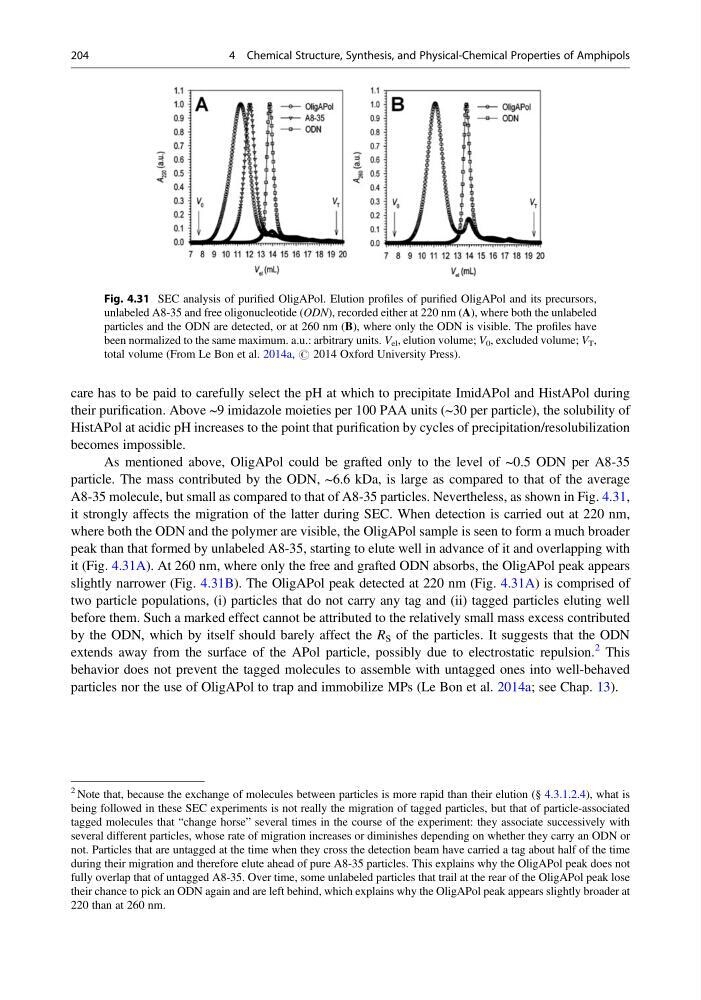
As mentioned above, OligAPol could be grafted only to the level of ~0.5 ODN per A8-35
particle. The mass contributed by the ODN, ~6.6 kDa, is large as compared to that of the average
A8-35 molecule, but small as compared to that of A8-35 particles. Nevertheless, as shown in Fig. 4.31,
it strongly affects the migration of the latter during SEC. When detection is carried out at 220 nm,
where both the ODN and the polymer are visible, the OligAPol sample is seen to form a much broader
peak than that formed by unlabeled A8-35, starting to elute well in advance of it and overlapping with
it (Fig. 4.31A). At 260 nm, where only the free and grafted ODN absorbs, the OligAPol peak appears
slightly narrower (Fig. 4.31B). The OligAPol peak detected at 220 nm (Fig. 4.31A) is comprised of
two particle populations, (i) particles that do not carry any tag and (ii) tagged particles eluting well
before them. Such a marked effect cannot be attributed to the relatively small mass excess contributed
by the ODN, which by itself should barely affect the R S of the particles. It suggests that the ODN
extends away from the surface of the APol particle, possibly due to electrostatic repulsion.
2 This
behavior does not prevent the tagged molecules to assemble with untagged ones into well-behaved
particles nor the use of OligAPol to trap and immobilize MPs (Le Bon et al. 2014a; see Chap. 13).
Fig. 4.31 SEC analysis of purified OligAPol. Elution profiles of purified OligAPol and its precursors,
unlabeled A8-35 and free oligonucleotide (ODN), recorded either at 220 nm (A), where both the unlabeled
particles and the ODN are detected, or at 260 nm (B), where only the ODN is visible. The profiles have
been normalized to the same maximum. a.u.: arbitrary units. V el , elution volume; V 0 , excluded volume; V T ,
total volume (From Le Bon et al. 2014a, # 2014 Oxford University Press).
2 Note that, because the exchange of molecules between particles is more rapid than their elution (§ 4.3.1.2.4), what is
being followed in these SEC experiments is not really the migration of tagged particles, but that of particle-associated
tagged molecules that “change horse” several times in the course of the experiment: they associate successively with
several different particles, whose rate of migration increases or diminishes depending on whether they carry an ODN or
not. Particles that are untagged at the time when they cross the detection beam have carried a tag about half of the time
during their migration and therefore elute ahead of pure A8-35 particles. This explains why the OligAPol peak does not
fully overlap that of untagged A8-35. Over time, some unlabeled particles that trail at the rear of the OligAPol peak lose
their chance to pick an ODN again and are left behind, which explains why the OligAPol peak appears slightly broader at
220 than at 260 nm.
204
4 Chemical Structure, Synthesis, and Physical-Chemical Properties of Amphipols
their purification. Above ~9 imidazole moieties per 100 PAA units (~30 per particle), the solubility of
HistAPol at acidic pH increases to the point that purification by cycles of precipitation/resolubilization
becomes impossible.
As mentioned above, OligAPol could be grafted only to the level of ~0.5 ODN per A8-35
particle. The mass contributed by the ODN, ~6.6 kDa, is large as compared to that of the average
A8-35 molecule, but small as compared to that of A8-35 particles. Nevertheless, as shown in Fig. 4.31,
it strongly affects the migration of the latter during SEC. When detection is carried out at 220 nm,
where both the ODN and the polymer are visible, the OligAPol sample is seen to form a much broader
peak than that formed by unlabeled A8-35, starting to elute well in advance of it and overlapping with
it (Fig. 4.31A). At 260 nm, where only the free and grafted ODN absorbs, the OligAPol peak appears
slightly narrower (Fig. 4.31B). The OligAPol peak detected at 220 nm (Fig. 4.31A) is comprised of
two particle populations, (i) particles that do not carry any tag and (ii) tagged particles eluting well
before them. Such a marked effect cannot be attributed to the relatively small mass excess contributed
by the ODN, which by itself should barely affect the R S of the particles. It suggests that the ODN
extends away from the surface of the APol particle, possibly due to electrostatic repulsion.
2 This
behavior does not prevent the tagged molecules to assemble with untagged ones into well-behaved
particles nor the use of OligAPol to trap and immobilize MPs (Le Bon et al. 2014a; see Chap. 13).
Fig. 4.31 SEC analysis of purified OligAPol. Elution profiles of purified OligAPol and its precursors,
unlabeled A8-35 and free oligonucleotide (ODN), recorded either at 220 nm (A), where both the unlabeled
particles and the ODN are detected, or at 260 nm (B), where only the ODN is visible. The profiles have
been normalized to the same maximum. a.u.: arbitrary units. V el , elution volume; V 0 , excluded volume; V T ,
total volume (From Le Bon et al. 2014a, # 2014 Oxford University Press).
2 Note that, because the exchange of molecules between particles is more rapid than their elution (§ 4.3.1.2.4), what is
being followed in these SEC experiments is not really the migration of tagged particles, but that of particle-associated
tagged molecules that “change horse” several times in the course of the experiment: they associate successively with
several different particles, whose rate of migration increases or diminishes depending on whether they carry an ODN or
not. Particles that are untagged at the time when they cross the detection beam have carried a tag about half of the time
during their migration and therefore elute ahead of pure A8-35 particles. This explains why the OligAPol peak does not
fully overlap that of untagged A8-35. Over time, some unlabeled particles that trail at the rear of the OligAPol peak lose
their chance to pick an ODN again and are left behind, which explains why the OligAPol peak appears slightly broader at
220 than at 260 nm.
204
4 Chemical Structure, Synthesis, and Physical-Chemical Properties of Amphipols