

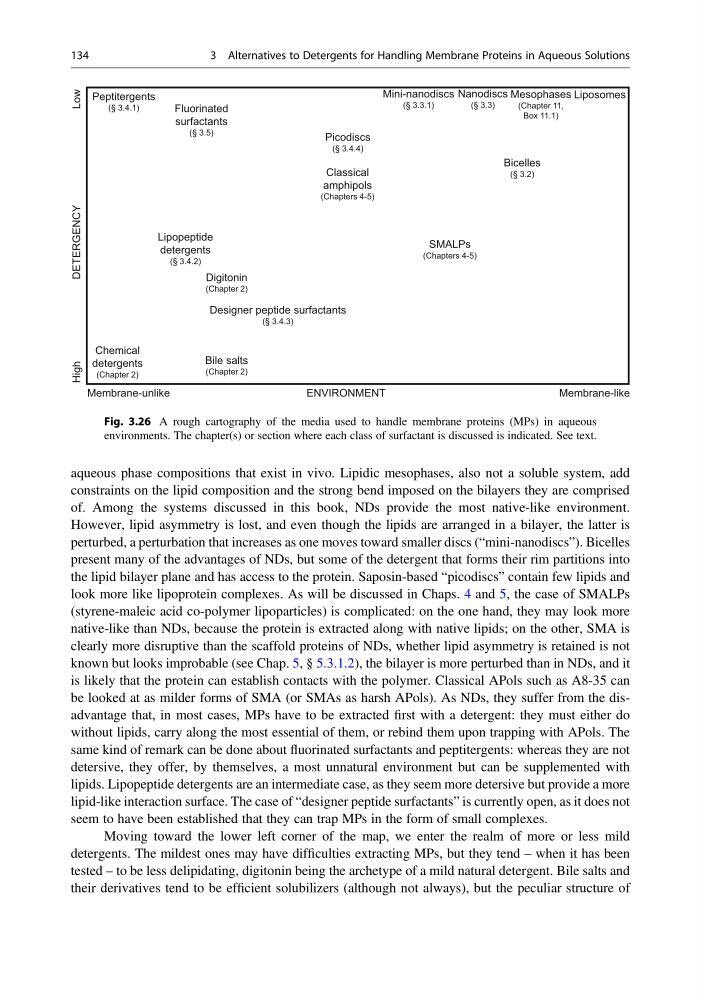
aqueous phase compositions that exist in vivo. Lipidic mesophases, also not a soluble system, add
constraints on the lipid composition and the strong bend imposed on the bilayers they are comprised
of. Among the systems discussed in this book, NDs provide the most native-like environment.
However, lipid asymmetry is lost, and even though the lipids are arranged in a bilayer, the latter is
perturbed, a perturbation that increases as one moves toward smaller discs (“mini-nanodiscs”). Bicelles
present many of the advantages of NDs, but some of the detergent that forms their rim partitions into
the lipid bilayer plane and has access to the protein. Saposin-based “picodiscs” contain few lipids and
look more like lipoprotein complexes. As will be discussed in Chaps. 4 and 5, the case of SMALPs
(styrene-maleic acid co-polymer lipoparticles) is complicated: on the one hand, they may look more
native-like than NDs, because the protein is extracted along with native lipids; on the other, SMA is
clearly more disruptive than the scaffold proteins of NDs, whether lipid asymmetry is retained is not
known but looks improbable (see Chap. 5, § 5.3.1.2), the bilayer is more perturbed than in NDs, and it
is likely that the protein can establish contacts with the polymer. Classical APols such as A8-35 can
be looked at as milder forms of SMA (or SMAs as harsh APols). As NDs, they suffer from the disadvantage that, in most cases, MPs have to be extracted first with a detergent: they must either do
without lipids, carry along the most essential of them, or rebind them upon trapping with APols. The
same kind of remark can be done about fluorinated surfactants and peptitergents: whereas they are not
detersive, they offer, by themselves, a most unnatural environment but can be supplemented with
lipids. Lipopeptide detergents are an intermediate case, as they seem more detersive but provide a more
lipid-like interaction surface. The case of “designer peptide surfactants” is currently open, as it does not
seem to have been established that they can trap MPs in the form of small complexes.
Moving toward the lower left corner of the map, we enter the realm of more or less mild
detergents. The mildest ones may have difficulties extracting MPs, but they tend – when it has been
tested – to be less delipidating, digitonin being the archetype of a mild natural detergent. Bile salts and
their derivatives tend to be efficient solubilizers (although not always), but the peculiar structure of
e
k
i
l
-
e
n
a
r
b
m
e
M
T
N
E
M
N
O
R
I
V
N
E
e
k
i
l
n
u
-
e
n
a
r
b
m
e
M
High
DETERGENCY
Low
Chemical
detergents
(Chapter 2)
Nanodiscs
(§ 3.3)
Mini-nanodiscs
(§ 3.3.1)
Classical
amphipols
(Chapters 4-5)
SMALPs
(Chapters 4-5)
Picodiscs
(§ 3.4.4)
Fluorinated
surfactants
(§ 3.5)
Peptitergents
(§ 3.4.1)
Lipopeptide
detergents
(§ 3.4.2)
Bicelles
(§ 3.2)
Liposomes
Mesophases
(Chapter 11,
Box 11.1)
Bile salts
(Chapter 2)
Digitonin
(Chapter 2)
Designer peptide surfactants
(§ 3.4.3)
Fig. 3.26 A rough cartography of the media used to handle membrane proteins (MPs) in aqueous
environments. The chapter(s) or section where each class of surfactant is discussed is indicated. See text.
134
3 Alternatives to Detergents for Handling Membrane Proteins in Aqueous Solutions
constraints on the lipid composition and the strong bend imposed on the bilayers they are comprised
of. Among the systems discussed in this book, NDs provide the most native-like environment.
However, lipid asymmetry is lost, and even though the lipids are arranged in a bilayer, the latter is
perturbed, a perturbation that increases as one moves toward smaller discs (“mini-nanodiscs”). Bicelles
present many of the advantages of NDs, but some of the detergent that forms their rim partitions into
the lipid bilayer plane and has access to the protein. Saposin-based “picodiscs” contain few lipids and
look more like lipoprotein complexes. As will be discussed in Chaps. 4 and 5, the case of SMALPs
(styrene-maleic acid co-polymer lipoparticles) is complicated: on the one hand, they may look more
native-like than NDs, because the protein is extracted along with native lipids; on the other, SMA is
clearly more disruptive than the scaffold proteins of NDs, whether lipid asymmetry is retained is not
known but looks improbable (see Chap. 5, § 5.3.1.2), the bilayer is more perturbed than in NDs, and it
is likely that the protein can establish contacts with the polymer. Classical APols such as A8-35 can
be looked at as milder forms of SMA (or SMAs as harsh APols). As NDs, they suffer from the disadvantage that, in most cases, MPs have to be extracted first with a detergent: they must either do
without lipids, carry along the most essential of them, or rebind them upon trapping with APols. The
same kind of remark can be done about fluorinated surfactants and peptitergents: whereas they are not
detersive, they offer, by themselves, a most unnatural environment but can be supplemented with
lipids. Lipopeptide detergents are an intermediate case, as they seem more detersive but provide a more
lipid-like interaction surface. The case of “designer peptide surfactants” is currently open, as it does not
seem to have been established that they can trap MPs in the form of small complexes.
Moving toward the lower left corner of the map, we enter the realm of more or less mild
detergents. The mildest ones may have difficulties extracting MPs, but they tend – when it has been
tested – to be less delipidating, digitonin being the archetype of a mild natural detergent. Bile salts and
their derivatives tend to be efficient solubilizers (although not always), but the peculiar structure of
e
k
i
l
-
e
n
a
r
b
m
e
M
T
N
E
M
N
O
R
I
V
N
E
e
k
i
l
n
u
-
e
n
a
r
b
m
e
M
High
DETERGENCY
Low
Chemical
detergents
(Chapter 2)
Nanodiscs
(§ 3.3)
Mini-nanodiscs
(§ 3.3.1)
Classical
amphipols
(Chapters 4-5)
SMALPs
(Chapters 4-5)
Picodiscs
(§ 3.4.4)
Fluorinated
surfactants
(§ 3.5)
Peptitergents
(§ 3.4.1)
Lipopeptide
detergents
(§ 3.4.2)
Bicelles
(§ 3.2)
Liposomes
Mesophases
(Chapter 11,
Box 11.1)
Bile salts
(Chapter 2)
Digitonin
(Chapter 2)
Designer peptide surfactants
(§ 3.4.3)
Fig. 3.26 A rough cartography of the media used to handle membrane proteins (MPs) in aqueous
environments. The chapter(s) or section where each class of surfactant is discussed is indicated. See text.
134
3 Alternatives to Detergents for Handling Membrane Proteins in Aqueous Solutions