

• Two maltose-based surfactants bearing either a perfluoroethyl (F 2 H 9 ) or a perfluorobutyl
(F 4 H 5 ) tip at the end of their alkyl chain (Fig. 3.25E; Polidori et al. 2016).
• Two hybrid double-chain surfactants possessing a diglucose polar head group, a
perfluorinated hexyl chain and a hydrogenated butyl chain (Fig. 3.25G; Legrand et al. 2016).
When developing novel (H)FS, care should be brought to optimize both the physical-chemical
and the biochemical properties of the new molecules, which depend on the nature of both the apolar
and the polar moieties. A typical example is, as mentioned above, that of the development of a series of
(H)FSs sporting polar heads carrying either one, two, or three glucose moieties (Breyton et al. 2009;
see Fig. 3.25B). Analytical ultracentrifugation and SANS data showed that molecules whose polar
head bears a single glucosyl group form very large cylindrical micelles, whereas those with two or
three glucose moieties form small, homogeneous, globular micelles. Surfactants that form cylindrical
micelles are of limited use in membrane biology, because they do not give rise to the small
MP/surfactant complexes that are required for such applications as purification, NMR, crystallization,
or small-angle scattering studies. As regards the biochemical stability of trapped MPs, however,
molecules bearing one or two glucose moieties were found to be stabilizing, whereas those with
three moieties were destabilizing. Fluorinated and hemifluorinated surfactants with a two-glucose
polar head thus appeared as the most promising molecules for biochemical applications and structural
studies (Breyton et al. 2009). Similarly, a recent study showed that, of two surfactants carrying the
same fluorinated chain, one was able and the other unable to destabilize lipid vesicles, depending on
the nature of the polar head (Frotscher et al. 2015; Vargas et al. 2015).
3.5.3
Applications of Fluorinated Surfactants
After NDs (§ 3.3), amphipols (Chap. 5), and bicelles (§ 3.2), FSs are the nonconventional surfactants
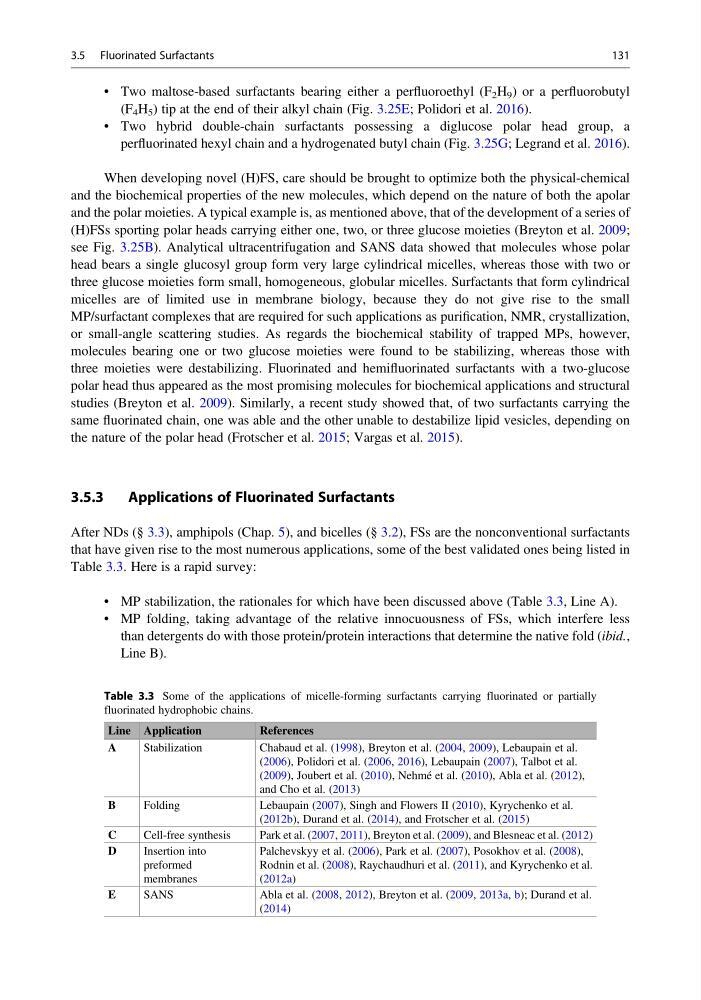
that have given rise to the most numerous applications, some of the best validated ones being listed in
Table 3.3. Here is a rapid survey:
• MP stabilization, the rationales for which have been discussed above (Table 3.3, Line A).
• MP folding, taking advantage of the relative innocuousness of FSs, which interfere less
than detergents do with those protein/protein interactions that determine the native fold (ibid.,
Line B).
Table 3.3 Some of the applications of micelle-forming surfactants carrying fluorinated or partially
fluorinated hydrophobic chains.
Line Application
References
A
Stabilization
Chabaud et al. (1998), Breyton et al. (2004, 2009), Lebaupain et al.
(2006), Polidori et al. (2006, 2016), Lebaupain (2007), Talbot et al.
(2009), Joubert et al. (2010), Nehmé et al. (2010), Abla et al. (2012),
and Cho et al. (2013)
B
Folding
Lebaupain (2007), Singh and Flowers II (2010), Kyrychenko et al.
(2012b), Durand et al. (2014), and Frotscher et al. (2015)
C
Cell-free synthesis
Park et al. (2007, 2011), Breyton et al. (2009), and Blesneac et al. (2012)
D
Insertion into
preformed
membranes
Palchevskyy et al. (2006), Park et al. (2007), Posokhov et al. (2008),
Rodnin et al. (2008), Raychaudhuri et al. (2011), and Kyrychenko et al.
(2012a)
E
SANS
Abla et al. (2008, 2012), Breyton et al. (2009, 2013a, b); Durand et al.
(2014)
3.5 Fluorinated Surfactants
131
(F 4 H 5 ) tip at the end of their alkyl chain (Fig. 3.25E; Polidori et al. 2016).
• Two hybrid double-chain surfactants possessing a diglucose polar head group, a
perfluorinated hexyl chain and a hydrogenated butyl chain (Fig. 3.25G; Legrand et al. 2016).
When developing novel (H)FS, care should be brought to optimize both the physical-chemical
and the biochemical properties of the new molecules, which depend on the nature of both the apolar
and the polar moieties. A typical example is, as mentioned above, that of the development of a series of
(H)FSs sporting polar heads carrying either one, two, or three glucose moieties (Breyton et al. 2009;
see Fig. 3.25B). Analytical ultracentrifugation and SANS data showed that molecules whose polar
head bears a single glucosyl group form very large cylindrical micelles, whereas those with two or
three glucose moieties form small, homogeneous, globular micelles. Surfactants that form cylindrical
micelles are of limited use in membrane biology, because they do not give rise to the small
MP/surfactant complexes that are required for such applications as purification, NMR, crystallization,
or small-angle scattering studies. As regards the biochemical stability of trapped MPs, however,
molecules bearing one or two glucose moieties were found to be stabilizing, whereas those with
three moieties were destabilizing. Fluorinated and hemifluorinated surfactants with a two-glucose
polar head thus appeared as the most promising molecules for biochemical applications and structural
studies (Breyton et al. 2009). Similarly, a recent study showed that, of two surfactants carrying the
same fluorinated chain, one was able and the other unable to destabilize lipid vesicles, depending on
the nature of the polar head (Frotscher et al. 2015; Vargas et al. 2015).
3.5.3
Applications of Fluorinated Surfactants
After NDs (§ 3.3), amphipols (Chap. 5), and bicelles (§ 3.2), FSs are the nonconventional surfactants
that have given rise to the most numerous applications, some of the best validated ones being listed in
Table 3.3. Here is a rapid survey:
• MP stabilization, the rationales for which have been discussed above (Table 3.3, Line A).
• MP folding, taking advantage of the relative innocuousness of FSs, which interfere less
than detergents do with those protein/protein interactions that determine the native fold (ibid.,
Line B).
Table 3.3 Some of the applications of micelle-forming surfactants carrying fluorinated or partially
fluorinated hydrophobic chains.
Line Application
References
A
Stabilization
Chabaud et al. (1998), Breyton et al. (2004, 2009), Lebaupain et al.
(2006), Polidori et al. (2006, 2016), Lebaupain (2007), Talbot et al.
(2009), Joubert et al. (2010), Nehmé et al. (2010), Abla et al. (2012),
and Cho et al. (2013)
B
Folding
Lebaupain (2007), Singh and Flowers II (2010), Kyrychenko et al.
(2012b), Durand et al. (2014), and Frotscher et al. (2015)
C
Cell-free synthesis
Park et al. (2007, 2011), Breyton et al. (2009), and Blesneac et al. (2012)
D
Insertion into
preformed
membranes
Palchevskyy et al. (2006), Park et al. (2007), Posokhov et al. (2008),
Rodnin et al. (2008), Raychaudhuri et al. (2011), and Kyrychenko et al.
(2012a)
E
SANS
Abla et al. (2008, 2012), Breyton et al. (2009, 2013a, b); Durand et al.
(2014)
3.5 Fluorinated Surfactants
131