

β-barrel classes (McGregor et al. 2003), including small monomeric proteins and large multisubunit
enzyme complexes (unpublished data cited in Privé 2009).
Preliminary results with the β-barrel MP PagP demonstrated the potential of LPDs for solution
NMR studies of MPs (McGregor et al. 2003). This approach has not been fully exploited yet,
presumably hindered by high production costs. As regards X-ray crystallography, the same caveat
can probably be lodged as with peptitergents, namely that in most cases the formation of well-ordered
crystals of MP/LPD complexes would depend on the ability of LPDs to assemble (or reorganize)
around MPs in exactly the same manner from one complex to the next, probably a harsh requirement.
However, there seems to be no reason why LPDs could not be used as a shuttle to deliver MPs for
crystallization in a lipid mesophase, as amphipol A8-35 (Polovinkin et al. 2014), styrene-maleic acid
copolymers (Broecker et al. 2017), and NDs (Nikolaev et al. 2017) have been.
3.4.3
Designer Peptide Surfactants (Peptergents)
So-called designer peptide surfactants (DPSs) (also called “peptergents”; Yeh et al. 2005) have been
developed by Shuguang Zhang and collaborators (Table 3.2, Line 3; reviewed in Koutsopoulos et al.
2012). At variance with peptitergents and lipopeptide detergents, those are short peptides, comprised
of six to eight hydrophobic amino acid residues and one to two hydrophilic ones (Fig. 3.17). Rather
than membrane-spanning peptides, they resemble detergents or phospholipids in their overall structure,
and they are reasonably cheap to produce (typically < $ 30–50 a gram; Corin et al. 2011; Koutsopoulos
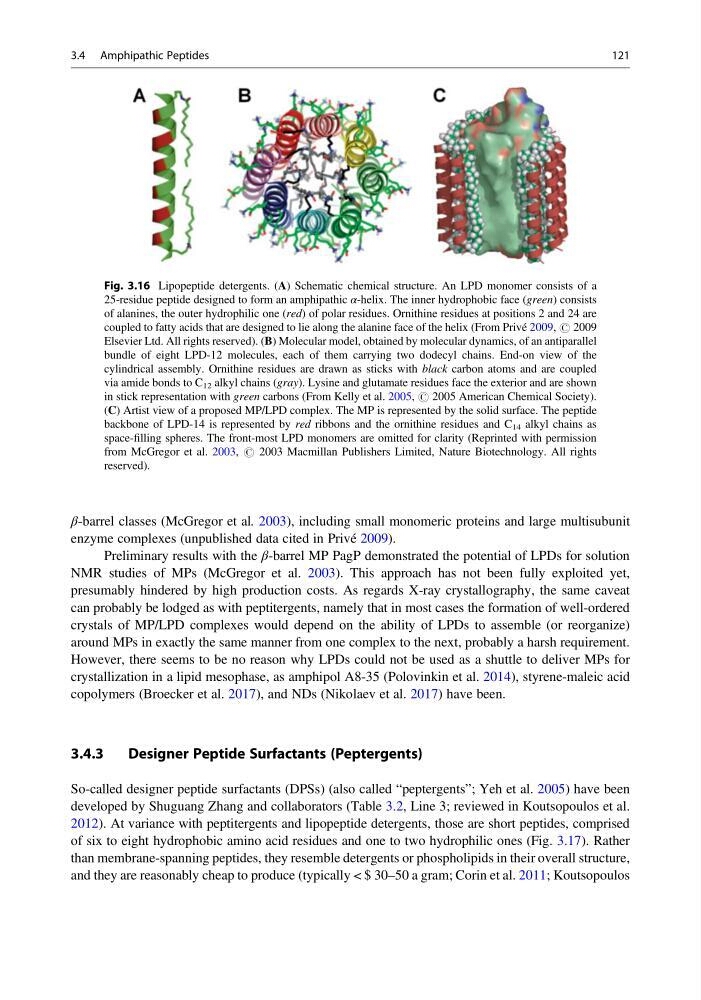
Fig. 3.16 Lipopeptide detergents. (A) Schematic chemical structure. An LPD monomer consists of a
25-residue peptide designed to form an amphipathic α-helix. The inner hydrophobic face (green) consists
of alanines, the outer hydrophilic one (red) of polar residues. Ornithine residues at positions 2 and 24 are
coupled to fatty acids that are designed to lie along the alanine face of the helix (From Privé 2009, # 2009
Elsevier Ltd. All rights reserved). (B) Molecular model, obtained by molecular dynamics, of an antiparallel
bundle of eight LPD-12 molecules, each of them carrying two dodecyl chains. End-on view of the
cylindrical assembly. Ornithine residues are drawn as sticks with black carbon atoms and are coupled
via amide bonds to C 12 alkyl chains (gray). Lysine and glutamate residues face the exterior and are shown
in stick representation with green carbons (From Kelly et al. 2005, # 2005 American Chemical Society).
(C) Artist view of a proposed MP/LPD complex. The MP is represented by the solid surface. The peptide
backbone of LPD-14 is represented by red ribbons and the ornithine residues and C 14 alkyl chains as
space-filling spheres. The front-most LPD monomers are omitted for clarity (Reprinted with permission
from McGregor et al. 2003, # 2003 Macmillan Publishers Limited, Nature Biotechnology. All rights
reserved).
3.4 Amphipathic Peptides
121
enzyme complexes (unpublished data cited in Privé 2009).
Preliminary results with the β-barrel MP PagP demonstrated the potential of LPDs for solution
NMR studies of MPs (McGregor et al. 2003). This approach has not been fully exploited yet,
presumably hindered by high production costs. As regards X-ray crystallography, the same caveat
can probably be lodged as with peptitergents, namely that in most cases the formation of well-ordered
crystals of MP/LPD complexes would depend on the ability of LPDs to assemble (or reorganize)
around MPs in exactly the same manner from one complex to the next, probably a harsh requirement.
However, there seems to be no reason why LPDs could not be used as a shuttle to deliver MPs for
crystallization in a lipid mesophase, as amphipol A8-35 (Polovinkin et al. 2014), styrene-maleic acid
copolymers (Broecker et al. 2017), and NDs (Nikolaev et al. 2017) have been.
3.4.3
Designer Peptide Surfactants (Peptergents)
So-called designer peptide surfactants (DPSs) (also called “peptergents”; Yeh et al. 2005) have been
developed by Shuguang Zhang and collaborators (Table 3.2, Line 3; reviewed in Koutsopoulos et al.
2012). At variance with peptitergents and lipopeptide detergents, those are short peptides, comprised
of six to eight hydrophobic amino acid residues and one to two hydrophilic ones (Fig. 3.17). Rather
than membrane-spanning peptides, they resemble detergents or phospholipids in their overall structure,
and they are reasonably cheap to produce (typically < $ 30–50 a gram; Corin et al. 2011; Koutsopoulos
Fig. 3.16 Lipopeptide detergents. (A) Schematic chemical structure. An LPD monomer consists of a
25-residue peptide designed to form an amphipathic α-helix. The inner hydrophobic face (green) consists
of alanines, the outer hydrophilic one (red) of polar residues. Ornithine residues at positions 2 and 24 are
coupled to fatty acids that are designed to lie along the alanine face of the helix (From Privé 2009, # 2009
Elsevier Ltd. All rights reserved). (B) Molecular model, obtained by molecular dynamics, of an antiparallel
bundle of eight LPD-12 molecules, each of them carrying two dodecyl chains. End-on view of the
cylindrical assembly. Ornithine residues are drawn as sticks with black carbon atoms and are coupled
via amide bonds to C 12 alkyl chains (gray). Lysine and glutamate residues face the exterior and are shown
in stick representation with green carbons (From Kelly et al. 2005, # 2005 American Chemical Society).
(C) Artist view of a proposed MP/LPD complex. The MP is represented by the solid surface. The peptide
backbone of LPD-14 is represented by red ribbons and the ornithine residues and C 14 alkyl chains as
space-filling spheres. The front-most LPD monomers are omitted for clarity (Reprinted with permission
from McGregor et al. 2003, # 2003 Macmillan Publishers Limited, Nature Biotechnology. All rights
reserved).
3.4 Amphipathic Peptides
121