

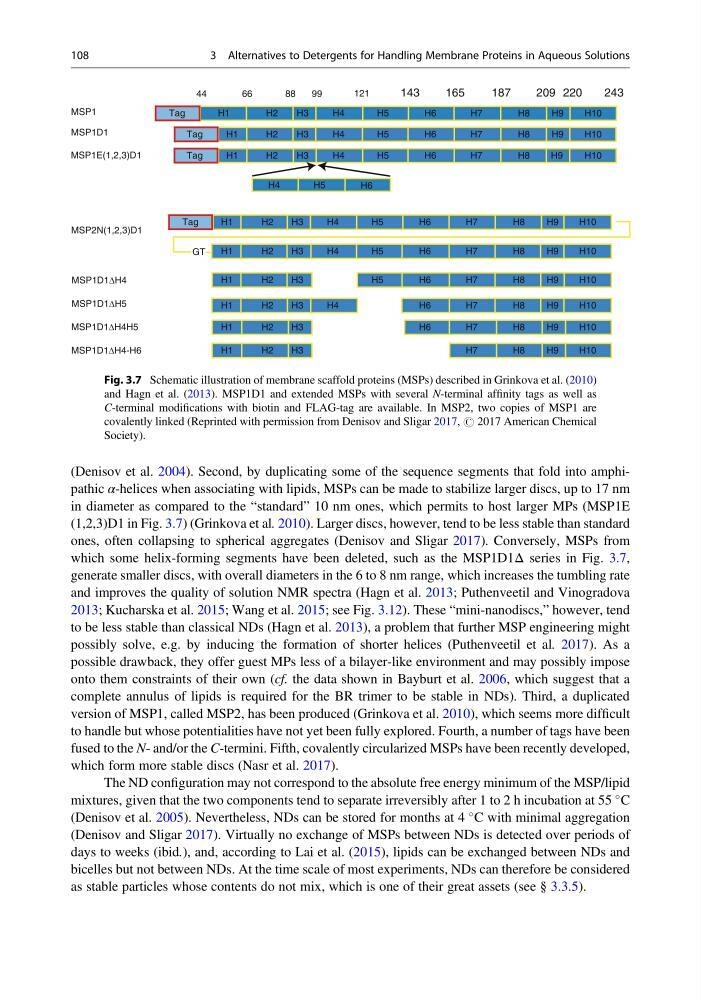
(Denisov et al. 2004). Second, by duplicating some of the sequence segments that fold into amphipathic α-helices when associating with lipids, MSPs can be made to stabilize larger discs, up to 17 nm
in diameter as compared to the “standard” 10 nm ones, which permits to host larger MPs (MSP1E
(1,2,3)D1 in Fig. 3.7) (Grinkova et al. 2010). Larger discs, however, tend to be less stable than standard
ones, often collapsing to spherical aggregates (Denisov and Sligar 2017). Conversely, MSPs from
which some helix-forming segments have been deleted, such as the MSP1D1Δ series in Fig. 3.7,
generate smaller discs, with overall diameters in the 6 to 8 nm range, which increases the tumbling rate
and improves the quality of solution NMR spectra (Hagn et al. 2013; Puthenveetil and Vinogradova
2013; Kucharska et al. 2015; Wang et al. 2015; see Fig. 3.12). These “mini-nanodiscs,” however, tend
to be less stable than classical NDs (Hagn et al. 2013), a problem that further MSP engineering might
possibly solve, e.g. by inducing the formation of shorter helices (Puthenveetil et al. 2017). As a
possible drawback, they offer guest MPs less of a bilayer-like environment and may possibly impose
onto them constraints of their own (cf. the data shown in Bayburt et al. 2006, which suggest that a
complete annulus of lipids is required for the BR trimer to be stable in NDs). Third, a duplicated
version of MSP1, called MSP2, has been produced (Grinkova et al. 2010), which seems more difficult
to handle but whose potentialities have not yet been fully explored. Fourth, a number of tags have been
fused to the N- and/or the C-termini. Fifth, covalently circularized MSPs have been recently developed,
which form more stable discs (Nasr et al. 2017).
The ND configuration may not correspond to the absolute free energy minimum of the MSP/lipid
mixtures, given that the two components tend to separate irreversibly after 1 to 2 h incubation at 55
C
(Denisov et al. 2005). Nevertheless, NDs can be stored for months at 4
C with minimal aggregation
(Denisov and Sligar 2017). Virtually no exchange of MSPs between NDs is detected over periods of
days to weeks (ibid.), and, according to Lai et al. (2015), lipids can be exchanged between NDs and
bicelles but not between NDs. At the time scale of most experiments, NDs can therefore be considered
as stable particles whose contents do not mix, which is one of their great assets (see § 3.3.5).
MSP1
44
66
88
99
121
143
165
187
209 220
243
Tag
H1
H1
H1
H1
H1
H1
H1
H1
H1
H2
H2
H2
H2
H2
H2
H2
H2
H2
H3
H3
H3
H3
H4
H4
H4
H4
H4
H5
H5
H5
H5
H5
H5
H5
H6
H6
H6
H6
H6
H7
H7
H7
H7
H8
H8
H8
H8
H8
H8
H8
H8
H8
H9
H9
H9
H9
H10
H10
H10
H10
H10
H10
H10
H10
H10
H9
H9
H9
H9
H9
H7
H7
H7
H7
H7
H6
H6
H6
H6
H4
H4
H3
H3
H3
H3
H3
Tag
Tag
Tag
GT
MSP1D1
MSP1E(1,2,3)D1
MSP2N(1,2,3)D1
MSP1D1ΔH4
MSP1D1ΔH5
MSP1D1ΔH4-H6
MSP1D1ΔH4H5
Fig. 3.7 Schematic illustration of membrane scaffold proteins (MSPs) described in Grinkova et al. (2010)
and Hagn et al. (2013). MSP1D1 and extended MSPs with several N-terminal affinity tags as well as
C-terminal modifications with biotin and FLAG-tag are available. In MSP2, two copies of MSP1 are
covalently linked (Reprinted with permission from Denisov and Sligar 2017, # 2017 American Chemical
Society).
108
3 Alternatives to Detergents for Handling Membrane Proteins in Aqueous Solutions
in diameter as compared to the “standard” 10 nm ones, which permits to host larger MPs (MSP1E
(1,2,3)D1 in Fig. 3.7) (Grinkova et al. 2010). Larger discs, however, tend to be less stable than standard
ones, often collapsing to spherical aggregates (Denisov and Sligar 2017). Conversely, MSPs from
which some helix-forming segments have been deleted, such as the MSP1D1Δ series in Fig. 3.7,
generate smaller discs, with overall diameters in the 6 to 8 nm range, which increases the tumbling rate
and improves the quality of solution NMR spectra (Hagn et al. 2013; Puthenveetil and Vinogradova
2013; Kucharska et al. 2015; Wang et al. 2015; see Fig. 3.12). These “mini-nanodiscs,” however, tend
to be less stable than classical NDs (Hagn et al. 2013), a problem that further MSP engineering might
possibly solve, e.g. by inducing the formation of shorter helices (Puthenveetil et al. 2017). As a
possible drawback, they offer guest MPs less of a bilayer-like environment and may possibly impose
onto them constraints of their own (cf. the data shown in Bayburt et al. 2006, which suggest that a
complete annulus of lipids is required for the BR trimer to be stable in NDs). Third, a duplicated
version of MSP1, called MSP2, has been produced (Grinkova et al. 2010), which seems more difficult
to handle but whose potentialities have not yet been fully explored. Fourth, a number of tags have been
fused to the N- and/or the C-termini. Fifth, covalently circularized MSPs have been recently developed,
which form more stable discs (Nasr et al. 2017).
The ND configuration may not correspond to the absolute free energy minimum of the MSP/lipid
mixtures, given that the two components tend to separate irreversibly after 1 to 2 h incubation at 55
C
(Denisov et al. 2005). Nevertheless, NDs can be stored for months at 4
C with minimal aggregation
(Denisov and Sligar 2017). Virtually no exchange of MSPs between NDs is detected over periods of
days to weeks (ibid.), and, according to Lai et al. (2015), lipids can be exchanged between NDs and
bicelles but not between NDs. At the time scale of most experiments, NDs can therefore be considered
as stable particles whose contents do not mix, which is one of their great assets (see § 3.3.5).
MSP1
44
66
88
99
121
143
165
187
209 220
243
Tag
H1
H1
H1
H1
H1
H1
H1
H1
H1
H2
H2
H2
H2
H2
H2
H2
H2
H2
H3
H3
H3
H3
H4
H4
H4
H4
H4
H5
H5
H5
H5
H5
H5
H5
H6
H6
H6
H6
H6
H7
H7
H7
H7
H8
H8
H8
H8
H8
H8
H8
H8
H8
H9
H9
H9
H9
H10
H10
H10
H10
H10
H10
H10
H10
H10
H9
H9
H9
H9
H9
H7
H7
H7
H7
H7
H6
H6
H6
H6
H4
H4
H3
H3
H3
H3
H3
Tag
Tag
Tag
GT
MSP1D1
MSP1E(1,2,3)D1
MSP2N(1,2,3)D1
MSP1D1ΔH4
MSP1D1ΔH5
MSP1D1ΔH4-H6
MSP1D1ΔH4H5
Fig. 3.7 Schematic illustration of membrane scaffold proteins (MSPs) described in Grinkova et al. (2010)
and Hagn et al. (2013). MSP1D1 and extended MSPs with several N-terminal affinity tags as well as
C-terminal modifications with biotin and FLAG-tag are available. In MSP2, two copies of MSP1 are
covalently linked (Reprinted with permission from Denisov and Sligar 2017, # 2017 American Chemical
Society).
108
3 Alternatives to Detergents for Handling Membrane Proteins in Aqueous Solutions