

3.1
Introduction
In Chap. 2, we have discussed the mechanisms that underlie the frequent instability of membrane
proteins (MPs) in detergent solutions and argued that a key factor is the loss of protein/protein and
protein/lipid interactions that stabilize the protein in situ. We have mentioned four possible
countermeasures: (i) to transfer the protein to lipid vesicles or other detergent-free lipid phases,
(ii) to genetically modify it so as to render it detergent-resistant, (iii) to turn it into a water-soluble
protein, and (iv) to develop particularly mild detergents. The systems described in the present chapter
draw on approaches i and iv. As in approach i, they aim to preserve protein/lipid interactions and, for
some of them, to reconstitute, around the protein, an environment chemically and physically as similar
as possible to that it experiences in vivo while generally avoiding the formation of large structures.
As in approach iv, they often rely of the development of original surfactants whose structure and
properties are more and more remote from those of classical detergents.
The following four approaches will be considered:
(i) Bicelles, that is discoidal fragments of lipid bilayer whose rim is stabilized by molecules of
detergent or short-chain lipid;
(ii) Nanodiscs, which also comprise a discoidal bilayer fragment but are stabilized by specially
designed amphipathic proteins;
(iii) Peptide-based systems, which come in a variety of flavors, some of them attempting to
mimic the proteins that stabilize nanodiscs, whereas others simply aim at replacing
detergents;
(iv) Fluorinated surfactants, which are detergent-like molecules whose hydrophobic moiety or
moieties incorporate(s) fluorine, which limits their ability to disrupt protein/protein and
protein/lipid interactions.
For general reviews covering these and other systems, see e.g. Popot (2010), Warschawski et al.
(2011), Zhang et al. (2011), Serebryany et al. (2012), Catoire et al. (2014), Otzen (2015), Tu et al.
(2016), and Mineev and Nadezhdin (2017).
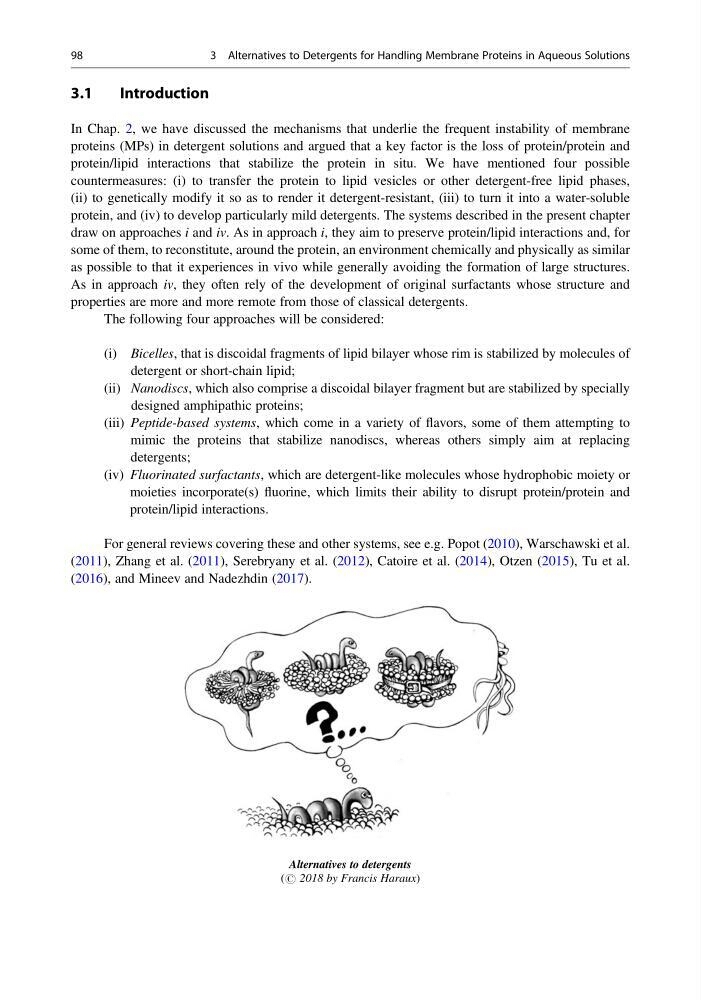
Alternatives to detergents
(# 2018 by Francis Haraux)
98
3 Alternatives to Detergents for Handling Membrane Proteins in Aqueous Solutions
Introduction
In Chap. 2, we have discussed the mechanisms that underlie the frequent instability of membrane
proteins (MPs) in detergent solutions and argued that a key factor is the loss of protein/protein and
protein/lipid interactions that stabilize the protein in situ. We have mentioned four possible
countermeasures: (i) to transfer the protein to lipid vesicles or other detergent-free lipid phases,
(ii) to genetically modify it so as to render it detergent-resistant, (iii) to turn it into a water-soluble
protein, and (iv) to develop particularly mild detergents. The systems described in the present chapter
draw on approaches i and iv. As in approach i, they aim to preserve protein/lipid interactions and, for
some of them, to reconstitute, around the protein, an environment chemically and physically as similar
as possible to that it experiences in vivo while generally avoiding the formation of large structures.
As in approach iv, they often rely of the development of original surfactants whose structure and
properties are more and more remote from those of classical detergents.
The following four approaches will be considered:
(i) Bicelles, that is discoidal fragments of lipid bilayer whose rim is stabilized by molecules of
detergent or short-chain lipid;
(ii) Nanodiscs, which also comprise a discoidal bilayer fragment but are stabilized by specially
designed amphipathic proteins;
(iii) Peptide-based systems, which come in a variety of flavors, some of them attempting to
mimic the proteins that stabilize nanodiscs, whereas others simply aim at replacing
detergents;
(iv) Fluorinated surfactants, which are detergent-like molecules whose hydrophobic moiety or
moieties incorporate(s) fluorine, which limits their ability to disrupt protein/protein and
protein/lipid interactions.
For general reviews covering these and other systems, see e.g. Popot (2010), Warschawski et al.
(2011), Zhang et al. (2011), Serebryany et al. (2012), Catoire et al. (2014), Otzen (2015), Tu et al.
(2016), and Mineev and Nadezhdin (2017).
Alternatives to detergents
(# 2018 by Francis Haraux)
98
3 Alternatives to Detergents for Handling Membrane Proteins in Aqueous Solutions